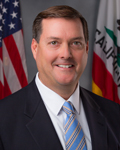
Photo of William P. Brough
R California House · District 73

Rep. William P. Brough

Compare
Total votes
14,942
all sessions
Attendance
91%
953 missed
Near the chamber average
With party
96%
of cast votes
Lower than 82% of chamber peers
Bipartisan score
2%
crosses aisle rarely
Higher than 85% of chamber peers
Sponsored
770
bills & resolutions
Lower than 91% of chamber peers
Committees
0
assignments
770 bills and resolutions

Sponsored bills

Total
770
Primary
93
Co-sponsor
677
This page
770
matching current filters
Primary AB 502
died · California House · Lead sponsor
Personal income tax.

The Personal Income Tax Law imposes taxes on taxable income, as provided, and defines various terms for these purposes, including partnership and partner. This bill would make nonsubstantive changes to those definitions.

died Feb 3, 2020 0 co-sponsors
Co-sponsor SB 161
died · California Senate · Co-sponsor
Controlled substances: fentanyl.

Existing law classifies controlled substances into 5 schedules and places the greatest restrictions and penalties on the use of those substances placed in Schedule I. Existing law classifies the drug fentanyl in Schedule II. Existing law prohibits a person from possessing for sale or purchasing for purposes of sale, specified controlled substances, including fentanyl, and provides for imprisonment in a county jail for 2, 3, or 4 years for a violation of this provision. Existing law also imposes an additional term, and authorizes a trial court to impose a specified fine, upon a person who is convicted of a violation of, or of a conspiracy to violate, specified provisions of law with respect to a substance containing heroin, cocaine base, and cocaine, if the substance exceeds a specified weight. This bill would impose that additional term upon, and authorize a fine against, a defendant who violates those laws with respect to a substance containing fentanyl. By imposing additional incarceration costs on local agencies, the bill would impose a state-mandated local program. The California Constitution requires the state to reimburse local agencies and school districts for certain costs mandated by the state. Statutory provisions establish procedures for making that reimbursement. This bill would provide that no reimbursement is required by this act for a specified reason.

died Feb 3, 2020 1 co-sponsor
Primary AB 224
Failed · California House · Lead sponsor
Alcohol and drug programs: discharge plans.

Existing law provides for the licensure and regulation of adult alcoholism or drug abuse recovery or treatment facilities by the State Department of Health Care Services. Existing law authorizes the department to certify alcoholism or drug abuse recovery or treatment programs in order to, among other things, identify programs that exceed minimal levels of service quality. Existing law requires all programs licensed or certified by the department to disclose specified information to the department, including specified ownership or financial interests, upon initial licensure or certification and renewal of licensure or certification. This bill would require programs licensed or certified by the department to have a written patient discharge plan policy that includes a process for identifying appropriate posttreatment housing for patients, and to submit a copy of that policy to the department upon initial licensure or certification and renewal of licensure or certification. The bill would authorize the department to suspend or revoke the license or certification of a program that does not comply with these provisions.

Failed Feb 3, 2020 0 co-sponsors
Primary AB 780
Failed · California House · Lead sponsor
Hearing aid dispensers: practice: cerumen management: apprentice license.

Existing law, the Speech-Language Pathologists and Audiologists and Hearing Aid Dispensers Licensure Act, provides for the licensure and regulation of hearing aid dispensers by the Speech-Language Pathology and Audiology and Hearing Aid Dispensers Board within the Department of Consumer Affairs. A violation of the act is a crime. Existing law defines the practice of fitting or selling hearing aids for purposes of the licensure provisions, specifies the types of tests authorized to be conducted, and prohibits a hearing aid dispenser from conducting diagnostic hearing tests. This bill would prohibit a licensed hearing aid dispenser from testing a prospective hearing aid user or dispensing a hearing aid if the licensee determines that the prospective hearing aid user has one of specified conditions, including pain or discomfort in the ear. The bill would authorize the board to issue an advanced practice certificate to a licensed hearing aid dispenser who meets specified requirements, including that the licensee has at least 2 years of practice as a licensed hearing aid dispenser and the licensee and the licensee's supervising mentor or trainer attest under penalty of perjury that the licensee has received direct supervised training from the supervising licensee sufficient to ensure the safe administration of cerumen management. By expanding the crime of perjury, the bill would impose a state-mandated local program. The bill would authorize a licensee with an advanced practice certificate to perform cerumen management and tympanometry, as those terms are defined, in accordance with specified guidelines and requirements. The bill would authorize the board to revoke the advanced practice certificate of a licensee who violates the laws regulating hearing aid dispensers. Existing law provides for a trainee license to be issued by the board for a period of 6 months, subject to satisfaction of specified requirements, authorizes a trainee licensee to fit or sell hearing aids under the supervision of a licensed hearing aid dispenser, and authorizes a trainee to take the hearing aid dispenser's licensure examination, subject to compliance with specified requirements. This bill would also provide for the issuance of an apprentice hearing aid dispenser license to applicants who satisfy specified requirements, including submitting to the board a written statement by a licensed hearing aid dispenser that the licensee agrees to act as the applicant's apprentice sponsor, as specified, and payment of a fee established by the board. The bill would establish that the duration of the apprenticeship is 18 months and would establish requirements for an apprentice to sit for the practical examination required for licensure as a hearing aid dispenser, including completion of a specified course and at least 12 months of directly supervised practicum training. The bill would require the board, by regulation, to establish a list of approved courses for an apprentice hearing aid dispenser training program, as specified. Because a violation of the bill's requirements would be a crime, the bill would impose a state-mandated local program. The California Constitution requires the state to reimburse local agencies and school districts for certain costs mandated by the state. Statutory provisions establish procedures for making that reimbursement. This bill would provide that no reimbursement is required by this act for a specified reason.

Failed Feb 3, 2020 0 co-sponsors
Primary AB 427
Failed · California House · Lead sponsor
Personal income taxes: exclusion: uniformed services: retirement pay.

The Personal Income Tax Law imposes a tax on individual taxpayers measured by the taxpayer's taxable income for the taxable year, but excludes certain items of income from the computation of tax, including an exclusion for combat-related special compensation. This bill, for taxable years beginning on or after January 1, 2020, and before January 1, 2030, would exclude from gross income specified amounts of retirement pay received by a taxpayer from the federal government for service performed in the uniformed services, as defined, during the taxable year. This bill would take effect immediately as a tax levy.

Failed Feb 3, 2020 0 co-sponsors
Primary AB 615
Failed · California House · Lead sponsor
Alcoholism or drug abuse recovery and treatment services: referrals.

(1) Existing law provides for the licensure and regulation of alcoholism or drug abuse recovery or treatment facilities serving adults by the State Department of Health Care Services, and provides for the certification of alcohol and other drug treatment recovery services. Existing law prohibits specified persons, programs, or entities, including a partner or shareholder who holds an interest of at least 10% in a licensed alcoholism or drug abuse recovery and treatment facility or a certified alcohol or other drug program, from giving or receiving remuneration or anything of value for the referral of a person who is seeking alcoholism or drug abuse recovery and treatment services. Existing law authorizes the department to investigate allegations of violations of these requirements, and, upon finding a violation of these requirements, authorizes the department to take specified actions against the alcoholism or drug abuse recovery or treatment facility, including suspending or revoking the facility license. This bill would make a willful violation of this prohibition against referrals for remuneration a crime, punishable by a fine of not more than $10,000, imprisonment in a county jail for 16 months, or 2 or 3 years, or both fine and imprisonment. (2) The California Constitution requires the state to reimburse local agencies and school districts for certain costs mandated by the state. Statutory provisions establish procedures for making that reimbursement. This bill would provide that no reimbursement is required by this act for a specified reason.

Failed Feb 3, 2020 0 co-sponsors
Primary AB 856
Failed · California House · Lead sponsor
Personal income tax: credit: home care services.

The Personal Income Tax Law allows various credits against the taxes imposed by that law. This bill would allow a credit against those taxes for each taxable year beginning on or after January 1, 2020, and before January 1, 2024, in an amount equal to 25% of the amount paid or incurred during the taxable year, not compensated for by insurance or otherwise, by a qualified taxpayer, as defined, for home care services, not to exceed $5,000. The bill would define "home care services" to mean specified nonmedical services and assistance provided by a registered home care aide, as defined, a licensed home health agency, or a licensed hospice to a qualified taxpayer who, because of advanced age or physical or mental disability, cannot perform these services that enable the qualified taxpayer to remain in the qualified taxpayer's residence. This bill would take effect immediately as a tax levy.

Failed Feb 3, 2020 0 co-sponsors
Primary AB 1273
Failed · California House · Lead sponsor
County of Orange: joint exercise of powers agreements: toll roads.

The Joint Exercise of Powers Act generally authorizes 2 or more public agencies, by agreement, to jointly exercise any common power. Existing law authorizes the County of Orange and the cities in that county, by ordinance, to require the payment of development fees, as specified, for purposes of defraying the costs of constructing bridges and major thoroughfares. Existing law authorizes those entities to form a joint powers agency for specified purposes, including constructing bridges and major thoroughfares, collecting tolls for the use of those facilities, and incurring indebtedness for the construction of those facilities. Pursuant to this authority, various toll roads in the County of Orange were constructed. This bill would limit the expenditure of those development fees to the maintenance, operation, or financing of a completed toll facility that is in service on January 1, 2020, and for which indebtedness was incurred. The bill would prohibit those entities, on and after January 1, 2020, from forming a new joint powers agency to construct bridge facilities or major thoroughfares under that specific authorization or the general authorization. The bill would prohibit a joint powers agency formed under that specific authorization before January 1, 2020, from designing, planning, developing, or constructing any of those facilities on or after January 1, 2020. The bill would prohibit a joint powers agency formed under that specific authorization from incurring new bonded indebtedness, except for specified purposes. The bill would make other related changes. Existing law authorizes a joint powers agency created for these purposes to make certain toll revenues and fees available as a loan to other specified joint powers agencies to pay for the cost of construction and toll collection of major thoroughfares other than those for which the toll or fee is charged if specified requirements are met and findings are made. This bill would delete that provision. Existing law authorizes an entity constructing bridge facilities or major thoroughfares pursuant to the above-described provisions to transfer all or a portion of those facilities to the state, subject to terms and conditions that are satisfactory to the Director of Transportation. This bill would require any facility constructed under these provisions and operated as a toll road to be transferred to the state after any indebtedness has been repaid subject to terms and conditions that are satisfactory to the Director of Transportation. After the facilities have been transferred to the state, the bill would prohibit the imposition of a toll for the use of these facilities.


Failed Feb 3, 2020 0 co-sponsors
Primary AB 399
Failed · California House · Lead sponsor
Taxation: renters' credit.

The Personal Income Tax Law authorizes various credits against the taxes imposed by that law, including a credit for qualified renters in the amount of $120 for spouses filing joint returns, heads of household, and surviving spouses if adjusted gross income is $50,000, as adjusted, or less, and in the amount of $60 for other individuals if adjusted gross income is $25,000, as adjusted, or less. Existing law requires the Franchise Tax Board to annually adjust for inflation these adjusted gross income amounts. For 2018, the adjusted gross income limit is $83,282 and $41,641, respectively. This bill would, for each taxable year beginning on and after January 1, 2019, and before January 1, 2024, contingent upon a specified appropriation, increase this credit for a qualified renter to $240 for spouses filing joint returns, heads of household, and surviving spouses if adjusted gross income is $100,000 or less, and to an amount equal to $120 for other individuals if adjusted gross income is $50,000 or less. The bill would require the Franchise Tax Board to annually adjust the increased adjusted gross income amount for inflation. This bill would take effect immediately as a tax levy.

Failed Feb 3, 2020 0 co-sponsors
Primary AB 1317
Failed · California House · Lead sponsor
Personal income taxes: gross income exclusion: homeownership savings accounts.

The Personal Income Tax Law, in modified conformity with federal income tax laws, allows various exclusions from gross income. This bill, on or after January 1, 2020, and before January 1, 2025, would exclude from gross income any income earned on the moneys contributed to a homeownership savings account, subject to specified restrictions, including that the account is designated as a homeownership savings account by the trustee for the benefit of a qualified taxpayer, as defined, and that the account is closed once the purchase of the qualified taxpayer's principal residence is complete. This bill would take effect immediately as a tax levy.

Failed Feb 3, 2020 0 co-sponsors
Showing 61 to 70 of 770 bills
Previous 1 6 7 8 77 Next