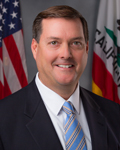
Photo of William P. Brough
R California House · District 73

Rep. William P. Brough

Compare
Total votes
14,942
all sessions
Attendance
91%
953 missed
Near the chamber average
With party
96%
of cast votes
Lower than 82% of chamber peers
Bipartisan score
2%
crosses aisle rarely
Higher than 85% of chamber peers
Sponsored
770
bills & resolutions
Lower than 91% of chamber peers
Committees
0
assignments
770 bills and resolutions

Sponsored bills

Total
770
Primary
93
Co-sponsor
677
This page
770
matching current filters
Co-sponsor ACR 155
Signed into law · California House · Co-sponsor
Relative to Black History Month.

This measure would recognize February 2020 as Black History Month, urge all citizens to join in celebrating the accomplishments of African Americans during Black History Month, encourage the people of California to recognize the many talents of African Americans and the achievements and contributions they make to their communities to create equity and equality for education, economics, and social justice, and recognize the significance in protecting citizens' right to vote and remedying racial discrimination in voting.

Signed into law Jun 17, 2020 1 co-sponsor
Co-sponsor SCR 88
Passed · California Senate · Co-sponsor
Relative to California Peace Officers' Memorial Day.

This measure would designate Monday, May 4, 2020, as California Peace Officers' Memorial Day, urge all Californians to use that day to honor California peace officers, and recognize specified California peace officers who were killed in defense of their communities.

Passed Jun 11, 2020 1 co-sponsor
Co-sponsor SB 1319
died · California Senate · Co-sponsor
Property taxation: change in ownership.

The California Constitution generally limits ad valorem taxes on real property to 1% of the full cash value of that property. For purposes of this limitation, "full cash value" is defined as the assessor's valuation of real property as shown on the 1975–76 tax bill under "full cash value" or, thereafter, the appraised value of that real property when purchased, newly constructed, or a change in ownership has occurred. Existing law specifies those circumstances in which the transfer of ownership interests in a corporation, partnership, limited liability company, or other legal entity results in a change in ownership of the real property owned by that entity, and generally provides that a change in ownership as so described occurs if a legal entity or other person obtains a controlling or majority ownership interest in the legal entity. Existing law requires the Franchise Tax Board to include a question on returns for partnerships, banks, and corporations to assist in the determination of whether a change in ownership under the circumstances described above has occurred. This bill would additionally specify that if 90% or more of the direct or indirect ownership interests in a legal entity are sold or transferred in a single transaction, as defined, the real property owned by that legal entity has changed ownership whether or not any one legal entity or person that is a party to the transaction obtains control, as defined. The bill would require the Franchise Tax Board to include an additional question on returns for partnerships, banks, and corporations to assist in the determination of whether a change in ownership as so described has occurred. The bill would require the State Board of Equalization to prescribe regulations as may be necessary to carry out the purposes of this act. The bill would also require the State Board of Equalization to report to the Legislature, no later than January 1, 2023, regarding the implementation of these changes in ownership, including, but not limited to, the revenue impact and frequency of reassessments of real property owned by legal entities. The bill would require the Legislative Analyst's Office to report to the Legislature no later than January 1, 2023, regarding the economic impact of this bill. Existing law requires, upon a change in control or change in ownership of a legal entity that owns an interest in real property in this state, or when requested by the State Board of Equalization, that the person or legal entity acquiring ownership or control, or the legal entity that has undergone a change in ownership, file a change in ownership statement with the board, as specified. Existing law requires a penalty of 10% of the taxes applicable to the new base year value, as specified, or 10% of the current year's taxes on the property, as specified, to be added to the assessment made on the roll if a person or legal entity required to file a change in ownership statement fails to do so, including a change in ownership of a floating home. This bill would require a person or legal entity acquiring ownership interests in a legal entity, if 90% or more of the ownership interests in the legal entity are sold or transferred, as described above, to file a change in ownership statement signed under penalty of perjury with the State Board of Equalization. The bill would increase the penalties for failure to file a change in ownership statement, as described above, from 10% to 15%, would provide that the penalty shall apply for failure to file a complete statement with the State Board of Equalization following a transfer of legal entity ownership interests, but would eliminate the application of these penalties to a change in ownership of a floating home. This bill would require the State Board of Equalization to notify assessors if a change in control or a change in ownership of a legal entity has occurred. By expanding the crime of perjury and by imposing new duties upon local county officials with respect to changes in ownership, this bill would impose a state-mandated local program. The California Constitution requires the state to reimburse local agencies and school districts for certain costs mandated by the state. Statutory provisions establish procedures for making that reimbursement. This bill would provide that with regard to certain mandates no reimbursement is required by this act for a specified reason. With regard to any other mandates, this bill would provide that, if the Commission on State Mandates determines that the bill contains costs so mandated by the state, reimbursement for those costs shall be made pursuant to the statutory provisions noted above. This bill would declare that it is to take effect immediately as an urgency statute.


died Jun 3, 2020 1 co-sponsor
Co-sponsor ACR 182
Passed · California House · Co-sponsor
California Down Syndrome Awareness Week and Day.

This measure would proclaim March 15, 2020, to March 22, 2020, as California Down Syndrome Awareness Week and March 21, 2020, as California Down Syndrome Day, and would encourage all Californians to support and participate in related activities.

Passed May 26, 2020 1 co-sponsor
Co-sponsor SB 1071
In committee · California Senate · Co-sponsor
Personal income taxes: exclusion: uniformed services: retirement pay.

The Personal Income Tax Law imposes a tax on individual taxpayers measured by the taxpayer's taxable income for the taxable year, but excludes certain items of income from the computation of tax, including an exclusion for combat-related special compensation. This bill, for taxable years beginning on or after January 1, 2021, and before January 1, 2031, would exclude from gross income specified amounts of retirement pay received by a taxpayer from the federal government for service performed in the uniformed services, as defined, during the taxable year. Existing law requires any bill authorizing a new tax expenditure to contain, among other things, specific goals, purposes, and objectives that the tax expenditure with achieve, detailed performance indicators, and data collection requirements. The bill also would include additional information required for any bill authorizing a new income tax credit. This bill would take effect immediately as a tax levy.

In committee May 12, 2020 1 co-sponsor
Co-sponsor AB 2489
In committee · California House · Co-sponsor
Worker status: employees: independent contractors: health care providers: COVID-19.

Existing law requires a 3-part test, commonly known as the "ABC" test, to determine if workers are employees or independent contractors for purposes of the Labor Code, the Unemployment Insurance Code, and the wage orders of the Industrial Welfare Commission. Under the ABC test, a person providing labor or services for remuneration is considered an employee rather than an independent contractor unless the hiring entity demonstrates that the person is free from the control and direction of the hiring entity in connection with the performance of the work, the person performs work that is outside the usual course of the hiring entity's business, and the person is customarily engaged in an independently established trade, occupation, or business. Existing law charges the Labor Commissioner with the enforcement of labor laws, including worker classification. Existing law exempts specified occupations and business relationships from the application of the ABC test described above. Existing law, instead, provides that these exempt relationships are governed by the multifactor test previously established in the case of S. G. Borello & Sons, Inc. v. Department of Industrial Relations (1989) 48 Cal.3d 341. On March 4, 2020, the Governor declared a State of Emergency in accordance with the powers vested in the Governor under the California Constitution and statutes in order to preserve public health and safety throughout the state due to the threat of COVID-19. This bill would, during the timeframe in which a state of emergency is in effect due to COVID-19 and 90 days thereafter, prohibit the application of the ABC test for respiratory therapists and other medical personnel not otherwise covered by an existing exemption from the ABC test, and would instead require that the multifactor test set forth in the case of Borello apply.

In committee May 12, 2020 1 co-sponsor
Co-sponsor AB 3208
In committee · California House · Co-sponsor
Income tax: gross income: loan forgiveness.

The Personal Income Tax Law and the Corporation Tax Law, in conformity with federal income tax law, generally defines "gross income" as income from whatever source derived, except as specifically excluded, and provides various exclusions from gross income. Existing federal law, the Coronavirus Aid, Relief, and Economic Security Act (CARES Act) , among other things, authorizes forgiveness of indebtedness for eligible recipients with covered loans, as defined, in an amount equal to the sum of the recipient's payroll costs, interest on mortgage obligations, rent obligations, and utility payments, subject to specified conditions and during a specified time period. Existing federal law excludes any amounts of covered loans forgiven under the CARES Act from gross income for federal income tax purposes. This bill, for taxable years beginning on or after January 1, 2020, would exclude from gross income, for state income tax purposes, any covered loan amount forgiven pursuant to the federal CARES Act. This bill would take effect immediately as a tax levy.

In committee May 6, 2020 1 co-sponsor
Primary AB 3017
In committee · California House · Lead sponsor
Public postsecondary education: veterans: priority registration.

Existing law establishes the California Community Colleges, the California State University, and the University of California as the 3 segments of public institutions of higher education in the state. Existing law requires the California State University and each community college district, and requests the University of California, to grant priority registration for enrollment to a member or former member of the Armed Forces of the United States who is a resident of California and to any member or former member of the State Guard, as specified, for any academic term attended at one of these institutions for 4 academic years after leaving state or federal active duty for use within 15 years of leaving state or federal active duty. This bill would instead require, and request, these institutions to grant the priority registration for any academic term attended at one of these institutions during any period for which the student is eligible for educational benefits under the federal Montgomery GI Bill, the Post-9/11 Veterans Educational Assistance Act of 2008, or the Vocational Rehabilitation and Employment program. To the extent that this bill would create new duties for community college districts, the bill would impose a state-mandated local program. The California Constitution requires the state to reimburse local agencies and school districts for certain costs mandated by the state. Statutory provisions establish procedures for making that reimbursement. This bill would provide that, if the Commission on State Mandates determines that the bill contains costs mandated by the state, reimbursement for those costs shall be made pursuant to the statutory provisions noted above.

In committee May 5, 2020 0 co-sponsors
Co-sponsor AB 2793
In committee · California House · Co-sponsor
Worker status: independent contractors.

Existing law requires a 3-part test, commonly known as the "ABC" test, to determine if workers are employees or independent contractors for purposes of the Labor Code, the Unemployment Insurance Code, and the wage orders of the Industrial Welfare Commission. Under the ABC test, a person providing labor or services for remuneration is considered an employee rather than an independent contractor unless the hiring entity demonstrates that the person is free from the control and direction of the hiring entity in connection with the performance of the work, the person performs work that is outside the usual course of the hiring entity's business, and the person is customarily engaged in an independently established trade, occupation, or business. Existing law charges the Labor Commissioner with the enforcement of labor laws, including worker classification. Existing law exempts specified occupations and business relationships from the application of Dynamex and the provisions described above. Existing law instead provides that these exempt relationships are governed by the test adopted in S. G. Borello & Sons, Inc. v. Department of Industrial Relations (1989) 48 Cal.3d 341. This bill would expand these exemptions to include an individual providing services as a licensed clinical social worker, a licensed education psychologist, a licensed professional clinical counselor, or a licensed marriage and family therapist.

In committee May 5, 2020 1 co-sponsor
Showing 11 to 20 of 770 bills