

This measure would mark December 17, 2019, as the 76th anniversary of the repeal of the Chinese Exclusion Act to honor the contributions of all immigrants and refugees in our communities. The measure would also declare the opposition of the Legislature to executive orders and a presidential proclamation signed by President Trump relating to immigration, call upon the President to revoke those orders and that proclamation, condemn the expansion of deportations being undertaken under the current presidential administration, stand in firm opposition to the President's proposal for construction of a wall along the southern border with Mexico, and reaffirm that the state is open and welcoming to immigrants and refugees who are integral to life in our state.
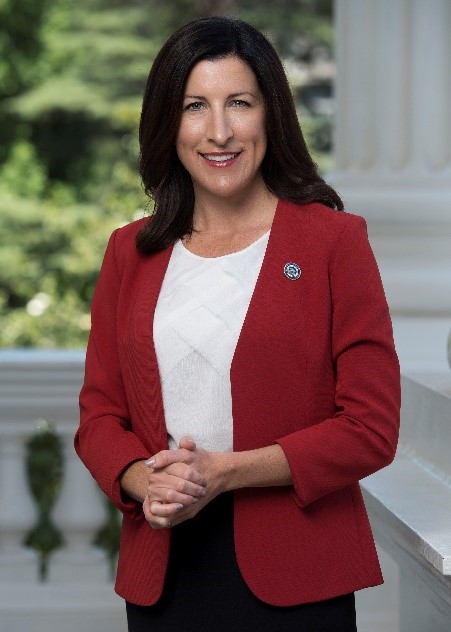
Asm. Cottie Petrie-Norris
Sponsored bills
The California Constitution allows a United States citizen who is at least 18 years of age and a resident of California to vote. This measure would reduce the minimum voting age to 17.
This measure would designate a specified portion of State Route 55 from 19th Street to MacArthur Boulevard in the County of Orange as the Costa Mesa Fire Captain Michael Kreza Memorial Highway. The measure would request the Department of Transportation to determine the cost of appropriate signs showing this special designation and, upon receiving donations from nonstate sources covering that cost, to erect those signs.
The California Coastal Act of 1976 requires any person undertaking development in the coastal zone to obtain a coastal development permit issued by the California Coastal Commission for a project, as defined, in accordance with prescribed procedures. The act authorizes the commission to require a reasonable filing fee and reimbursement of expenses for the processing by the commission of an application for a coastal development permit and, except for local coastal program submittals, for any other filing, including, but not limited to, a request for revocation, categorical exclusion, or boundary adjustment, submitted for review by the commission. This bill would authorize the commission to waive the filing fee for an application for a coastal development permit required under the act, as specified.
Existing law provides that it is the intent of the Legislature that the state should coordinate and integrate its watershed programs and implement those programs by working with diverse interests at the local level. Existing law provides that the state's watershed management goals should include maintaining and restoring healthy watersheds that support thriving communities, provide clean water, and sustain natural habitats for future generations. Existing law provides that there is in the Natural Resources Agency the Department of Conservation. Existing law provides that the work of the department be divided into various divisions, including the Division of Land Resource Protection. Existing law authorizes the department to expend the money in any appropriation or in any special fund in the State Treasury made available by law for the administration of the statutes, the administration of which is committed to the department. Existing law requires these expenditures to be made in accordance with law in carrying out the purposes for which the appropriations were made or the special funds created. This bill would require the department, to the extent funds are available, to establish and administer the Ecosystem Resilience Program to fund watershed coordinator positions, as provided, and other necessary costs, throughout the state for the purpose of achieving specified goals, including the goal to develop and implement watershed improvement plans, and other plans to enhance the natural functions of a watershed, aligned with multiple statewide and regional objectives across distinct bioregions. The bill would require the department to develop performance measures and accountability controls to track progress and outcomes of all watershed coordinator grants. The bill would require, on or before January 31, 2022, and every 3 years thereafter, the department to report those outcomes to the appropriate fiscal and policy committees of the Legislature.
(1) Existing law vests with the State Lands Commission jurisdiction over specified public lands in the state, including tidelands and submerged lands. The California Coastal Act of 1976 also establishes the California Coastal Commission and requires the commission to regulate development in the coastal zone, as defined. Existing law creates the Integrated Climate Adaptation and Resiliency Program to be administered by the Office of Planning and Research, and requires the Director of State Planning and Research, no later than January 1, 2017, to establish the program to coordinate regional and local efforts with state climate adaptation strategies to adapt to the impacts of climate change, as specified. This bill would establish the Program for Coastal Resilience, Adaptation, and Access for the purpose of funding specified activities intended to help the state prepare, plan, and implement actions to address and adapt to sea level rise and coastal climate change. The bill would create the Coastal Resilience, Adaptation, and Access Fund in the State Treasury, and would authorize the California Coastal Commission and specified state agencies to expend moneys in the fund, upon appropriation in the annual Budget Act, to take actions, based upon the best scientific information, that are designed to address and adapt to sea level rise and coastal climate change, as prescribed. The bill would require the Natural Resources Agency to annually make available information regarding any activity funded under the program on a publicly accessible internet website. The bill would also require the Natural Resources Agency, and any other state agency to which funding is allocated, to consider the guidance and resources developed by the Integrated Climate Adaptation and Resiliency Program to help inform decisions relating to activities funded with moneys from the Coastal Resilience, Adaptation, and Access Fund. (2) Existing law requires the State Lands Commission, with specified exceptions, to deposit all revenue, money, and remittances received by the commission from certain state lands in the General Fund, and requires that sufficient moneys from those deposits be made available each fiscal year for payments for expenditures of the commission, specified payments to cities and counties pursuant to agreements covering transferred lands, mineral rights, and oil and gas well removal and remediation, as prescribed. This bill would require, for the 2020–21 fiscal year and for each fiscal year thereafter, an amount equal to 30% of those funds received by the commission and required to be deposited into the General Fund by the commission pursuant to those provisions, except as provided, but not to exceed $50,000,000, to be transferred to the Coastal Resilience, Adaptation, and Access Fund and made available, upon appropriation in the annual Budget Act, for expenditure for purposes of the Program for Coastal Resilience, Adaptation, and Access.
Existing law establishes the Medi-Cal program, which is administered by the State Department of Health Care Services and under which qualified low-income individuals receive health care services. The Medi-Cal program is, in part, governed and funded by federal Medicaid program provisions. Existing federal law authorizes a state to provide in its Medicaid state plan that in determining eligibility under the federal Medicaid program for a child, the state is authorized to rely on a finding made within a reasonable period from an Express Lane agency, as defined, when it determines whether a child satisfies one or more components of eligibility for medical assistance under the federal Medicaid program. Existing law establishes the California Special Supplemental Nutrition Program for Women, Infants, and Children (WIC Program) , which is administered by the State Department of Public Health and counties and under which nutrition and other assistance are provided to eligible low-income pregnant women, low-income postpartum and lactating women, and low-income infants and children under 5 years of age, who have been determined to be at nutritional risk. Existing law requires the former Managed Risk Medical Insurance Board and former State Department of Health Services, in collaboration with program offices for the WIC Program and other designated entities, to design, promulgate, and implement policies and procedures for an automated enrollment gateway system, subject to appropriation, allowing children applying to the WIC Program to obtain presumptive eligibility for, and to facilitate application for enrollment in, the Medi-Cal program or the former Healthy Families Program, to the extent federal financial participation is available, as specified. This bill would delete the above-described provisions relating to the automated enrollment gateway system and would instead require the State Department of Health Care Services, in collaboration with the same designated entities, to design, promulgate, and implement policies and procedures for an automated enrollment pathway, designating the WIC Program and its local WIC agencies as Express Lane agencies and using WIC eligibility determinations to meet Medi-Cal eligibility requirements. The bill would require the pathway to perform specified functions to streamline Medi-Cal enrollment and maximize health care coverage. The bill would require that benefits for applicants enrolling in the Medi-Cal program using the pathway be provided immediately through accelerated enrollment for children and presumptive eligibility for pregnant women. The bill would also require the pathway to modify the existing WIC enrollment system and Medi-Cal eligibility and enrollment systems to electronically transfer to the WIC Program the Medi-Cal eligibility determinations and contact information of Medi-Cal enrollees who are eligible for the WIC Program for the purpose of local WIC agencies contacting prospective WIC enrollees to complete their enrollment in the WIC Program. The bill would, while the automated enrollment pathway is being developed, require the department, in coordination with the WIC Program and local WIC agencies to, among other things, conduct regular data matches to identify which WIC recipients are not enrolled in the Medi-Cal program and which Medi-Cal beneficiaries are eligible for, but not enrolled in, the WIC Program, and to provide specified notices about program eligibility to those persons. The bill would require the department to seek approval of any amendments to the state plan necessary to implement these provisions, and would condition their implementation on the department obtaining all necessary federal approvals. The bill would also require the department to complete the project approval lifecycle process, as specified, for the automated enrollment pathway prior to implementing these provisions. Because counties are responsible for making eligibility determinations under the Medi-Cal program, by revising eligibility requirements, this bill would impose a state-mandated local program. The California Constitution requires the state to reimburse local agencies and school districts for certain costs mandated by the state. Statutory provisions establish procedures for making that reimbursement. This bill would provide that, if the Commission on State Mandates determines that the bill contains costs mandated by the state, reimbursement for those costs shall be made pursuant to the statutory provisions noted above.
Existing law establishes various advisory boards and commissions in state government with specified duties and responsibilities. Existing law requires the Governor to transmit to the Legislature, no later than April 15 of each year, an economic report to be designated as the "Economic Report of the Governor" setting forth, among other things, a review of economic developments during the preceding calendar year and forecasts of trends in employment, income, and investment for the coming year and trends in such major economic sectors as it is feasible to project. This bill, until January 1, 2025, would establish in state government the advisory Commission on Tech Equity, which would consist of 7 appointed members, as specified, and the Director of the Governor's Office of Business and Economic Development and the Director of Finance serving as ex officio members. The bill would require the commission to develop recommendations on a policy framework to manage the development, deployment, regulation, taxation, and fair distribution of the benefits of innovation and technology, as specified, and submit the recommendations to the Legislature and to the Governor no later than January 1, 2021, and annually on or before January 1, thereafter.
This measure would recognize June 12, 2019, as the 121st Anniversary of Philippine Independence and would call upon the people of the state to observe the month of June with appropriate ceremonies, programs, and activities.