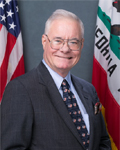
Photo of Randy Voepel
R California Assembly · District 71

Asm. Randy Voepel

Compare
Total votes
12,001
all sessions
Attendance
88%
1,256 missed
Lower than 84% of chamber peers
With party
98%
of cast votes
Lower than 80% of chamber peers
Bipartisan score
1%
crosses aisle rarely
Higher than 87% of chamber peers
Sponsored
1,099
bills & resolutions
Near the chamber average
Committees
0
assignments
1,099 bills and resolutions

Sponsored bills

Total
1,099
Primary
108
Co-sponsor
991
This page
1,099
matching current filters
Co-sponsor ACR 8
Signed into law · California Assembly · Co-sponsor
Adverse childhood experiences: post-traumatic "street" disorder.

This measure would recognize adverse childhood experiences (ACEs) , also known as post-traumatic "street" disorder in communities of color, as having lasting negative outcomes to both physical and mental health with growing implications for our state.

Signed into law Sep 7, 2017 1 co-sponsor
Co-sponsor AB 834
Passed · California Assembly · Co-sponsor
School-based health programs.

Existing law provides for the Medi-Cal program, which is administered by the State Department of Health Care Services, under which qualified low-income individuals receive health care services. The Medi-Cal program is, in part, governed by, and funded pursuant to, federal Medicaid program provisions. Existing law establishes the Administrative Claiming process under which the department is authorized to contract with local governmental agencies and local educational consortia for the purpose of obtaining federal matching funds to assist with the performance of administrative activities relating to the Medi-Cal program that are provided by a local governmental agency or local educational agency (LEA) . Existing law also provides that specified services provided by LEAs are covered Medi-Cal benefits and are reimbursable on a fee-for-service basis under the LEA Medi-Cal billing option. Existing law requires the State Department of Health Care Services to engage in specified activities relating to the LEA Medi-Cal billing option, such as amending the Medicaid state plan to ensure that schools shall be reimbursed for all eligible services and examining methodologies for increasing school participation in the LEA Medi-Cal billing option. Existing law requires that these activities be funded and staffed by proportionately reducing federal Medicaid payments allocable to LEAs for the provision of benefits funded by federal Medicaid program payments under the LEA Medi-Cal billing option in an amount not to exceed $1,500,000 annually. This bill would require the State Department of Education to, no later than July 1, 2018, establish an Office of School-Based Health Programs for the purpose of, among other things, administering health-related programs under the purview of the State Department of Education and advising on issues related to the delivery of school-based Medi-Cal services in the state. The bill would authorize the office to form additional advisory groups, as specified, and would require the State Department of Education to make available to the office any information on other school-based dental, health, and mental health programs. The bill would require the office to be supported through an interagency agreement with the State Department of Health Care Services, by federal matching funds available through the Administrative Claiming process for eligible staff time, and would authorize the office to receive additional funds from grants and other sources. The bill would increase the annual funding limit for the activities of the State Department of Health Care Services that support the LEA Medi-Cal billing option to $2,000,000, and require that $500,000 of that amount be available for transfer to the State Department of Education to support the office pursuant to that interagency agreement.

Passed Sep 1, 2017 1 co-sponsor
Co-sponsor SB 8
Passed · California Senate · Co-sponsor
Diversion: mental disorders.

Existing law authorizes a court, with the consent of the defendant and a waiver of the defendant's speedy trial right, to postpone prosecution of a misdemeanor and place the defendant in a pretrial diversion program if the defendant is suffering from sexual trauma, a traumatic brain injury, post-traumatic stress disorder, substance abuse, or mental health problems as a result of his or her military service. Existing law authorizes the defendant to be referred to services for treatment and requires the responsible agencies to report to the court and the prosecution not less than every 6 months. This bill would authorize a court, with the consent of the defendant and a waiver of the defendant's speedy trial right, to postpone prosecution of a misdemeanor or a felony punishable in a county jail, and place the defendant in a pretrial diversion program for up to 2 years if the court is satisfied the defendant suffers from a mental disorder, that the defendant's mental disorder played a significant role in the commission of the charged offense, and that the defendant would benefit from mental health treatment. For specified offenses, the bill would condition granting diversion on the consent of the prosecution. The bill would require the defense to arrange, to the satisfaction of the court, for a program of mental health treatment utilizing existing inpatient or outpatient mental health resources. The bill would require the divertee's mental health provider to provide reports on the defendant's progress to the court, the defense, and the prosecution not less than every 3 months. By increasing the duties of local prosecutors and public defenders, this bill would impose a state-mandated local program. The bill would require, upon successful completion of the diversion program, that the charges be dismissed and the records of the arrest sealed, and that the arrest be deemed never to have occurred, except as provided. The bill would state findings and declarations by the Legislature regarding the need for the diversion program. The California Constitution requires the state to reimburse local agencies and school districts for certain costs mandated by the state. Statutory provisions establish procedures for making that reimbursement. This bill would provide that, if the Commission on State Mandates determines that the bill contains costs mandated by the state, reimbursement for those costs shall be made pursuant to the statutory provisions noted above.

Passed Sep 1, 2017 1 co-sponsor
Co-sponsor AB 229
Passed · California Assembly · Co-sponsor
Human trafficking: vertical prosecution program.

Existing law establishes the Office of Emergency Services, which is required to, among other things, allocate and award funds to communities developing and providing ongoing citizen involvement and crime resistance programs. This bill would require the office, to the extent funds are available for this purpose and until January 1, 2022, to allocate and award funds to up to 11 district attorney offices that employ a vertical prosecution methodology for the prosecution of human trafficking crimes and that meet other specified criteria, including minimum staffing levels for the program. The bill would require the office, on or before January 1, 2020, to submit to the Legislature and the Governor's office a report that describes the counties that received funding pursuant to this program, the number of prosecutions for human trafficking cases filed by the counties receiving funding, the number of human trafficking convictions obtained by those counties, and the sentences imposed for human trafficking crimes in those counties. The bill would also appropriate $2,600,000 from the General Fund to the office for this program.

Passed Sep 1, 2017 1 co-sponsor
Co-sponsor SB 135
Passed · California Senate · Co-sponsor
Pupil instruction: media literacy: model curriculum.

Existing law requires the adopted course of study for grades 1 to 6, inclusive, and for grades 7 to 12, inclusive, to offer courses in specified areas of study, including social sciences. Existing law establishes the Instructional Quality Commission and requires the commission to, among other things, recommend curriculum frameworks to the State Board of Education. This bill would require the commission to develop, and the state board to adopt, reject, or modify, a model curriculum in media literacy for kindergarten and grades 1 to 12, inclusive. The bill would require the commission to submit the model curriculum to the state board on or before January 1, 2019, and would require the state board to adopt, reject, or modify the model curriculum on or before March 31, 2019, in accordance with specified procedural requirements. The bill would require the State Department of Education to make available on its Internet Web site a list of resources and instructional materials on media literacy, including media literacy professional development programs for teachers.

Passed Sep 1, 2017 1 co-sponsor
Co-sponsor AB 1090
Passed · California Assembly · Co-sponsor
Cannabis use: location restrictions.

The Control, Regulate and Tax Adult Use of Marijuana Act (AUMA) , an initiative statute enacted by the approval of Proposition 64 at the November 8, 2016, statewide general election, authorizes a person 21 years of age or older to possess and use specified amounts of cannabis. AUMA specifies that possessing, smoking, or ingesting cannabis or cannabis products in or upon the grounds of a school, day care center, or youth center while children are present is prohibited. AUMA makes a violation of this location restriction punishable as an infraction or a misdemeanor, as specified. AUMA authorizes the Legislature to amend its provisions with a 23 vote of each house of the Legislature, if the amendments are consistent with and further the purposes and intent of the act. This bill would prohibit the possession, smoking, or ingesting of cannabis or cannabis products in or upon the grounds of a school, day care center, or youth center, regardless of whether children are present. By expanding the scope of a crime, this bill would impose a state-mandated local program. The California Constitution requires the state to reimburse local agencies and school districts for certain costs mandated by the state. Statutory provisions establish procedures for making that reimbursement. This bill would provide that no reimbursement is required by this act for a specified reason.

Passed Sep 1, 2017 1 co-sponsor
Co-sponsor AB 735
Passed · California Assembly · Co-sponsor
Swimming pools: public safety.

Existing law provides for the regulation of private swimming pools. Existing law also provides for the regulation of public swimming pools by the State Department of Public Health. Existing law requires the provision of lifeguard services at any public swimming pool that is of wholly artificial construction and for the use of which a direct fee, as defined, is imposed. A violation of those provisions is a crime. This bill would require those public swimming pools, as defined, that are required to provide lifeguard services and that charge a direct fee to additionally provide an Automated External Defibrillator (AED) during pool operations. Because the failure to comply with these provisions would be a crime, the bill would create a state-mandated local program. The bill would also require the State Department of Education, in consultation with the State Department of Public Health, to issue best practices guidelines related to pool safety at K–12 schools. The California Constitution requires the state to reimburse local agencies and school districts for certain costs mandated by the state. Statutory provisions establish procedures for making that reimbursement. This bill would provide that no reimbursement is required by this act for a specified reason.

Passed Sep 1, 2017 1 co-sponsor
Co-sponsor SB 197
Passed · California Senate · Co-sponsor
Sales and use taxes: exemption: military and veteran medical facilities.

Existing state sales and use tax laws impose a tax on retailers measured by the gross receipts from the sale of tangible personal property sold at retail in this state, or on the storage, use, or other consumption in this state of tangible personal property purchased from a retailer for storage, use, or other consumption in this state. The Sales and Use Tax Law provides various exemptions from those taxes, including an exemption for the sale of, or the storage, use, or other consumption of, meals and food products that are furnished or served by any nonprofit veteran's organization for purposes of fundraising, as specified. This bill, on and after April 1, 2017, and before January 1, 2023, would exempt from these taxes the gross receipts from the sale of, and the storage, use, or other consumption in this state of, building materials and supplies purchased by a qualified person for use by that qualified person in the construction of specified military and veteran medical facilities. The bill would make a legislative finding and declaration that the retroactive application of the bill serves a public purpose and does not constitute a gift of public funds. The Bradley-Burns Uniform Local Sales and Use Tax Law authorizes cities and counties to impose local sales and use taxes in conformity with the Sales and Use Tax Law, and existing laws authorize districts, as specified, to impose transactions and use taxes in accordance with the Transactions and Use Tax Law, which generally conforms to the Sales and Use Tax Law. Amendments to the Sales and Use Tax Law are automatically incorporated into the local tax laws. Existing law requires the state to reimburse cities and counties for revenue losses caused by the enactment of sales and use tax exemptions. This bill would provide that, notwithstanding these provisions, no appropriation is made and the state shall not reimburse cities and counties for sales and use tax revenues lost by them pursuant to this bill.


Passed Sep 1, 2017 1 co-sponsor
Co-sponsor SJR 10
In committee · California Senate · Co-sponsor
Relative to Falun Gong.

This measure would express the Legislature's support for, and condemn any government-sanctioned persecution of, Falun Gong practitioners, as specified. The measure would urge the President and the Congress of the United States to condemn any government-sanctioned persecution of Falun Gong practitioners.

In committee Sep 1, 2017 1 co-sponsor
Showing 971 to 980 of 1,099 bills
Previous 1 … 97 98 99 … 110 Next