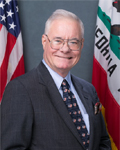
Photo of Randy Voepel
R California Assembly · District 71

Asm. Randy Voepel

Compare
Total votes
12,001
all sessions
Attendance
88%
1,256 missed
Lower than 84% of chamber peers
With party
98%
of cast votes
Lower than 80% of chamber peers
Bipartisan score
1%
crosses aisle rarely
Higher than 87% of chamber peers
Sponsored
1,099
bills & resolutions
Near the chamber average
Committees
0
assignments
1,099 bills and resolutions

Sponsored bills

Total
1,099
Primary
108
Co-sponsor
991
This page
1,099
matching current filters
Co-sponsor ACR 249
Signed into law · California Assembly · Co-sponsor
Relative to Father's Day.

This measure would recognize June 17, 2018, as Father's Day and would commend fathers and father figures present in their children's lives.

Signed into law Aug 17, 2018 1 co-sponsor
Co-sponsor ACR 241
Signed into law · California Assembly · Co-sponsor
Relative to cardiopulmonary resuscitation.

This measure would declare the week of June 1, 2018, to June 7, 2018, inclusive, as Cardiopulmonary Resuscitation and Automated External Defibrillator Awareness Week in California, as specified.

Signed into law Aug 17, 2018 1 co-sponsor
Co-sponsor ACR 242
Signed into law · California Assembly · Co-sponsor
Relative to California Manufacturing Day.

This measure would declare Friday, October 5, 2018, as California Manufacturing Day and would recognize the importance of California's manufacturing sector. The measure would also commemorate California's manufacturers as they continue to push the bounds of clean technologies that reduce emissions and increase energy efficiency in products and processes.

Signed into law Aug 17, 2018 1 co-sponsor
Co-sponsor AB 2018
Passed · California Assembly · Co-sponsor
Mental health workforce planning: loan forgiveness, loan repayment, and scholarship programs.

Existing law establishes the Steven M. Thompson Physician Corps Loan Repayment Program (program) in the California Physician Corps Program within the Health Professions Education Foundation, which provides financial incentives, including repayment of educational loans, to a physician and surgeon who practices in a medically underserved area, as defined. Existing law establishes the Medically Underserved Account for Physicians, a continuously appropriated account, within the Health Professions Education Fund, to primarily provide funding for the ongoing operations of the program. Existing law defines "practice setting," for these purposes, to include a community clinic, as defined, a clinic owned or operated by a public hospital and health system, or a clinic owned and operated by a hospital that maintains the primary contract with a county government to fulfill the county's role to serve its indigent population, that is located in a medically underserved area and at least 50% of whose patients are from a medically underserved population. Existing law also defines "practice setting," for these purposes, to include a physician owned and operated medical practice setting that provides primary care located in a medically underserved area and has a minimum of 50% of patients who are uninsured, Medi-Cal beneficiaries, or beneficiaries of another publicly funded program that serves patients who earn less than 250% of the federal poverty level. This bill also would define "practice setting" to include a program or facility operated by, or contracted to, a county mental health plan. By expanding the group of persons eligible for financial incentives payable from a continuously appropriated fund, this bill would make an appropriation. Existing law, the Mental Health Services Act, an initiative measure enacted by the voters as Proposition 63 at the November 2, 2004, statewide general election, requires the Office of Statewide Health Planning and Development (OSHPD) , in coordination with the California Behavioral Health Planning Council, to identify the total statewide needs for each professional and other occupational category utilizing county needs assessment information and develop a 5-year education and training development plan. Existing law requires OSHPD to include specified components in the 5-year plan, including expansion plans for the forgiveness and scholarship programs offered in return for a commitment to employment in California's public mental health system and making loan forgiveness programs available to current employees of the mental health system who want to obtain Associate of Arts, Bachelor of Arts, master's degrees, or doctoral degrees. This bill would clarify that OSHPD needs to include in the 5-year plan both expansion plans for loan forgiveness and scholarship programs offered in return for a commitment to employment in California's public mental health system and expansion plans for making loan forgiveness programs available to current employees of the mental health system who want to obtain Associate of Arts, Bachelor of Arts, master's degrees, or doctoral degrees. The bill would also make specified findings and declarations.

Passed Aug 16, 2018 1 co-sponsor
Co-sponsor AB 986
Passed · California Assembly · Co-sponsor
Hunting and sport fishing licenses: sport fishing license duration: reduction in license fees for veterans.

Existing law requires every person 16 years of age or older who takes any fish, reptile, or amphibian for any purpose other than profit to first obtain a sport fishing license for that purpose, with specified exceptions, and to have that license on his or her person or in his or her immediate possession when engaged in carrying out any activity authorized by the license. Existing law requires a resident or a nonresident, 16 years of age or older, upon payment of a specified fee, to be issued a sport fishing license for the period of a calendar year, or, if issued after the beginning of the year, for the remainder thereof. Existing law also requires the issuance of shorter term licenses upon payment of a specified lesser fee. Existing law requires the Fish and Game Commission to adjust the amount of the fees, as prescribed, to fully recover, but not exceed, all reasonable administrative and implementation costs of the Department of Fish and Wildlife and the commission relating to those licenses. This bill, in addition to sport fishing licenses for the periods specified above, would require a sport fishing license to be issued to a resident or nonresident for the period of 12 consecutive months, upon payment of a fee that is equal to 130% of the fees for issuance of resident or nonresident calendar-year licenses, as applicable. The bill would require the commission to adjust the amount of the fees as necessary to fully recover, but not exceed, all reasonableimplementation and administrative costs of the department and the commission relating to these licenses, including all costs related to their establishment and enforcement. The bill would require the department to submit to the Legislature a written report on the implementation of these provisions, as provided. The bill would make these provisions operative beginning January 1, 2020, until January 1, 2023. Under existing law, a hunting license grants the privilege to take birds and mammals. Existing law requires the department to issue a hunting license for specified periods of time, including for a term of one year, as provided, upon payment of a fee, to eligible residents and nonresidents. Existing law requires the department to issue a sport fishing license for specified periods of time, including for the period of a calendar year, as provided, upon payment of a fee, to eligible residents and nonresidents. Existing law requires the department to issue lifetime hunting licenses and lifetime sport fishing licenses, and grants certain lifetime privileges to holders of those licenses, upon the one-time payment of specified fees. This bill would require the department to reduce the fee required to obtain the above-described licenses and the 12 consecutive month licenses created by this bill by 25% for a person who is a veteran of the Armed Forces of the United States, was honorably discharged, and is a resident of California. Under existing law, the department issues, upon payment of specified fees, various types of sport fishing report cards and validations that are required, in addition to a sport fishing license, to engage in various activities relating to the taking and possession of amphibians, reptiles, and fish for purposes other than profit. This bill would require the department to reduce the fee required to obtain a sport fishing report card, validation, or other entitlement by 25% for a person who is a veteran of the Armed Forces of the United States, was honorably discharged, and is a resident of California and by 50% for a person who meets those requirements and who also has a 50% or greater service-connected disability.


Passed Aug 16, 2018 1 co-sponsor
Primary AB 2481
Passed · California Assembly · Lead sponsor
State employees: Infant at Work programs.

Existing law establishes various employment protections to promote parent-infant bonds and infant health. The Moore-Brown-Roberti Family Rights Act, or California Family Rights Act, makes it an unlawful employment practice for an employer, as defined, to refuse to grant a request by an eligible employee to take up to 12 workweeks of unpaid protected leave during any 12-month period to care for a child born to, adopted by, or placed for foster care with, the employee. The New Parent Leave Act prohibits an employer, as defined, from refusing to allow eligible employees to take up to 12 weeks of parental leave to bond with a new child within one year of the child's birth, adoption, or foster care placement. Other existing law requires both public and private employers to provide accommodations for maternal lactation, including a reasonable amount of break time to employees desiring to express breast milk and a reasonable effort to provide the employee use of a room or other location in close proximity to the employees' work area for that purpose. This bill, until January 1, 2020, would authorize a state agency, as defined, to adopt an Infant at Work program to allow an employee of the agency who is a new parent or caregiver to an infant to bring the infant to the workplace. The bill would establish certain required elements for such a program. The bill would authorize a state agency to adopt regulations that it determines necessary to establish the program. The bill would prohibit a state agency from adopting the program in circumstances that are inappropriate based on safety, health, or other concerns for the infant or adult, as specified.

Passed Aug 16, 2018 0 co-sponsors
Primary AB 2479
Passed · California Assembly · Lead sponsor
Public postsecondary education: income share agreement: pilot program.

The Donahoe Higher Education Act provides for a public postsecondary education system in this state. This system consists of the University of California, the California State University, and the California Community Colleges. The act applies to the University of California only to the extent that the Regents of the University of California act by resolution to make it applicable. This bill would require the California State University and, as a condition of receipt of funds appropriated for purposes of the bill's provisions, the University of California to each select a campus of their respective system to establish, commencing with the 2020–21 academic year, a pilot program for participating students to enter into an income share agreement with the campus. These agreements would specify that moneys for the pilot program would be provided to students for costs of attendance, with students agreeing to pay a portion of their future incomes in exchange. The bill would provide that the period of repayment shall not exceed 10 years and shall commence 6 months after the student's graduation. The bill would require the income share agreement to be subject to specified requirements, including, among others, that the agreement provide for monthly payments to be based on a specified percentage of the student's annual income. The bill would require the pilot program to be open to students in their sophomore, junior, or senior year, and would authorize the campus to impose other eligibility requirements and cap the number of participants based on the amount of moneys appropriated for the pilot program. The bill would require that implementation of the pilot program be contingent upon the appropriation of funds for this purpose in the annual Budget Act or other statute. The bill would require each participating campus to submit a report no later than November 1, 2022, and a 2nd report no later than November 1, 2025, to the appropriate policy and fiscal committees of the Legislature containing specified information about the pilot program.

Passed Aug 16, 2018 0 co-sponsors
Co-sponsor AB 1784
Passed · California Assembly · Co-sponsor
Resource families: pilot program: supportive services.

Existing law provides for the implementation, by counties and foster family agencies, of the resource family approval process, which is a unified, family friendly, and child-centered approval process that replaces the multiple processes for licensing foster family homes, approving relatives and nonrelative extended family members as foster care providers, and approving adoptive families. This bill would require the State Department of Social Services to establish and facilitate a pilot program, as specified, in up to five counties that voluntarily apply and are selected by the department, to increase placement stability for foster youth and facilitate greater resource family retention through strengths-based, skills-based, trauma-informed coaching. The bill would set forth the components of the pilot program and would require the department, by June 30, 2019, to consult with relevant stakeholders and to consider the stakeholders' recommendations to the department regarding certain parameters of the pilot program, as specified. The bill would require a county that elects to participate in the pilot program to conduct at least one evaluation of the program's impact and effectiveness on increasing placement stability for foster youth and retaining resource families in accordance with, and upon issuance of guidance from, the department, and to submit the evaluation to the department, no later than December 31, 2021. The bill would require the department to report the information provided by the counties to the Legislature, as prescribed. The provisions of the bill would be repealed on January 1, 2022.

Passed Aug 16, 2018 1 co-sponsor
Co-sponsor SCR 107
Signed into law · California Senate · Co-sponsor
Relative to developmental services.

This measure would declare the intent of the Legislature to further support the housing needs of individuals with developmental disabilities by exploring models that facilitate the private donation of homes in perpetuity and would recognize the work of organizations that have developed a property donation program.

Signed into law Aug 15, 2018 1 co-sponsor
Co-sponsor ACR 280
Introduced · California Assembly · Co-sponsor
Legislature: Wounded Warrior Program.

Existing law authorizes certain internship and fellowship programs, as specified. This measure would honor the achievements of the United States House of Representatives' Wounded Warrior Program and would encourage the Assembly Committee on Rules to study the potential of implementing similar programs in the Legislature.

Introduced Aug 14, 2018 1 co-sponsor
Showing 731 to 740 of 1,099 bills
Previous 1 … 73 74 75 … 110 Next