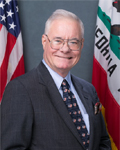
Photo of Randy Voepel
R California Assembly · District 71

Asm. Randy Voepel

Compare
Total votes
12,001
all sessions
Attendance
88%
1,256 missed
Lower than 84% of chamber peers
With party
98%
of cast votes
Lower than 80% of chamber peers
Bipartisan score
1%
crosses aisle rarely
Higher than 87% of chamber peers
Sponsored
1,099
bills & resolutions
Near the chamber average
Committees
0
assignments
1,099 bills and resolutions

Sponsored bills

Total
1,099
Primary
108
Co-sponsor
991
This page
1,099
matching current filters
Co-sponsor SCR 99
Signed into law · California Senate · Co-sponsor
Relative to Take Our Daughters And Sons To Work Day.

This measure would declare April 28, 2022, as Take Our Daughters and Sons to Work Day, and would recognize the goals of introducing our daughters and sons to the workplace and commend all participants of Take Our Daughters And Sons To Work Day.

Signed into law May 27, 2022 1 co-sponsor
Co-sponsor SB 1134
Passed · California Senate · Co-sponsor
Substance use disorder counselors: Allied Behavioral Health Board.

Existing law provides for the licensure and regulation of adult alcoholism or drug abuse recovery or treatment facilities by the State Department of Health Care Services and authorizes the department to enforce those provisions. Existing law also requires the department to require that an individual providing counseling services within a program be certified by a certifying organization approved by the department. Existing law authorizes the department to charge a fee to all programs for licensure or certification by the department, and establishes the Residential and Outpatient Program Licensing Fund to hold these fees. This bill would create the Allied Behavioral Health Board within the Department of Consumer Affairs, and would transfer the responsibility to oversee those certifying organizations from the State Department of Health Care Services to the board. The bill would require the board to establish regulations and standards for the licensure of substance use disorder counselors, as specified. This bill would require an applicant for a substance use disorder counselor license to have documented to a certifying organization that they have obtained a master's degree in alcohol and drug counseling or a related counseling master's degree, as specified, and to pass specified examinations. The bill would require the board to review the criminal history of the applicant, as specified. The bill would prohibit a person from using the title of "Licensed Alcohol Drug Counselor" unless the person has applied for and obtained a license from the board, and would make a violation of that provision punishable by an administrative penalty not to exceed $1,000. The bill would require the board to establish fees for licensure, as specified, and would revert all unencumbered funds appropriated from fees in the Residential and Outpatient Program Licensing Fund to the State Department of Health Care Services for the purpose of certification oversight of substance use disorder counselors to that fund. The bill would make its provisions operative upon the appropriation by the Legislature of sufficient funds allocated to the state from a specified settlement agreement, consistent with the requirements of the settlement agreement.

Passed May 26, 2022 1 co-sponsor
Co-sponsor SCR 88
Signed into law · California Senate · Co-sponsor
Relative to California Wines: Down to Earth Month.

This measure would proclaim, in perpetuity, the month of April as California Wines: Down to Earth Month, to celebrate the sustainable leadership of California wineries and winegrape growers throughout the month of April.

Signed into law May 24, 2022 1 co-sponsor
Co-sponsor AB 2952
In committee · California Assembly · Co-sponsor
Driver's licenses: veteran designation.

Existing law requires the Department of Motor Vehicles to issue a driver's license to an applicant when the department determines that the applicant is lawfully entitled to a license. Existing law allows an in-person applicant for a driver's license or identification card to request the word "VETERAN" be printed on the face of the driver's license or identification card, subject to certain requirements, including, among others, verification of veteran status, as specified, and payment of a $5 fee, which the department is authorized to increase by regulation, in an amount not to exceed $15, as specified. This bill would allow an applicant for a driver's license or identification card, who served for another country in military operations that supported the United States during the Vietnam War and later became a naturalized citizen, to request a "NON-US VIETNAM VETERAN" designation on their driver's license or identification card, subject to certain requirements, including verification of military service for a foreign country during the Vietnam War and payment of a $5 fee, which the department is authorized to increase by regulation, in an amount not to exceed $15, as specified. This bill would authorize the department to consult with the Department of Veterans Affairs to determine the proof necessary to verify an applicant's veteran status.

In committee May 19, 2022 1 co-sponsor
Co-sponsor AB 2569
In committee · California Assembly · Co-sponsor
Department of Homelessness Prevention, Outreach, and Support.

Existing law establishes various programs to provide assistance to homeless persons, including, among others, the Emergency Housing and Assistance Program and homeless youth emergency service pilot projects. Existing law also establishes the California Interagency Council on Homelessness to oversee the implementation of Housing First guidelines and regulations, and, among other things, identify resources, benefits, and services that can be accessed to prevent and end homelessness in California. This bill would require the California Health and Human Services Agency to convene a working group that includes representatives from all departments and agencies that currently receive funding relating to services for homeless individuals. The bill would require the working group to determine the best approach to creating a Department of Homelessness Prevention, Outreach, and Support and to submit its findings and recommendations to the Legislature no later than January 1, 2024. The bill would repeal these provisions on January 1, 2024.

In committee May 19, 2022 1 co-sponsor
Co-sponsor AB 1665
Failed · California Assembly · Co-sponsor
Trafficking a minor: plea bargains.

Existing law defines the crime of human trafficking and imposes a penalty of at least 5, 8, or 12 years in state prison and a fine of not more than $500,000. This bill would prohibit plea bargaining in a case in which the indictment or information charges the crime of human trafficking and it is alleged that the victim is a minor, unless there is insufficient evidence to prove the people's case, or testimony of a material witness cannot be obtained, or a reduction or dismissal would not result in a substantial change in sentence. By increasing the penalty for a crime, this bill would impose a state-mandated local program. The California Constitution requires the state to reimburse local agencies and school districts for certain costs mandated by the state. Statutory provisions establish procedures for making that reimbursement. This bill would provide that no reimbursement is required by this act for a specified reason.

Failed May 19, 2022 1 co-sponsor
Co-sponsor SB 1073
In committee · California Senate · Co-sponsor
Property tax: exemptions: disabled veterans.

Existing property tax law, pursuant to the authorization of the California Constitution, provides a disabled veteran's property tax exemption for the principal place of residence of a veteran, the veteran's spouse, or the veteran and veteran's spouse jointly, and the unmarried surviving spouse of a veteran, as provided, if the veteran is blind in both eyes, has lost the use of 2 or more limbs, or is totally disabled as a result of injury or disease incurred in military service, or if the veteran has, as a result of a service-connected injury or disease, died while on active duty in military service. Existing law exempts that part of the full value of the residence that does not exceed $100,000, or $150,000 if the household income of the claimant does not exceed $40,000, as adjusted for inflation, as specified. This bill, for property tax lien dates occurring on or after January 1, 2023, would additionally provide a partial exemption for property owned by, and that constitutes the principal place of residence of, a veteran who is partially disabled, as defined, or the veteran's spouse or the veteran and the veteran's spouse jointly, under these provisions. The bill would require that the amount of partial exemption provided be the percentage of the full amount of exemption, as described above, equivalent to the partially disabled veteran's disability rating percentage by the United States Department of Veterans Affairs or the military service from which the veteran was discharged, as applicable. By adding to the duties of local tax officials in administering the disabled veterans' property tax exemption, this bill would impose a state-mandated local program. The California Constitution requires the state to reimburse local agencies and school districts for certain costs mandated by the state. Statutory provisions establish procedures for making that reimbursement. This bill would provide that, if the Commission on State Mandates determines that the bill contains costs mandated by the state, reimbursement for those costs shall be made pursuant to the statutory provisions noted above. Existing law requires the state to reimburse local agencies annually for certain property tax revenues lost as a result of any exemption or classification of property for purposes of ad valorem property taxation. This bill would provide that, notwithstanding those provisions, no appropriation is made and the state shall not reimburse local agencies for property tax revenues lost by them pursuant to the bill. This bill would take effect immediately as a tax levy.


In committee May 19, 2022 1 co-sponsor
Primary AB 1729
In committee · California Assembly · Lead sponsor
Personal income taxes: gross income: exclusion: student loan assistance.

The Personal Income Tax Law excludes from the gross income of an employee amounts paid or incurred by an employer for educational assistance to the employee, as specified, up to $5,250 during a calendar year. This bill would include in the definition of "educational assistance" a payment made by an employer on or after January 1, 2023, and before January 1, 2026, paid or incurred by the employer, whether paid to the employee or to a lender, of principal or interest on a qualified education loan, as defined, relating to interest on education loans, incurred by the employee for education of the employee. The bill would also make various technical changes to these provisions and delete obsolete language relating to graduate level educational assistance. Existing law requires that any bill introduced on or after January 1, 2020, that would authorize certain tax expenditures, as defined, or tax exemptions contain, among other things, specific goals, purposes, and objectives that the tax expenditure or exemption will achieve, detailed performance indicators, and data collection requirements. This bill would state the intent of the Legislature to apply these requirements to its provisions and make findings regarding the purpose of the exclusion from gross income allowed by the bill, as described above. This bill would take effect immediately as a tax levy.
In committee May 19, 2022 0 co-sponsors
Co-sponsor AB 1821
In committee · California Assembly · Co-sponsor
Unemployment compensation benefts: application processing timeframes: public information.

Existing law establishes the Employment Development Department and vests the department with various duties. Existing law establishes the Director of Employment Development as the executive officer of the department. Existing law provides for the payment of unemployment compensation benefits to eligible persons who are unemployed through no fault of their own through a federal-state unemployment insurance program administered by the department. Existing law requires the department to make various types of information available on its internet website, including information about overpayments and information for victims of identity theft who receive incorrect tax forms. This bill would require the director, beginning on July 1, 2023, to make certain information about timeframes for processing unemployment compensation benefit applications available on the department's internet website, including the current average timeframe for issuing a first payment when the department does not request additional or clarifying information, and for making a final determination of eligibility for benefits, as specified. The bill would also require the director to update the required information every 2 weeks and to display on the department's internet website graphical representations of certain data. The bill would further require the director to provide the web address where this information may be found to claimants, as specified.

In committee May 19, 2022 1 co-sponsor
Showing 141 to 150 of 1,099 bills
Previous 1 … 14 15 16 … 110 Next