

(1) Existing law requires the Commission on Peace Officer Standards and Training to establish and award certain certificates for peace officers to foster the education and experience necessary to perform general police service duties, as specified. Existing law requires the office of the Chancellor of the California Community Colleges to develop a modern policing degree program, and requires the chancellor's office to submit a report on recommendations to the Legislature outlining a plan to implement that program, as specified. Existing law requires the commission to approve and adopt the education criteria for peace officers, based on the recommendations in the report, as specified. This bill, subject to an appropriation, would establish the Law Enforcement Officer Grant Program under the administration of the Student Aid Commission to provide grants of up to $6,000 per year to individuals enrolled in a modern policing degree program at a California community college who commit to work for 4 years as a peace officer at a law enforcement agency, as specified. The bill would require grant recipients to agree to repay the grant to the state if certain conditions for the grant are not met, except as specified. The bill would require, subject to an appropriation, the chancellor's office to develop, in consultation with specified entities, materials to be distributed to counselors' offices in schools serving grades 9 to 12, inclusive. The bill would require those materials to inform high school students about the existence of the modern policing degree program and the grant program described above, among other things. The bill would require the chancellor's office to particularly target the materials for students of historically underserved and disadvantaged communities with barriers to higher education access. (2) Existing law provides for the training and certification of local peace officers, including police and sheriff deputies. Existing law requires criminal justice and delinquency prevention planning districts to be established for the purpose of coordinating local criminal justice activities and planning for the use of state and federal action funds made available through any grant programs. This bill would require, commencing January 1, 2026, and subject to appropriation by the Legislature, the Board of State and Community Corrections to award grants to local law enforcement agencies that are significantly understaffed in order for the agency to provide hiring bonuses for peace officers employed by that agency. The bill would require a peace officer receiving these funds to agree to work for that agency for at least four years, except as specified. The bill would authorize the board to establish additional guidelines for the allocation of these hiring bonuses.
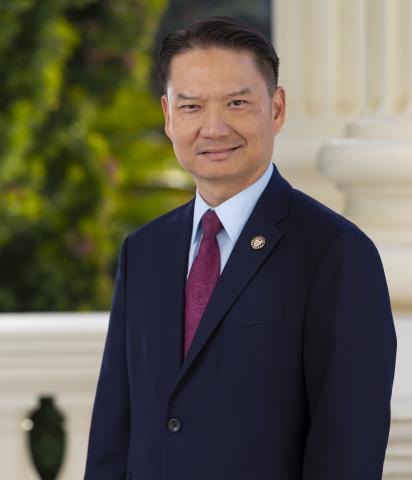
Asm. Tri Ta
Sponsored bills
Existing law authorizes the Department of Motor Vehicles to impose a registration fee for vehicles registered for use in California. Existing law imposes penalties for the failure of a person to pay the registration fee. Existing law permits the department to suspend, cancel, or revoke the registration of a vehicle when the department determines that the required fee has not been paid. Existing law requires, prior to the expiration of the registration of a vehicle, if that registration is not to be renewed prior to its expiration, the owner of the vehicle to file a specified certification that the vehicle will not be operated, moved, or left standing upon a highway without first making an application for registration of the vehicle, including full payment of all fees, except as specified. Existing law authorizes certifications to be filed after the expiration of the registration, but not later than 90 days after the expiration date, subject to the payment of specified filing fees and delinquency penalties. This bill would, notwithstanding any law, prohibit a person who is subject to these delinquency penalties and has been determined to have a current income level that meets the eligibility requirements for specified public social services programs, including, among others, the California Work Opportunity and Responsibility to Kids (CalWORKs) program, from being required to pay the delinquency penalty in order to renew the registration of their vehicle. The bill would instead authorize the person to delay payment of their penalty until after the vehicle is registered, but by no later than the expiration date of the vehicle's registration. If the delayed penalty payment is not received by the expiration date of the vehicle's registration, the bill would prohibit the person from renewing their registration the following year until the penalty is paid.
Existing law defines "disabled veteran" for purposes of the Vehicle Code as, among other things, a person who, as a result of injury or disease suffered while on active service with the Armed Forces of the United States, has a disability that has been rated at 100% by the Department of Veterans Affairs. Existing law also defines a "disabled veteran" as a veteran who is unable to move without the aid of an assistant device. This bill would instead define a disabled veteran as a veteran who cannot walk without the use of an assistant device. The bill would expand the definition of "disabled veteran" to include a veteran who cannot walk 200 feet without stopping to rest, a veteran who is severely limited in the ability to walk because of an arthritic, neurological, or orthopedic condition, or a veteran who has visual acuity of 20/200 or less, among other conditions, as specified.
Existing law makes it a misdemeanor to report an emergency to specified government entities knowing that report to be false. Existing law makes it a misdemeanor to initiate communication with the 911 emergency system with the intent to annoy or harass another person. This bill would make a second or subsequent violation of these provisions punishable as a misdemeanor or felony for a person who is 18 years of age or older. By increasing the penalty for existing crimes, this bill would impose a state-mandated local program. The California Constitution requires the state to reimburse local agencies and school districts for certain costs mandated by the state. Statutory provisions establish procedures for making that reimbursement. This bill would provide that no reimbursement is required by this act for a specified reason.
Existing law makes theft a crime, and distinguishes between grand theft and petty theft. Existing law makes the theft of money, labor, or property petty theft punishable as a misdemeanor, whenever the value of the property taken does not exceed $950. Under existing law, if the value of the property taken exceeds $950, the theft is grand theft, punishable as a misdemeanor or a felony. Existing law makes a first conviction for petty theft involving merchandise taken from a merchant's premises punishable by a mandatory fine and as a misdemeanor. This bill would require the Department of Justice to determine the number of misdemeanor convictions for a crime of theft for which the property was taken from a retail establishment during the Governor's declared state of emergency related to the COVID-19 pandemic, and to report that information to the Legislature on or before January 1, 2026.
Maddy summaryThis bill designates October 2024 as Menopause Awareness Month in California to highlight the health and societal impacts of menopause on women. It acknowledges that millions of women face symptoms that can affect their daily lives and work, noting that women of color are at higher risk for complications like premature menopause and heart disease. The resolution encourages the state to provide better health information and services to support women's well-being before, during, and after this transition. While the text outlines these goals, the bill itself is a formal recognition rather than a law that creates new funding or mandates specific programs.
The Personal Income Tax Law and the Corporation Tax Law allow various credits against the taxes imposed by those laws. This bill, for taxable years beginning on or after January 1, 2025, and before January 1, 2030, would allow a credit against those taxes to a qualified taxpayer in an amount equal to 40% of the qualified wages paid or incurred to a qualified employee employed during the taxable year. The bill would define a qualified employee for this purpose to mean an individual that, among other things, has been convicted of a felony, as provided, and has a hiring date not more than one year after the date the individual was convicted or was released from prison. Existing law requires any bill authorizing a new tax expenditure to contain, among other things, specific goals that the tax expenditure will achieve, detailed performance indicators, and data collection requirements. This bill would include additional information required for any bill authorizing a new income tax expenditure. This bill would take effect immediately as a tax levy.
Existing law requires, upon the immediate approach of an authorized emergency vehicle that is sounding a siren and has a lighted lamp exhibiting red light, that a driver of a vehicle yield the right-of-way to the emergency vehicle, that the operator of a street car immediately stop the street car, and that all pedestrians proceed to the nearest curb or place of safety and remain there until the authorized emergency vehicle has passed. Existing law makes a violation of that provision an infraction, punishable by specified fines. This bill would prohibit a person driving a vehicle upon a highway or a pedestrian from willfully obstructing a highway, including in the course of a protest, in any manner that interferes with the ability of an authorized emergency vehicle to pass and would make a violation of this provision punishable by specified fines. By creating a new crime, this bill would impose a state-mandated local program. The California Constitution requires the state to reimburse local agencies and school districts for certain costs mandated by the state. Statutory provisions establish procedures for making that reimbursement. This bill would provide that no reimbursement is required by this act for a specified reason.
This measure would proclaim the week of April 14, 2024 to April 20, 2024, to be Cities Week, and would encourage all Californians to be involved in their communities and be civically engaged with their local government.
This measure would join Asian and Pacific Islander communities throughout the state, nation, and world in celebrating April 13, 2024, to April 15, 2024, as the Songkran New Year Festival.