

Existing law, the Knox-Keene Health Care Service Plan Act of 1975, provides for the licensure and regulation of health care service plans by the Department of Managed Health Care. Existing law provides for the regulation of health insurers by the Department of Insurance. Existing law requires a health care service plan contract or health insurance policy to provide coverage for behavioral health treatment provided for pervasive developmental disorder or autism and requires a plan or policy to maintain an adequate network of qualified autism service providers. Under existing law, a "qualified autism service provider" means, among other things, a person who is certified by a national entity, such as the Behavior Analyst Certification Board, with a certification that is accredited by the National Commission for Certifying Agencies. This bill would clarify that the Qualified Applied Behavior Analysis Credentialing Board is also a national entity that may certify a qualified autism service provider, and would authorize the certification to be accredited by another national accrediting entity approved by the Secretary of California Health and Human Services.
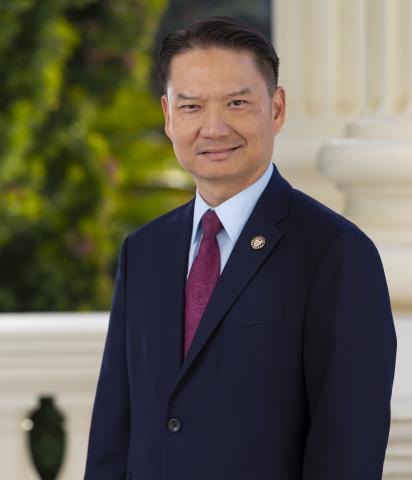
Asm. Tri Ta
Sponsored bills
Existing law, the Cal Grant Program, establishes the Cal Grant A Entitlement Awards, the Cal Grant B Entitlement Awards, the California Community College Expanded Entitlement Awards, the California Community College Transfer Entitlement Awards, the Competitive Cal Grant A and B Awards, the Cal Grant C Awards, and the Cal Grant T Awards under the administration of the Student Aid Commission. Existing law, the Cal Grant Reform Act revises and recasts the provisions establishing and governing the existing Cal Grant Program into a new Cal Grant Program. Existing law specifies that the act becomes operative only if General Fund moneys over the multiyear forecasts beginning in the 2024–25 fiscal year are available to support ongoing augmentations and actions, and if funding is provided in the annual Budget Act to implement the act. Under either Cal Grant Program that is operative, existing law establishes eligibility requirements for awards under the program for participating students attending qualifying institutions, including, among others, California residency requirements, as provided. Existing law establishes the Middle Class Scholarship Program (MCSP) under the administration of the commission. Existing law makes an undergraduate student eligible for a scholarship award under the MCSP if the student is enrolled at the University of California or the California State University, or enrolled in upper division coursework in a community college baccalaureate program, and meets certain eligibility requirements, including, among others, that the applicant meets the eligibility requirements for a Cal Grant. This bill would extend Cal Grant and MCSP eligibility to a student who was not a resident of California at the time of high school graduation or its equivalent but meets all other applicable eligibility requirements and is a dependent natural or adopted child, stepchild, or spouse of a member of the Armed Forces of the United States stationed outside of California on active duty, if the member of the Armed Forces of the United States otherwise maintains California as their state of legal residence. The bill also would make conforming changes.
The Personal Income Tax Law imposes a tax on individual taxpayers measured by the taxpayer's taxable income for the taxable year, but excludes certain items of income from the computation of tax, including an exclusion for combat-related special compensation. This bill, for taxable years beginning on or after January 1, 2024, and before January 1, 2034, would exclude from gross income retirement pay received by a taxpayer from the federal government for service performed in the uniformed services, as defined, during the taxable year. The bill, for taxable years beginning on or after January 1, 2024, and before January 1, 2034, would also exclude from gross income annuity payments received by a qualified taxpayer, as defined, pursuant to a United States Department of Defense Survivor Benefit Plan during the taxable year. The bill would make related findings and declarations. Existing law requires any bill authorizing a new tax expenditure to contain, among other things, specific goals, purposes, and objectives that the tax expenditure will achieve, detailed performance indicators, and data collection requirements. This bill also would include additional information required for any bill authorizing a new tax expenditure. The bill would require the Franchise Tax Board and the Department of Veterans Affairs to provide any data requested by the Legislative Analyst to write the report, as provided, and would make taxpayer information received by the Legislative Analyst subject to limitation on the collection and use of that information. By expanding the scope of a crime, this bill would impose a state-mandated local program. The California Constitution requires the state to reimburse local agencies and school districts for certain costs mandated by the state. Statutory provisions establish procedures for making that reimbursement. This bill would provide that no reimbursement is required by this act for a specified reason. This bill would take effect immediately as a tax levy.
Existing law defines certain acts as disorderly conduct, punishable as a misdemeanor. Under existing law, it is disorderly conduct to intentionally distribute or cause to be distributed the image of the intimate body part or parts of another identifiable person, or an image of the person depicted engaged in an act of sexual intercourse, sodomy, oral copulation, sexual penetration, or an image of masturbation by the person depicted or in which the person depicted participates, under circumstances in which the persons agree or understand that the image shall remain private, the person distributing the image knows or should know that distribution of the image will cause serious emotional distress, and the person depicted suffers that distress. This bill would make it a crime for a person who is 18 years of age or older to intentionally create and distribute a deepfake of an intimate body part or parts of another identifiable person, or a deepfake of the person depicted engaged in an act of sexual intercourse, sodomy, oral copulation, sexual penetration, or a deepfake of masturbation by the person depicted or in which the person depicted participates, if the person creating and distributing the deepfake knows or should know that the person depicted did not consent to the distribution and that the distribution of the deepfake will cause serious emotional distress, and the person depicted suffers that distress. The bill would define a deepfake as any audio or visual media, including, but not limited to, any image, motion picture film, or video recording, that is created or altered in a manner that it would falsely appear to a reasonable observer to be an authentic record of the actual speech or conduct of the individual depicted in the recording. By expanding the scope of a crime, this bill would impose a state-mandated local program. The California Constitution requires the state to reimburse local agencies and school districts for certain costs mandated by the state. Statutory provisions establish procedures for making that reimbursement. This bill would provide that no reimbursement is required by this act for a specified reason.
Existing law requires the Department of Food and Agriculture, headed by the Secretary of Food and Agriculture, to promote and protect the agricultural industry of the state. Existing law authorizes the department to expend in accordance with law all money that is made available for its use. This bill would find and declare that it is a primary goal of the state to prevent the introduction, and suppress the spread, of invasive species within its borders. The bill would require, in carrying out this goal, the department, in collaboration with relevant state agencies and stakeholders, to develop and implement strategies to detect, control, monitor, and eradicate invasive species to protect the state's agriculture, environment, and natural resources. The bill would require the department, in consultation with other relevant state agencies, to allocate funds, if available, to implement and enforce these provisions.
Maddy summaryThis California House Resolution condemns the July 13, 2024, assassination attempt on former President Donald J. Trump and calls for an end to political violence. The measure highlights the event where Trump was wounded while speaking at a rally in Butler, Pennsylvania, and notes that one attendee died and others were injured while trying to protect him. It urges the state to foster a political environment based on respectful discourse and nonviolence. The resolution is a formal statement of the Assembly's stance and does not create new laws or change existing policies.
Maddy summaryThis bill establishes Filipino American History Month to recognize the long-standing contributions of Filipinos to California and the United States. It directly affects state officials and the public by designating a specific month for commemoration and education. The resolution highlights historical milestones, including early Spanish-era interactions, the development of Filipino communities in cities like Stockton and San Francisco, and the significant roles Filipinos played in agriculture, shipbuilding, and military service during World War II. By formally acknowledging these events, the bill aims to promote awareness of Filipino American heritage within the state.
Maddy summaryThis bill designates November 22, 2024, as Kimchee Day in California to honor the traditional Korean dish and its cultural significance. It acknowledges the long history of kimchee, the contributions of Korean Americans, and the dish's recognized health benefits and growing popularity in the United States. The resolution directs the Assembly's Chief Clerk to send copies of the document to the author for distribution.
Maddy summaryThis bill is a House Resolution that formally recognizes Diwali as a significant cultural and religious holiday for Indian Americans and South Asian Americans in California. It acknowledges the festival's importance to Hindus, Sikhs, Buddhists, and Jains by highlighting its historical roots and the specific meanings it holds for each group. The resolution expresses the Assembly's respect for these communities and encourages Californians to participate in the celebration of lights on November 1, 2024. As a commemorative measure, the bill does not alter laws or funding but serves to officially honor the occasion within the state legislature.
Maddy summaryThis bill designates the week of June 3, 2024, as Sacramento Valley Ecosystem Awareness Week to highlight the region's unique natural and agricultural resources. The measure acknowledges the area's importance for migratory birds, endangered fish species, and rice farming while promoting efforts to restore local ecosystems. It expresses legislative support for the Floodplain Forward Coalition, a group working to improve water management and environmental health in the valley. The resolution serves as a formal recognition of these ecological values rather than creating new laws or funding.