

Existing law, the Knox-Keene Health Care Service Plan Act of 1975, provides for the licensure and regulation of health care service plans by the Department of Managed Health Care, and makes a willful violation of the act a crime. Existing law provides for the regulation of health insurers by the Department of Insurance. Existing law requires a health care service plan contract or health insurance policy to provide coverage for behavioral health treatment for pervasive developmental disorder or autism. This bill would prohibit a health care service plan contract or health insurance policy issued, amended, or renewed on or after January 1, 2025, from requiring an enrollee or insured previously diagnosed with pervasive developmental disorder or autism to be reevaluated or receive a new behavioral diagnosis to maintain coverage for behavioral health treatment for their condition. The bill would require a treatment plan to be made available to the plan or insurer upon request. Because a willful violation of this provision by a health care service plan would be a crime, the bill would impose a state-mandated local program. The California Constitution requires the state to reimburse local agencies and school districts for certain costs mandated by the state. Statutory provisions establish procedures for making that reimbursement. This bill would provide that no reimbursement is required by this act for a specified reason.
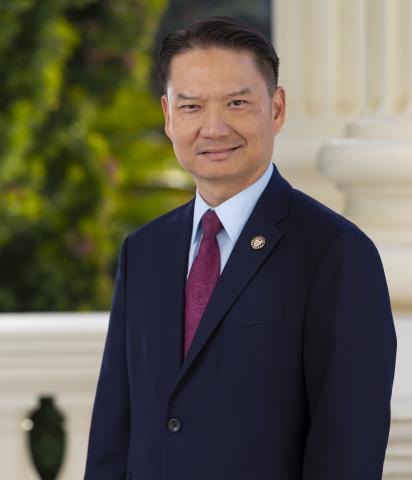
Asm. Tri Ta
Sponsored bills
Existing law, the Davis-Stirling Common Interest Development Act, defines and regulates common interest developments, including member elections. Existing law prescribes that a quorum is required only if stated in the governing documents or by law. In the absence of a quorum, existing law authorizes an association to adjourn the proceeding to a date at least 20 days after the adjourned proceeding, at which time the quorum required for purposes of a membership meeting is 20% of the voting members present in person, by proxy, or by secret written ballot received. Existing law requires an association to provide general notice of the membership meeting, as specified, no less than 15 days prior to the election of directors. In the absence of a quorum, this bill would instead authorize an association to adjourn the meeting to a date at least 20 days after the adjourned meeting, at which time the quorum required for purposes of a reconvened meeting would be 20% of the members, voting in person, by proxy, or by secret ballot. The bill would require an association to provide general notice of the reconvened meeting, as specified, no later than 15 days prior to the date of the reconvened meeting. Under existing law, for elections of directors and for recall elections, an association is required to provide general notice of specified information about the election at least 30 days before the ballots are distributed, including a statement that the board of directors may call a subsequent meeting at least 20 days after a scheduled election if the quorum is not reached, as specified. This bill would instead require an association whose governing documents require a quorum for election of directors to provide general notice of a statement that the association may call a reconvened meeting to be held at least 20 days after a scheduled election if the quorum is not reached, as specified. Existing law authorizes and regulates the formation and operation of various corporations, including a nonprofit mutual benefit corporation. Existing law sets forth the parameters of a quorum at a meeting of members, as specified. For a corporation that is a common interest development, existing law imposes notice requirements for special meetings. In the absence of a quorum, existing law authorizes a corporation that is a common interest development to adjourn a membership proceeding to a date at least 20 days after the adjourned proceeding, at which time the quorum required for purposes of a membership meeting is 20% of the voting members present in person, by proxy, or by secret written ballot received. In the absence of a quorum, this bill would instead authorize the corporation that is a common interest development to adjourn a meeting to a date at least 20 days after the adjourned meeting, at which time the quorum required for purposes of a reconvened meeting would be 20% of the members, voting in person, by proxy, or by secret ballot. This bill would incorporate additional changes to Section 5115 of the Civil Code proposed by AB 2159 to be operative only if this bill and AB 2159 are enacted and this bill is enacted last.
The Alcoholic Beverage Control Act provides for the issuance of various categories of alcoholic beverage licenses, including the imposition of fees, conditions, and restrictions in connection with the issuance of those licenses. The act provides that any on-sale licensee authorized to sell wine may also sell soju, an imported Korean alcoholic beverage, as specified, and shochu, an imported Japanese alcoholic beverage, as specified. This bill would provide that any on-sale licensee authorized to sell wine may also sell domestically produced soju and shochu, as specified.
Existing law establishes the Office of Vital Records within the State Department of Public Health. Existing law prescribes the duties of the State Registrar of Vital Statistics (State Registrar) and local registrars of births and deaths with respect to the registration of certificates of live birth, fetal death, or death, and marriage licenses. Existing law prescribes the information to be listed on a certificate of live birth. Existing law requires the State Registrar, upon request and payment of a fee, as specified, to provide an applicant a decorative heirloom certificate of any birth registered to that official, containing only identification information and the seal of the State of California and a facsimile of the State Registrar's signature. This bill would require the State Registrar to, upon request and payment of a fee, provide an applicant a decorative Asian Zodiac heirloom certificate, as specified. The bill would require the decorative Asian Zodiac heirloom certificate to be of a distinctive design as determined by the department to include Asian Zodiac artwork by local artists, the seal of the State of California, and a facsimile of the State Registrar's signature. The bill would require the certificate to contain only identification information, as determined by the State Registrar. The bill would require the department to set the fee for the decorative Asian Zodiac heirloom certificate to capture the reasonable costs of developing, preparing, and providing the decorative Asian Zodiac heirloom certificate. The bill would require the moneys collected by the State Registrar to be deposited with the Treasurer for credit to the Health Statistics Special Fund. The bill would specify that, upon appropriation, the moneys in the fund may be used by the department for the administrative costs of developing, preparing, and providing the decorative Asian Zodiac heirloom certificate, including payment of local artists.
Existing law provides for the licensure and regulation by the State Department of Public Health of health facilities, as defined. Existing law requires a health facility to allow a patient's domestic partner, the children of the patient's domestic partner, and the domestic partner of the patient's parent or child to visit unless no visitors are allowed, the facility reasonably determines that the presence of a particular visitor would endanger the health or safety of a patient, member of the health facility staff, or other visitor to the health facility, or would significantly disrupt the operations of a facility, or the patient has indicated to the health facility staff that the patient does not want this person to visit. A violation of this provision is a misdemeanor. This bill, Dianne's Law, would require a health facility to allow specified persons to visit, including the patient's children and grandparents. The bill would require the health facility to develop alternate visitation protocols, if circumstances require the health facility to restrict visitor access to the facility due to health or safety concerns, that allow visitation to the greatest extent possible while maintaining patient, visitor, and staff health and safety. Notwithstanding the requirement mentioned above, the bill would prohibit a health facility from prohibiting in-person visitation in end-of-life situations unless the patient has indicated to the health facility staff that the patient does not want this person to visit, as specified, and would authorize a health facility to require visitors to adhere to personal protective equipment and testing protocols not greater than those required of facility staff for the duration of their visit. The bill would also require the facility to provide personal protective equipment and testing resources to each visitor for a patient in an end-of-life situation, to the extent that those resources have been made readily available to the facility by state or local entities for that purpose. By expanding an existing crime, the bill would impose a state-mandated local program. The California Constitution requires the state to reimburse local agencies and school districts for certain costs mandated by the state. Statutory provisions establish procedures for making that reimbursement. This bill would provide that no reimbursement is required by this act for a specified reason.
Existing law requires the State Board of Education to adopt at least 5 basic instructional materials in specified subject areas, including, among others, social science, for use in kindergarten and grades 1 to 8, inclusive, as specified. Existing law establishes the Instructional Quality Commission, as specified, and requires the commission to, among other things, develop criteria for evaluating instructional materials. This bill would require the commission, when the state board adopts new instructional materials for history-social science on or after January 1, 2025, to consider providing for inclusion, in its evaluation criteria, content on the case of Mendez v. Westminster School District of Orange County. This bill would incorporate additional changes to Section 51226.3 of the Education Code proposed by AB 1821 to be operative only if this bill and AB 1821 are enacted and this bill is enacted last.
This measure would, among other things, urge the United States Congress and President Joseph R. Biden to fully fund the United States Environmental Protection Agency's Comprehensive Infrastructure Solution for the Tijuana River due to the ongoing impacts to public health, the environment, and the local economy caused by cross-border pollution and would urge President Joseph R. Biden to declare a national emergency due to those ongoing impacts.
Maddy summaryAssembly Concurrent Resolution 120 designates January 2024 as Positive Parenting Awareness Month in California. This measure does not change laws or allocate funding but instead encourages state agencies, communities, and organizations to focus on the importance of positive parenting strategies. The resolution highlights how supportive family environments can improve children's health and well-being while acknowledging the diverse forms families take in the state. It serves as a formal acknowledgment of existing programs and resources rather than creating new mandates or policies.
This measure would proclaim September 20, 2024, and September 20 of each year thereafter, as California Youth Climate Action Day to honor and support the efforts of young people in their pursuit of environmental sustainability, climate justice, and the preservation of biodiversity.
This measure would urge the federal government to allow vehicles registered to disabled veterans to utilize high-occupancy vehicle lanes or carpool lanes pursuant to the federal government's Clean Air Act program authority.