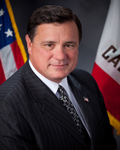
Photo of Donald Wagner
R California Assembly · District 68

Asm. Donald Wagner

Compare
Total votes
18,509
all sessions
Attendance
98%
238 missed
Near the chamber average
With party
98%
of cast votes
Lower than 90% of chamber peers
Bipartisan score
1%
crosses aisle rarely
Higher than 86% of chamber peers
Sponsored
763
bills & resolutions
Near the chamber average
Committees
0
assignments
763 bills and resolutions

Sponsored bills

Total
763
Primary
105
Co-sponsor
658
This page
763
matching current filters
Primary AB 2645
In committee · California Assembly · Lead sponsor
Attorneys: rules of professional conduct.

Existing law, the State Bar Act, provides for the licensure and regulation of attorneys by the State Bar of California. The State Bar is governed by the board of trustees of the State Bar. Under existing law, rules of professional conduct adopted by the board of trustees are binding upon all members of the State Bar and the board has power to discipline members for a willful breach of those rules. This bill would make a technical, nonsubstantive change to that provision.

In committee Feb 27, 2012 0 co-sponsors
Primary AB 2532
In committee · California Assembly · Lead sponsor
Mortgages and deeds of trust: foreclosure.

Existing law regulates the terms and conditions of mortgages and deeds of trust secured by real property. Existing law provides that a mortgagee, trustee, beneficiary, or authorized agent may not file a notice of default until 30 days after initial contact with the borrower is made, as specified, or 30 days after satisfying specified due diligence requirements. This bill would make a nonsubstantive change to these provisions.

In committee Feb 27, 2012 0 co-sponsors
Primary AB 2158
In committee · California Assembly · Lead sponsor
Sentencing: enhancements.

Existing law requires that when any person takes, damages, or destroys any property in the commission or attempted commission of a felony, with the intent to cause that taking, damage, or destruction, the court shall impose an additional term of imprisonment based on the amount of the loss. This bill would make technical, nonsubstantive changes to those provisions.

In committee Feb 24, 2012 0 co-sponsors
Co-sponsor ACA 22
In committee · California Assembly · Co-sponsor
A resolution to propose to the people of the State of California an amendment to the Constitution of the State, by adding Section 12 to Article VII thereof, and by amending subdivision (f) of Section 17 of Article XVI thereof, relating to public employees' retirement.

(1) Existing law establishes various public agency retirement systems, including the Public Employees' Retirement System (PERS) , the State Teachers' Retirement System (STRS) , the Judges' Retirement System II, and various county retirement systems pursuant to the County Employees Retirement Law of 1937, among others, and these systems provide defined pension benefits to public employees based on age, service credit, and amount of final compensation. The California Constitution permits a city or county to adopt a charter for purposes of its governance that supersedes general laws of the state in regard to specified subjects, including compensation of city or county employees. The California Constitution also establishes the University of California as a public trust with full powers of organization and government, subject only to specified limitations. Charter cities and the University of California may establish pension plans under their respective independent constitutional authority. These pension systems are funded by employee and employer contributions and investment returns. Existing law provides that public employee pension benefits are a form of deferred compensation, the right to which vests in the employee on contractual principles and is protected from impairment by the California Constitution and the United States Constitution. This measure would require each public retirement system, as defined in statute, to provide one or more hybrid pension plans meeting the requirements of this measure to each public employer that provides its employees a defined benefit pension plan administered by the public retirement system. The measure would require that a hybrid pension plan consist of a defined benefit component and a defined contribution or alternative plan design component, as specified. The measure would require, among other things, that a hybrid pension plan be designed with a goal of providing annually during retirement, based on a full career in public service, as defined, replacement income of 75% of a public employee's final compensation. The measure would require the Director of Finance, on or before January 1, 2013, to establish initial criteria and requirements for one or more hybrid pension plans, as specified. The measure would require, on and after July 1, 2013, each public retirement system to administer, and make available to each public employer that provides a defined benefit pension plan, one or more hybrid pension plans, except as specified, for public employees hired in each member classification in the public retirement system. The measure would require, for public employees hired on and after January 1, 2013, that retirement benefits be limited as provided, with regard to a defined benefit that is calculated with reference to final compensation, as specified, that final compensation be calculated using at least a consecutive 36-month period of service. The measure would establish various other limitations on the retirement benefits offered by public employers to public employees, regardless of the date the employees are hired, to the fullest extent permissible under the United States Constitution. In this regard, the measure would require that any change to a formula or benefit resulting in an increase in a member's pension benefits shall apply only to service performed on and after the operative date of the change and would require that employers and employees make required payments to fund the normal cost of benefits, as specified. The measure would require public employees to contribute at least 12 of the normal costs of any defined benefit plan and would prohibit an employer from paying an employee's required contributions, except as specified. The measure would also prohibit retirement systems from granting any nonqualified service credit, as specified. The measure additionally would require that a public employee, who is convicted of any felony arising from his or her official duties, forfeit retirement benefits based on certain statutes. The measure would limit the amount of service that a retired public employee may perform for public employers. The measure would provide that neither its provisions nor any related statutory provisions apply to, or otherwise restrict, death, survivor, and disability benefits, except as specified. The measure would provide that labor contracts that are in effect on November 7, 2012, and that are in conflict with the measure's provisions remain in effect until the expiration of the contract, at which time the requirements of the measure would apply. The measure would specify that terms used in those provisions are to be defined in a specified statute and would permit the Legislature to amend specified statutes referenced in the measure's provisions by a 23 vote of the membership of each house by a statute that is consistent with and furthers its purposes. The measure would provide that the activities, programs, and levels of service associated with its provisions are not state-mandated local programs requiring a subvention of funds. (2) The California Constitution prohibits the Legislature from changing the composition of the retirement board of a public pension or retirement system that included elected employee members as of a specified date, including the number, terms, and method of selection and removal of members, unless the change is ratified by a majority vote of the electors of the jurisdiction in which the participants of the system are, or were, prior to retirement, employed. This measure would require the composition of the retirement board of a public pension or retirement system to be modified, in the manner provided for in a specified statute, and would exempt that modification from ratification by the electors. (3) The measure would require the state to defend the constitutionality of its provisions.


In committee Feb 23, 2012 1 co-sponsor
Co-sponsor ACR 92
Passed · California Assembly · Co-sponsor
Relative to human trafficking.

This resolution would recognize the month of January 2012, and each following January, as National Slavery and Human Trafficking Prevention Month, and it would recognize February 1, 2012, and each following February 1, as California's Free From Slavery Day.

Passed Feb 7, 2012 1 co-sponsor
Primary AB 435
Failed · California Assembly · Lead sponsor
Elections: candidate's statement: nonpartisan office.

Existing law permits each candidate for a nonpartisan elective office in a local government agency to prepare a candidate's statement for publication in the voter's pamphlet sent to voters prior to the election. Existing law requires that the candidate's statement be limited to a recitation of the candidate's own personal background and qualifications and not make reference to other candidates for that office or to another candidate's qualifications, character, or activities. This bill would further prohibit the statement of a candidate for a nonpartisan local office from containing a pledge, promise, or commitment with respect to a matter that could come before the candidate in the office to which he or she is seeking election. In addition, the bill would require that the statement of the candidate's personal background and qualifications be limited to objective, verifiable facts concerning the candidate's experiences, accomplishments, and credentials and not include references to the candidate's beliefs, ideas, ideology, viewpoints, or campaign platform. The bill would also require that each voter's pamphlet contain a notice informing the voter that each candidate's statement has been prepared solely by, and contains the representations solely of, that candidate and has not been independently verified by the elections official or any other government official or agency. The California Constitution requires the state to reimburse local agencies and school districts for certain costs mandated by the state. Statutory provisions establish procedures for making that reimbursement. This bill would provide that, if the Commission on State Mandates determines that the bill contains costs mandated by the state, reimbursement for those costs shall be made pursuant to these statutory provisions.

Failed Feb 1, 2012 0 co-sponsors
Primary AB 993
Failed · California Assembly · Lead sponsor
Mediation and counseling services: discipline and immunity.

Existing law requires a court to set a case for mediation when child custody or visitation is at issue and authorizes a court to require parents, or other parties involved in a child custody or visitation dispute, to participate in outpatient counseling with a licensed mental health professional when it would be in the best interest of the child, as specified. This bill would specify that a mediator and a licensed mental health professional are not liable for damages for an act or omission constituting ordinary negligence that occurs on or after January 1, 2012, during the performance of the above-described mediation and counseling services. The bill would prohibit a person from making a complaint to the board that issued a license to practice to the mediator or licensed mental health professional regarding the provision of those services and would, instead, require that the complaint be made to the court that set the matter for mediation or that required outpatient counseling. The bill would require the court to refer the matter to the licensing board for disciplinary action if it found unprofessional conduct on the part of the mediator or licensed mental health professional.

Failed Feb 1, 2012 0 co-sponsors
Primary AB 393
died · California Assembly · Lead sponsor
Administrative Procedure Act: legislative intent.

Existing law, the Administrative Procedure Act, governs the procedure for the adoption, amendment, or repeal of regulations by state agencies and for the review of those regulatory actions by the Office of Administrative Law. Existing law declares the intent of the Legislature in establishing the office. This bill would make a technical, nonsubstantive change to these provisions.

died Feb 1, 2012 0 co-sponsors
Showing 661 to 670 of 763 bills
Previous 1 … 66 67 68 … 77 Next