

Passed Mar 1, 2016
1 co-sponsor
Total votes
18,509
all sessions
Attendance
98%
238 missed
Near the chamber average
With party
98%
of cast votes
Lower than 90% of chamber peers
Bipartisan score
1%
crosses aisle rarely
Higher than 86% of chamber peers
Sponsored
763
bills & resolutions
Near the chamber average
Committees
0
assignments
763 bills and resolutions
Sponsored bills
Total
763
Primary
105
Co-sponsor
658
This page
763
matching current filters
Passed Feb 29, 2016
1 co-sponsor
Motor Vehicle Fuel Tax Law.
The Motor Vehicle Fuel Tax Law imposes a tax on each gallon of motor vehicle fuel removed from a refinery or terminal rack in this state, entered into this state, or sold in this state. This bill would state the intent of the Legislature to enact legislation to reduce the amount of that tax.
In committee Feb 19, 2016
0 co-sponsors
Relative to Pet Care Education Month.
This measure would declare the month of January 2016 as Pet Care Education Month and would request Californians to observe the month by ensuring that their companion animals receive the proper preventative care by establishing a financial plan for pet health emergencies and by contributing to charitable organizations that provide low-cost spay and neuter services and vaccinations or funds to help low-income individuals pay for veterinary care.
Signed into law Feb 10, 2016
1 co-sponsor
Trial court funding.
Existing law establishes the Trial Court Trust Fund, the proceeds of which are required to be apportioned for authorized purposes, including apportionment to the trial courts to fund trial court operations. Existing law, for the purpose of funding trial court operations, authorizes the Judicial Council to establish bank accounts for the superior courts, into which are deposited all moneys appropriated in the Budget Act and allocated or reallocated to each court by the Judicial Council, moneys held in trust, and other moneys as deemed necessary or appropriate. "Court operations" is defined for these purposes. This bill would make technical, nonsubstantive changes to the provision defining court operations.
In committee Feb 2, 2016
0 co-sponsors
Appeals.
Existing law specifies the judgments and orders from which an appeal may be taken to the court of appeal. This bill would make a technical, nonsubstantive change to this provision.
died Feb 1, 2016
0 co-sponsors
Water quality: recycled water: storm-induced overflow.
Under existing law, the State Water Resources Control Board and the California regional water quality control boards prescribe waste discharge requirements in accordance with the federal Clean Water Act and the Porter-Cologne Water Quality Control Act. Existing law requires any person who causes or permits an unauthorized discharge of a specified amount of recycled water in any waters of the state or where the recycled water is, or probably will be, discharged in or on any waters of the state, to notify the appropriate regional board, as prescribed. This bill, on or before December 31, 2016, would require the state board, in consultation with stakeholders, to adopt a policy to address the potential for a storm-induced overflow from an impoundment in which recycled water is stored for subsequent beneficial use or aesthetic purposes.
Failed Feb 1, 2016
0 co-sponsors
Tax administration: refunds: property tax: state assessment: actions.
(1) The Franchise Tax Board administers the Personal Income Tax Law and the Corporation Tax Law and the State Board of Equalization administers the Sales and Use Tax Law and various other tax and fee laws. Counties, cities, and districts, as specified, are authorized to impose local sales or transactions and use taxes in conformity with the Sales and Use Tax Law. Amendments to the Sales and Use Tax Law are automatically incorporated into the local laws. Those laws generally require a claim for refund to be filed within specified timeframes based on the date of overpayment or specified board action if any amount has been overpaid, as specified. Under those laws, the rule of res judicata, which provides that a matter that has been adjudicated by a court of competent jurisdiction may not be pursued further by the same parties is applicable only if the liability involved is for the same reporting period as was involved in the case previously determined. This bill would, notwithstanding existing law regarding the rule of res judicata, where a tax, fee, assessment, surcharge, or other amount levied or collected by the tax agency, which this bill would define to include the board and the Franchise Tax Board, has been determined to have been illegally levied or collected in a final and nonappealable decision of a court of competent jurisdiction, authorize any person who paid that tax, fee, assessment, surcharge, or other amount to file with the tax agency a claim for refund, within one year after the date of the final and nonappealable decision and would require the tax agency to refund the amount so paid. This bill would also require the tax agency to refund these amounts without the person filing a claim for refund when information in the tax agencies' records is sufficient to identify the person. This bill would, upon appropriation by the Legislature, allocate the amounts necessary to make these refunds to the applicable tax agency. (2) Existing law requires an action to recover property taxes levied on state-assessed property arising out of a dispute as to an assessment to be commenced only after payment of the taxes in issue and within 4 years after the latest of the dates that the State Board of Equalization mailed its decision or its written findings and conclusions, as provided. This bill would instead require, where the tax assessed or allocated has been determined to have been illegally assessed or allocated in a final and nonappealable decision of a court of competent jurisdiction, the action to commence no later than one year from the date the court rendered that decision. (3) This bill would make a legislative finding and declaration regarding the public purpose served by the bill.
Failed Feb 1, 2016
0 co-sponsors
Offender Global Positioning System Database.
Existing law requires sex offenders to wear global positioning system (GPS) devices while on parole, and requires some of those offenders to wear those devices for life. This bill would require the Department of Justice to establish an Offender Global Positioning System Database that would receive and store GPS device data for offenders monitored by criminal justice agencies throughout the state. The database would be required, among other capabilities, to receive specified data and to be able to send commands to a GPS device requiring the device to report data and to comply with other functional requirements. The department would be required to provide, at state expense, connections to the database to one sheriff's system and one probation department system in each county for purposes of submitting data to the database. By imposing additional duties on local law enforcement agencies in connection with the operation of the GPS database, this bill would impose a state-mandated local program. The California Constitution requires the state to reimburse local agencies and school districts for certain costs mandated by the state. Statutory provisions establish procedures for making that reimbursement. This bill would provide that, if the Commission on State Mandates determines that the bill contains costs mandated by the state, reimbursement for those costs shall be made pursuant to these statutory provisions.
Failed Feb 1, 2016
0 co-sponsors
California Global Warming Solutions Act of 2006: market-based compliance mechanisms: exemption.
The California Global Warming Solutions Act of 2006 designates the State Air Resources Board as the state agency charged with monitoring and regulating sources of emissions of greenhouse gases. The state board is required to adopt a statewide greenhouse gas emissions limit equivalent to the statewide greenhouse gas emissions level in 1990 to be achieved by 2020, and to adopt rules and regulations in an open public process to achieve the maximum, technologically feasible, and cost-effective greenhouse gas emissions reductions. The act authorizes the state board to include the use of market-based compliance mechanisms. Existing state board regulations require specified entities to comply with a market-based compliance mechanism beginning January 1, 2013, and require additional specified entities to comply with that market-based compliance mechanism beginning January 1, 2015. This bill instead would exempt categories of persons or entities that did not have a compliance obligation, as defined, under a market-based compliance mechanism beginning January 1, 2013, from being subject to that market-based compliance mechanism through December 31, 2020. This bill would declare that it is to take effect immediately as an urgency statute.
died Feb 1, 2016
1 co-sponsor
Ask Maddy
·
AI policy assistant
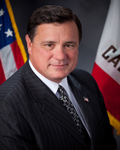
Ask Maddy about Donald Wagner
Scope: california
Hi! I can help you understand Donald Wagner's legislative record. What would you like to know?
Try one of these
i
Maddy answers using official bill text and legislative records. Always verify before sharing.
Sources cited inline