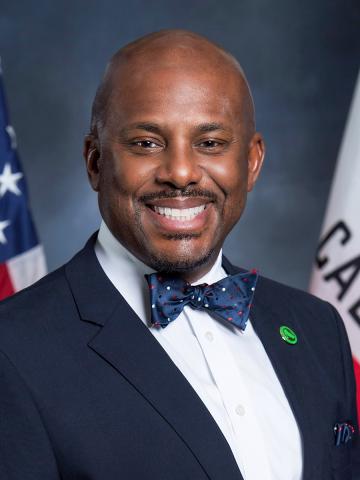
Photo of Mike Gipson
D California Assembly · District 65

Asm. Mike Gipson

Compare
Total votes
25,850
all sessions
Attendance
97%
707 missed
Near the chamber average
With party
99%
of cast votes
Near the chamber average
Bipartisan score
0%
crosses aisle rarely
Near the chamber average
Sponsored
2,631
bills & resolutions
Near the chamber average
Committees
7
assignments
2,631 bills and resolutions

Sponsored bills

Total
2,631
Primary
293
Co-sponsor
2,338
This page
2,631
matching current filters
Co-sponsor SCR 88
Signed into law · California Senate · Co-sponsor
Relative to Human Trafficking Awareness Month.

This measure would proclaim the month of January 2016 as Human Trafficking Awareness Month, encourage all Californians to become educated about human trafficking and work to eradicate these criminal practices within and beyond our borders, and encourage Members of the Legislature, as well as organizations, businesses, and individuals, to host or sponsor and attend community events in order to bring visibility and support to efforts made by nongovernmental organizations to recognize and combat human trafficking.

Signed into law Feb 1, 2016 1 co-sponsor
Co-sponsor AB 201
Failed · California Assembly · Co-sponsor
Registered sex offenders: local ordinances.

Existing law, the Sex Offender Registration Act, requires persons convicted of specified sex offenses to register with local authorities for life while residing, located, attending school, or working in California. Existing law, as adopted by the voters by the passage of Proposition 83 at the November 7, 2006, statewide general election, prohibits a person who is required to register as a sex offender from living in specified places, including within 2,000 feet of a school or park where children regularly gather. Existing law authorizes municipal jurisdictions to enact local ordinances that further restrict the residency of the registered sex offender. Existing law makes it a misdemeanor for a person who is on parole for specified sex offenses to enter any park where children regularly gather without express permission from the person's parole agent. This bill would state that a local agency is not preempted by state law from enacting and enforcing an ordinance that restricts a registered sex offender from residing or being present at certain locations within the local agency's jurisdiction. The bill would authorize a local agency to adopt ordinances, rules, or regulations that are more restrictive than state law relating to a registered sex offender's ability to reside or be present at certain locations within the local agency's jurisdiction.

Failed Feb 1, 2016 1 co-sponsor
Primary AB 986
Passed · California Assembly · Lead sponsor
Community Colleges: Compton Community College District: report.

Existing law establishes the California Community Colleges under the administration of the Board of Governors of the California Community Colleges. Existing law requires the board of governors to appoint a chief executive officer, known as the Chancellor of the California Community Colleges. Existing law provides for the establishment of community college districts throughout the state, including the Compton Community College District. Existing law authorizes these districts to provide instruction to students at the campuses operated by these districts. Existing law authorizes the board of governors to suspend the authority of the Board of Trustees of the Compton Community College District for a period lasting until June 30, 2011, plus a period lasting until the chancellor, the Fiscal Crisis and Management Assistance Team, the Director of Finance, and the Secretary for Education concur with the special trustee that the district, for 2 consecutive academic years, has met the requirements of the comprehensive assessment conducted, and the recovery plan prepared, pursuant to existing law. Existing law, in the event of a suspension, authorizes the chancellor to appoint a special trustee to manage the district, as specified. This bill would require the chancellor to report to the Legislature concerning the priorities identified in each Fiscal Crisis and Management Assistance Team report and to provide a response on how the chancellor intends to resolve the issues identified in the Fiscal Crisis and Management Assistance Team report in a timely manner. The bill would require the chancellor to submit the report to the Legislature within 150 days following the issuance of each Fiscal Crisis and Management Assistance Team report. In any instance that there is a decline in performance identified in a report, the chancellor would be required to also specifically identify strategies for ensuring progress in its response to that report.

Passed Jan 28, 2016 0 co-sponsors
Co-sponsor AB 88
Vetoed · California Assembly · Co-sponsor
Sales and use taxes: exemption: energy or water efficient home appliances.

(1) Existing sales and use tax laws impose a tax on retailers measured by the gross receipts from their sales of tangible personal property sold at retail in this state, or on the storage, use, or other consumption of tangible personal property purchased from a retailer for storage, use, or other consumption in this state, and specify certain exemptions from the amount of tax imposed. This bill, until January 1, 2021, would exempt from these taxes the gross receipts from the sale of, and the storage, use, or other consumption in this state of, an energy or water efficient home appliance purchased by a public utility that is provided at no cost to a low-income participant in a federal, state, or ratepayer-funded energy or water efficiency program for use by that low-income participant in the energy efficiency program. The bill would define terms for its purposes. (2) The Bradley-Burns Uniform Local Sales and Use Tax Law authorizes counties and cities to impose local sales and use taxes in conformity with the Sales and Use Tax Law, and existing law authorizes districts, as specified, to impose transactions and use taxes generally in accordance with the Transactions and Use Tax Law, which generally conforms to the Sales and Use Tax Law. Amendments to state sales and use taxes are incorporated into these laws. Section 2230 of the Revenue and Taxation Code provides that the state will reimburse counties and cities for revenue losses caused by the enactment of sales and use tax exemptions. This bill would provide that, notwithstanding Section 2230 of the Revenue and Taxation Code, no appropriation is made and the state shall not reimburse any local agencies for sales and use tax revenues lost by them pursuant to this bill. (3) This bill would take effect immediately as a tax levy, but its operative date would depend on its effective date.

Vetoed Jan 15, 2016 1 co-sponsor
Co-sponsor SB 63
Signed into law · California Senate · Co-sponsor
Seaport infrastructure financing districts.

Existing law authorizes the legislative body of a city or county to establish an enhanced infrastructure financing district, adopt an infrastructure financing plan, and issue bonds, for which only the district is liable, upon approval by 55% of the voters and to finance public capital facilities or other specified projects of communitywide significance, including, but not limited to, among other things, environmental mitigation, military base reuse, low-income housing, and specified housing and transit projects. Existing law authorizes an enhanced infrastructure financing district to fund infrastructure projects through tax increment financing, pursuant to the infrastructure financing plan and the agreement of affected taxing entities. This bill would additionally include port or harbor infrastructure, as defined, among the projects that may be financed by an enhanced infrastructure financing district. The bill would require a harbor agency to prepare an infrastructure financing plan for a seaport infrastructure financing district, defined as an enhanced infrastructure financing district that finances port or harbor infrastructure. The bill would increase the vote threshold for a seaport infrastructure financing district to issue bonds to 23 of the voters, and would provide that for purposes of these voters, a "landowner" includes an entity paying possessory interest tax on state-owned land. The bill would prescribe additional procedures and requirements for the establishment of a seaport infrastructure financing district, including approval by the harbor agency and the State Lands Commission before the proposal is submitted to the voters for approval. The bill would require the harbor agency to reimburse the commission, for its administrative costs of considering the proposal, from bond proceeds, if any. The bill would specify that the commission shall retain absolute discretion over the determination of whether or not investment of local resources in port or harbor infrastructure, the actions of a harbor agency, or any other action taken by a seaport infrastructure financing district is consistent with the state's interest in tidelands and submerged lands. The bill would exclude from its provisions the Stockton Port District and river port districts. This bill would incorporate additional changes in Sections 53398.52, 53398.62, and 53398.69 of the Government Code proposed by AB 313 that would become operative only if AB 313 and this bill are both chaptered and become effective on or before January 1, 2016, and this bill is chaptered last.


Signed into law Oct 11, 2015 1 co-sponsor
Co-sponsor AB 1391
Signed into law · California Assembly · Co-sponsor
Pupil instruction: adopted course of study: elementary school: physical education: complaints.

Existing law requires the adopted course of study for grades 1 to 6, inclusive, to include instruction in specified areas of study, including physical education, with emphasis upon the physical activities for the pupils that may be conducive to health and vigor of body and mind, for a total period of time of not less than 200 minutes each 10 schooldays, exclusive of recesses and the lunch period. Notwithstanding that provision, existing law provides that instruction in physical education in an elementary school maintaining any of grades 1 to 8, inclusive, shall be for a total period of time of not less than 200 minutes each 10 schooldays, exclusive of recesses and the lunch period. This bill would authorize a complaint that a school district or county superintendent of schools has not complied with the instructional minute requirements of the physical education adopted course of study for pupils in those grades to be filed with the school district or county superintendent of schools pursuant to the Uniform Complaint Procedures, as specified. To the extent this bill would impose additional duties on school district or county office of education officials, the bill would impose a state-mandated local program. The bill also would state the Legislature's finding and declaration that the provisions prescribing the requirements for the adopted course of study for grades 1 to 6, inclusive, and for instructional time for physical education in an elementary school maintaining any of grades 1 to 8, inclusive, were not intended to create a private right of action, but would provide that nothing in those provisions is to restrict or expand the existing right of any party to seek relief from noncompliance with them pursuant to a writ of mandate. The California Constitution requires the state to reimburse local agencies and school districts for certain costs mandated by the state. Statutory provisions establish procedures for making that reimbursement. This bill would provide that, if the Commission on State Mandates determines that the bill contains costs mandated by the state, reimbursement for those costs shall be made pursuant to these statutory provisions. This bill would declare that it is to take effect immediately as an urgency statute.

Signed into law Oct 9, 2015 1 co-sponsor
Primary AB 25
Signed into law · California Assembly · Lead sponsor
Financial aid: Cal Grant program: renewal.

The Cal Grant Program establishes the Cal Grant A and B Entitlement awards, the California Community College Transfer Entitlement awards, the Competitive Cal Grant A and B awards, the Cal Grant C awards, and the Cal Grant T awards under the administration of the Student Aid Commission, and establishes eligibility requirements for awards under these programs for participating students attending qualifying institutions. Existing law requires the commission to certify by November 1 of each year a qualifying institution's latest 3-year cohort default rate and graduation rate as most recently reported by the United States Department of Education. Existing law provides that an otherwise qualifying institution with a 3-year cohort default rate that is equal to or greater than 15.5% is ineligible for initial and renewal Cal Grant awards at the institution. Existing law provides that an otherwise qualifying institution is ineligible for an initial or renewal Cal Grant award at the institution if the institution has a graduation rate of 30% or less for students taking 150% or less of the expected time to complete degree requirements, as specified, with certain exceptions. This bill would require the commission to establish an appeal process for an otherwise qualifying institution that fails to satisfy the 3-year cohort default rate and graduation rate requirements and would authorize the commission to grant the appeal for an academic year only if the commission makes a specified determination.

Signed into law Oct 8, 2015 0 co-sponsors
Primary AB 1228
Signed into law · California Assembly · Lead sponsor
Public postsecondary education: campus housing: priority for homeless youth.

Existing law establishes the California Community Colleges, under the administration of the Board of Governors of the California Community Colleges, as one of the 3 segments of public postsecondary education in this state. Existing law establishes community college districts throughout the state, and authorizes them to provide instruction to students at community college campuses. Existing law establishes the California State University, under the administration of the Trustees of the California State University, and the University of California, under the administration of the Regents of the University of California, as the other 2 segments of public postsecondary education in this state. Existing law requests the regents and the trustees to explore methods of using the admissions-by-exemption category to assist the transition of students in foster care into 4-year public institutions of higher education. This bill would request the regents and the trustees to provide that assistance to students who are homeless youth. Existing law requests campuses of the California Community Colleges, requires campuses of the California State University, and requires campuses of the University of California, subject to its agreement by resolution, to do all of the following: (1) give priority for housing to current and former foster youth, and (2) as to campuses that maintain student housing facilities open for occupation during school breaks, or on a year-round basis, give first priority to current and former foster youth for residence in housing facilities that are open for uninterrupted year-round occupation and next give priority to current and former foster youth for housing that is open for occupation during the most days in the calendar year. This bill would provide priority for campus housing to current and former homeless youth that is identical to that priority extended to current and former foster youth under existing law. This bill would request the campuses of the California Community Colleges, and would require the campuses of the California State University, and of the University of California, subject to its agreement by resolution, if they maintain student housing facilities, to provide housing in housing facilities that are open for uninterrupted year-round occupation to current and former homeless youth and current and former foster youth at no extra cost during academic or campus breaks, and would request each campus of the California Community Colleges, the California State University, and the University of California to develop a plan to ensure that current and former homeless youth and current and former foster youth can access housing resources during and between academic terms, including during academic and campus breaks. This bill would define current and former homeless youth for each of these purposes.

Signed into law Oct 7, 2015 0 co-sponsors
Co-sponsor SB 319
Signed into law · California Senate · Co-sponsor
Child welfare services: public health nursing.

Existing law requires the State Department of Social Services to establish a program of public health nursing in the child welfare services program, and requires counties to use the services of the foster care public health nurse under this program. Existing law requires the foster care public health nurse to perform specified duties, including participating in medical care planning and coordinating for a child in foster care. This bill would authorize a foster care public health nurse, as part of his or her requirement to participate in medical care planning and coordinating for a child, to monitor and oversee the child's use of psychotropic medications. The bill would also require a foster care public health nurse to assist a nonminor dependent to make informed decisions about his or her health care. By imposing this additional duty on foster care public health nurses, this bill would impose a state-mandated local program. Existing law restricts the disclosure of medical and mental health information by providers of health care and mental health care services, but authorizes disclosure of this information to county social workers, probation officers, or any other person who is legally authorized to have custody and care of a minor who is in temporary custody or subject to the jurisdiction of the juvenile court, for the purpose of coordinating medical treatment and health care, mental health, and developmental disability services for the minor. This bill would authorize the disclosure of this health care and mental health care information to a foster care public health nurse, as specified. This bill would incorporate changes to Section 16501.3 of the Welfare and Institutions Code proposed by both this bill and SB 238, which would become operative only if both bills are enacted and become effective on or before January 1, 2016, and this bill is chaptered last. The California Constitution requires the state to reimburse local agencies and school districts for certain costs mandated by the state. Statutory provisions establish procedures for making that reimbursement. This bill would provide that no reimbursement is required by this act for a specified reason.
Signed into law Oct 6, 2015 1 co-sponsor
Showing 2,481 to 2,490 of 2,631 bills