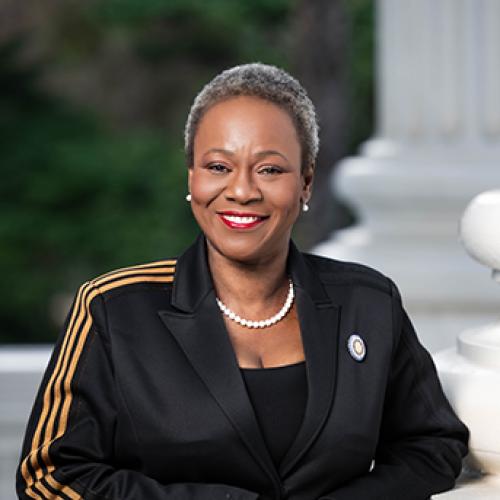
Photo of Tina McKinnor
D California Assembly · District 61 On the 2026 ballot

Asm. Tina McKinnor

Compare
Total votes
10,628
all sessions
Attendance
91%
873 missed
Lower than 88% of chamber peers
With party
99%
of cast votes
Near the chamber average
Bipartisan score
0%
crosses aisle rarely
Near the chamber average
Sponsored
967
bills & resolutions
Near the chamber average
Committees
9
assignments
967 bills and resolutions

Sponsored bills

Total
967
Primary
87
Co-sponsor
880
This page
967
matching current filters
Co-sponsor SJR 6
Signed into law · California Senate · Co-sponsor
Don't Ask, Don't Tell: discharge characterizations.

This measure would urge the President and the Congress of the United States to address, with effective policies, the issue of servicemembers who were unjustly discharged under "Don't Ask, Don't Tell" or predecessor provisions, in order to unify efforts to upgrade discharges issued under the DADT policy, and to restore benefits.

Signed into law Aug 21, 2024 1 co-sponsor
Co-sponsor HR 121
Passed · California Assembly · Co-sponsor
Relative to boat people awareness.

Maddy summaryThis bill designates specific periods in 2024 as Boat People Awareness Week and Month to honor Vietnamese refugees who fled their country by sea after the Vietnam War. The resolution highlights the historical hardships these individuals faced, including dangerous voyages and high mortality rates, while acknowledging their significant contributions to communities across California. It does not create new laws or funding but serves as a commemorative measure to recognize the resilience and spirit of the Vietnamese refugee community. The text is intended to be shared with the bill's author for public distribution to raise awareness about this historical event.

Passed Aug 19, 2024 1 co-sponsor
Co-sponsor ACR 214
Signed into law · California Assembly · Co-sponsor
Relative to India's Independence Day.

Maddy summaryThis bill recognizes August 15, 2024, as India's Independence Day and encourages all Californians to participate in celebrations honoring the occasion. It directly affects the residents of California, particularly the state's large Indian American community, by formally acknowledging the historical significance of the date when India gained independence from British rule. The measure does not create new laws or change government operations; instead, it serves as a symbolic gesture to highlight the cultural contributions of Indian Americans and the shared values of democracy and nonviolence between the two nations.

Signed into law Aug 19, 2024 1 co-sponsor
Co-sponsor ACR 209
Signed into law · California Assembly · Co-sponsor
Relative to the 2024 International Day of Yoga.

Maddy summaryThis bill officially recognizes June 21, 2024, as the 2024 International Day of Yoga within the state of California. It does not create new laws or change existing regulations but serves as a formal acknowledgment of the global event. The measure is intended to highlight the history and benefits of yoga as a wellness practice.

Signed into law Aug 19, 2024 1 co-sponsor
Co-sponsor SB 1144
Signed into law · California Senate · Co-sponsor
Marketplaces: online marketplaces.

Existing law generally requires an online marketplace to require a high-volume third-party seller on the online marketplace to make certain disclosures. Existing law requires an online marketplace to suspend future sales activity of a high-volume third-party seller that is not in compliance with those information sharing requirements, as specified. Existing law imposes certain information retention and security requirements on an online marketplace and prohibits specified uses of that information. Existing law generally defines a "high-volume third-party seller," for purposes of the above-described provisions, as a third-party seller who has entered into a certain number of consumer product sales transactions through an online marketplace for which payment is processed by the online marketplace, as specified. Existing law defines an "online marketplace," for purposes of those provisions, as a consumer-directed, electronically accessed platform that includes features that allow for, facilitate, or enable, and are used by, a third-party seller to engage in the sale, purchase, payment, storage, shipment, or delivery of a consumer product and that has a contractual relationship with consumers governing their use of the platform to purchase consumer products. This bill would revise the types of transactions that qualify a third-party seller as a "high-volume third-party seller," for those purposes. Specifically, the bill would remove the conditions that the transactions be made through an online marketplace and that the online marketplace process the payment and, instead, would add the condition that the transactions were made utilizing an online marketplace. The bill would also revise the definition of "online marketplace" by removing the conditions that the above-described features be used by third-party sellers, and that the platform have the above-described contractual relationship with consumers. Existing law requires a high-volume third-party seller to disclose and certify to the online marketplace certain identification, contact, and payment information of the seller, as specified. This bill would require an online marketplace to establish and maintain a policy prohibiting the sale of stolen goods on the marketplace and to provide a mechanism to notify the marketplace of the sale of stolen goods, as specified. The bill would require an online marketplace to alert local, regional, or state law enforcement agencies in California if it knows or should know that a third-party seller is selling or attempting to sell stolen goods to a California resident, except as specified. Existing law requires a person or entity who violates the above-described provisions to be liable for a civil penalty not to exceed $10,000 for each violation and reasonable attorney's fees and costs and to be subject to preventive relief, as specified. Existing law limits recovery and relief to a civil action brought by the Attorney General, as specified. This bill would expand recovery and relief to a civil action brought by a district attorney in any county, a city attorney in any city or city and county, or a county counsel in any county. The bill would make these changes operative on July 1, 2025.


Signed into law Aug 16, 2024 1 co-sponsor
Primary AB 3127
Passed · California Assembly · Lead sponsor
Reporting of crimes: mandated reporters.

Existing law requires a health practitioner, as defined, to make a report to law enforcement when they suspect a patient has suffered physical injury that is either self-inflicted, caused by a firearm, or caused by assaultive or abusive conduct, including elder abuse, sexual assault, or torture. A violation of these provisions is punishable as a misdemeanor. This bill would remove the requirement that a health practitioner make a report to law enforcement when they suspect a patient has suffered physical injury caused by assaultive or abusive conduct. The bill would instead require that a health practitioner make a report when the injury is life threatening or results in death, as specified, or is the result of child abuse or elder or dependent adult abuse. The bill would require the health practitioner to additionally make a report when a person is seeking care for injuries related to domestic, sexual, or any nonaccidental violent injury if the patient requests a report be sent, as specified. The bill would also require a health practitioner who suspects that a patient has suffered physical injury that is caused by domestic violence, as defined, to provide brief counseling and a referral to local and national domestic violence or sexual violence advocacy services, as specified. This bill would make other conforming changes. Because a violation of these requirements would be a crime, this bill would impose a state-mandated local program. The California Constitution requires the state to reimburse local agencies and school districts for certain costs mandated by the state. Statutory provisions establish procedures for making that reimbursement. This bill would provide that no reimbursement is required by this act for a specified reason.

Passed Aug 15, 2024 0 co-sponsors
Co-sponsor AB 4
Passed · California Assembly · Co-sponsor
Covered California: expansion.

Existing federal law, the Patient Protection and Affordable Care Act (PPACA) , requires each state to establish an American Health Benefit Exchange to facilitate the purchase of qualified health benefit plans by qualified individuals and qualified small employers. Existing state law creates the California Health Benefit Exchange, also known as Covered California, to facilitate the enrollment of qualified individuals and qualified small employers in qualified health plans as required under PPACA. Existing law requires the Exchange to apply for a federal waiver to allow persons otherwise not able to obtain coverage through the Exchange because of their immigration status to obtain coverage from the Exchange. This bill would delete that requirement and would instead require the Exchange, no sooner than January 1, 2026, and upon appropriation by the Legislature for this purpose, to administer a program to allow persons otherwise not able to obtain coverage by reason of immigration status to enroll in health insurance coverage in a manner as substantially similar to other Californians as feasible, consistent with federal guidance and given existing federal law and rules. The bill would require the Exchange to undertake outreach, marketing, and other efforts to ensure enrollment, which would begin on October 1, 2027. The bill would also require the Exchange to adopt an annual program design for each coverage year to implement the program, provide appropriate opportunities for stakeholders, including the Legislature, and the public to consult on the design of the program, and report to the Department of Finance and the Legislature on progress toward implementation, as specified. The bill would establish the Covered California for All Fund in the General Fund, to be administered by the Exchange, into which user fees, appropriations, and other funds would be deposited to be used upon appropriation to pay for the administration of the program.

Passed Aug 15, 2024 1 co-sponsor
Co-sponsor SB 1446
Passed · California Senate · Co-sponsor
Grocery retail store and retail drug establishment employees: self-service checkout and consequential workplace technology.

Existing law imposes certain requirements on grocery employers, as defined, upon the purchase or change in control of a grocery establishment, including requiring a successor grocery employer to retain eligible grocery workers for a specified period after transfer of the grocery establishment. This bill would prohibit a grocery retail store or a retail drug establishment, as those terms are defined, from providing a self-service checkout option for customers unless specified conditions are satisfied, including having no more than 2 self-service checkout stations monitored by any one employee and requiring the employee to be relieved of all other duties. The bill would require a grocery retail store or retail drug establishment that offers self-service checkout to include self-service checkout in the employer's illness and prevention program, as required by Division of Occupational Safety and Health regulations. The bill would require a grocery retail store or retail drug establishment that intends to implement consequential workplace technology, as defined, to notify workers, their collective bargaining representatives, and the public at least 60 days in advance of the implementation of the technology with a general description of the technology and the intended purpose of the technology, as specified. This bill would establish remedies and penalties for a violation of the bill's provisions, including a civil penalty of $100 for each day in violation, not to exceed an aggregate penalty of $10,000.

Passed Aug 15, 2024 1 co-sponsor
Showing 451 to 460 of 967 bills
Previous 1 … 45 46 47 … 97 Next