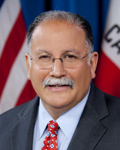
Photo of Jose Medina
D California Assembly · District 61 · Former member

Asm. Jose Medina

Compare
Total votes
20,618
all sessions
Attendance
97%
536 missed
Near the chamber average
With party
99%
of cast votes
Near the chamber average
Bipartisan score
0%
crosses aisle rarely
Near the chamber average
Sponsored
1,627
bills & resolutions
Near the chamber average
Committees
0
assignments
1,627 bills and resolutions

Sponsored bills

Total
1,627
Primary
153
Co-sponsor
1,474
This page
1,627
matching current filters
Co-sponsor SCR 31
Signed into law · California Senate · Co-sponsor
Relative to the Willie L. Brown, Jr. Circle and Plaza.

This measure would name the public street, circle, and plaza at 914 and 915 Capitol Mall in the City of Sacramento as the Willie L. Brown, Jr. Circle and Plaza. The measure would request the Department of General Services to determine the cost of erecting the appropriate signage commemorating this special designation and, upon receiving donations from nonstate sources, to cover that cost to erect that signage.

Signed into law Jan 24, 2020 1 co-sponsor
Co-sponsor AB 1307
Vetoed · California Assembly · Co-sponsor
Student financial aid: Cal Grant program.

Existing law, the Ortiz-Pacheco-Poochigian-Vasconcellos Cal Grant Program, establishes the Cal Grant A and B Entitlement Awards, the California Community College Transfer Entitlement Awards, the Competitive Cal Grant A and B Awards, the Cal Grant C Awards, and the Cal Grant T Awards under the administration of the Student Aid Commission, and establishes eligibility requirements for awards under these programs for participating students attending qualifying institutions. Existing law specifies the amounts of the maximum Cal Grant A and B awards for students attending private nonprofit postsecondary institutions of higher education and private for-profit postsecondary educational institutions that are regionally accredited, as specified. Beginning with the 2020–21 award year, the maximum tuition award is either $9,084 or $8,056, depending upon whether the number of new unduplicated transfer students accepted by private nonprofit postsecondary educational institutions who have been given associate degree for transfer commitments, as defined, in the prior award year meet and exceed specified targets. This bill would change, in accordance with a prescribed formula, the maximum Cal Grant award for tuition for a new recipient attending an independent institution of higher education, commencing with the 2020–21 award year. This bill would provide that the award amount for a student attending an independent institution of higher education may be determined in the annual Budget Act if the independent institutions of higher education, as a group, do not accept the specified number of transfer students who have been given associate degree for transfer commitments.

Vetoed Jan 21, 2020 1 co-sponsor
Co-sponsor AB 751
Vetoed · California Assembly · Co-sponsor
Pupil assessments: Pathways to College Act.

Existing law establishes the California Assessment of Student Performance and Progress (CAASPP) as the statewide system of pupil assessments under which certain assessments are required or authorized to be administered in public schools, as specified, including a consortium summative assessment in English language arts and mathematics for grades 3 to 8, inclusive, and grade 11 that measures content standards adopted by the State Board of Education. This bill would require, pursuant to specified provisions of the federal Elementary and Secondary Education Act, the Superintendent of Public Instruction to approve a nationally recognized high school assessment that a local educational agency, as defined, may, at its own discretion, administer, if the alternative assessment is approved by the local educational agency's governing board or body in a public meeting, commencing with the 2021–22 school year, and each school year thereafter, in lieu of the consortium summative assessment in English language arts and mathematics for grade 11. The bill would require a nationally recognized high school assessment approved by the Superintendent to meet specified requirements, would authorize the Superintendent to require the publisher of that assessment to provide documentation that the assessment meets or exceeds these requirements, and would require the Superintendent, if he or she determines that the assessment does not meet these requirements, to inform the assessment's publisher in writing of specific deficiencies and changes needed to meet these requirements. The bill would authorize a governing board of a local educational agency that is part of a consortium of local educational agencies to enter into a cooperative contract with a publisher for purposes of providing an assessment, as provided. To the extent permitted by the United States Department of Education, the bill would deem certain nationally recognized high school assessments to meet these requirements, and would require the Superintendent to approve these assessments for selection by a local educational agency. The bill would require the state board to amend the state plan required pursuant to federal law to account for the authorization for local educational agencies to use an alternate assessment pursuant to the bill's provisions, if required by federal law. The bill would require a local educational agency that administers a nationally recognized high school assessment to comply with specified requirements, would require the Superintendent to apportion to the local educational agency the lesser of the actual cost of administering the alternative assessment, as specified, and the amount that would have been apportioned to the local educational agency if it had administered the consortium summative assessment in English language arts and mathematics for grade 11. The bill would state that a local educational agency may administer only one nationally recognized high school assessment in lieu of the consortium summative assessment in English language arts and mathematics for grade 11. The bill would make these provisions inoperative 5 years after the first school year in which a local educational agency is able to exercise the authority to administer the alternative assessment, as specified, and would repeal these provisions as of the following January 1. The bill would require the Superintendent to inform the Legislative Counsel within 30 days of when this 5 year condition has been satisfied and post that determination on its internet website. The bill would require the State Department of Education to ensure that local educational agencies comply with specified requirements concerning the alternative assessment that apply in connection with the summative assessments under the CAASPP, including that grade 11 pupils, or parents or legal guardians of those pupils, may request results from the alternative assessment. Existing law requires the Superintendent to prepare and submit, and subsequently post on the internet website of the department, an annual report to the state board containing an analysis of the results and test scores of the summative assessments administered under the CAASPP. This bill would require the Superintendent to include the results and test scores of the alternative assessment in that annual report.

Vetoed Jan 21, 2020 1 co-sponsor
Co-sponsor ACR 28
Passed · California Assembly · Co-sponsor
Sickle Cell Disease Awareness Month.

This measure would recognize September 2020 as Sickle Cell Disease Awareness Month and encourage the Legislature to appropriate funds for research, treatment, and monitoring of sickle cell disease, and for related education and outreach.

Passed Jan 15, 2020 1 co-sponsor
Co-sponsor SB 468
Vetoed · California Senate · Co-sponsor
Taxation: tax expenditures: California Tax Expenditure Review Board.

Existing law, including, but not limited to, property tax law, the Sales and Use Tax Law, the Personal Income Tax Law, the Corporation Tax Law, the Motor Vehicle Fuel Tax Law, the law governing the taxation of insurers, the Use Fuel Tax Law, and the Diesel Fuel Tax Law provide for tax expenditures, including exemptions, deductions, exclusions, and credits against the taxes imposed by those laws. This bill would establish in state government the California Tax Expenditure Review Board as an independent advisory body to comprehensively assess major tax expenditures, as defined, and make recommendations to the Legislature. The bill would require the board to be composed of 5 members, as specified, who would serve without compensation. This bill would request the University of California, through a new or existing research center, to perform a comprehensive assessment of the major tax expenditures and to present a comprehensive, peer-reviewed assessment to the board by July 1, 2021, at a public hearing of the board. The bill, to the extent that the University of California needs access to taxpayer data and information, would require the Franchise Tax Board or the California Department of Tax and Fee Administration to ensure relevant taxpayer data is made available and ensure appropriate levels of data security and protections are in place for transferred and sensitive data. This bill would set forth the scope of the comprehensive assessment, which would include certain specified information, including a brief description of the beneficiaries of the tax expenditure, and would require the board to post the comprehensive assessment on its internet website after receipt. The bill would require the board to make recommendations to the Legislature regarding the major tax expenditures, and to provide a report to the Legislature that compiles all of its recommendations regarding those tax expenditures, after a vote of the members of the board, by January 1, 2022, as specified. The bill would also require the board to submit the report to the Senate Committee on Budget and Fiscal Review, the Senate Committee on Governance and Finance, the Assembly Committee on Budget, and the Assembly Committee on Revenue and Taxation, and post it on its internet website. The bill would require the Senate Committee on Governance and Finance and the Assembly Committee on Revenue and Taxation, after receipt of the report by the Legislature, to hold a joint public hearing on the report by August 15 of the second year of the legislative session.


Vetoed Jan 13, 2020 1 co-sponsor
Co-sponsor ACR 98
Passed · California Assembly · Co-sponsor
Relative to mental health and substance use treatment.

This measure would urge specified state departments and the Attorney General to use their authority to ensure that health care service plans and health insurers subject to their authority comply with the federal Paul Wellstone and Pete Domenici Mental Health Parity and Addiction Equity Act of 2008.

Passed Jan 9, 2020 1 co-sponsor
Co-sponsor AB 1747
Signed into law · California Assembly · Co-sponsor
California Law Enforcement Telecommunications System: immigration.

Existing law requires the Department of Justice to maintain a statewide telecommunications system for use by law enforcement agencies. Existing law also requires the Attorney General, upon the advice of an advisory committee, to adopt policies, practices and procedures, and conditions of qualification for connection to the system. Existing law, the California Values Act, generally prohibits, with exceptions, a California law enforcement agency from using its moneys or personnel to investigate, detain, or arrest persons for immigration enforcement purposes. This bill would, commencing January 1, 2020, consistent with the California Values Act, prohibit subscribers to the system from using information other than criminal history information transmitted through the system for immigration enforcement purposes, as defined. The bill would also prohibit subscribers to the system from using the system for purposes of investigating violations of a specified federal law if a violation of that federal law is the only criminal history in an individual's record. The bill would, commencing July 1, 2021, with exceptions, require any inquiry submitted through the statewide telecommunications system for information other than criminal history information to include a reason for the inquiry. The bill would also, commencing July 1, 2021, authorize the Attorney General, and personnel they so authorize, to conduct investigations, as provided, as the Attorney General deems appropriate to monitor compliance with these provisions.

Signed into law Oct 12, 2019 1 co-sponsor
Primary AB 485
Signed into law · California Assembly · Lead sponsor
Local government: economic development subsidies.

Existing law requires each local agency, as defined, to provide specified information to the public before approving an economic development subsidy within its jurisdiction, and to, among other things, hold hearings and report on those subsidies, as provided. Existing law defines "economic development subsidy" for these purposes to mean any expenditure of public funds or loss of revenue to a local agency in the amount of $100,000 or more, for the purpose of stimulating economic development within the jurisdiction of a local agency, as provided. This bill, on and after January 1, 2020, would similarly require each local agency to provide specified information to the public before approving an economic development subsidy for a warehouse distribution center, as defined, and to, among things, hold hearings and report on those subsidies, as provided. The bill would require local agencies to submit a report to the Governor's Office of Business and Economic Development providing specified information and would require the office to make those reports available to the public through its internet website. The bill would require a warehouse distribution center to provide a local agency any information necessary to comply with these provisions. The bill would prohibit a local agency from signing a nondisclosure agreement regarding a warehouse distribution center as part of negotiations or in the contract for any economic development subsidy. The bill would declare that its provisions address a matter of statewide concern rather than a municipal affair and, therefore, apply to all cities, including charter cities. The California Constitution requires local agencies, for the purpose of ensuring public access to the meetings of public bodies and the writings of public officials and agencies, to comply with a statutory enactment that amends or enacts laws relating to public records or open meetings and contains findings demonstrating that the enactment furthers the constitutional requirements relating to this purpose. This bill would make legislative findings to that effect.

Signed into law Oct 12, 2019 0 co-sponsors
Co-sponsor AB 1548
Signed into law · California Assembly · Co-sponsor
California State Nonprofit Security Grant Program.

Existing law establishes the Office of Emergency Services within the office of the Governor and under the supervision of the Director of Emergency Services and makes the Office of Emergency Services responsible for the state's emergency and disaster response services for natural, technological, or manmade disasters and emergencies. This bill would establish the California State Nonprofit Security Grant Program under the administration of the director to improve the physical security of nonprofit organizations that are at high risk of violent attacks or hate crimes due to ideology, beliefs, or mission, as specified. The bill would make the operation of the program contingent upon an appropriation in the annual Budget Act for these purposes. The bill would repeal those provisions on January 1, 2025. This bill would declare that it is to take effect immediately as an urgency statute.

Signed into law Oct 11, 2019 1 co-sponsor
Showing 521 to 530 of 1,627 bills
Previous 1 … 52 53 54 … 163 Next