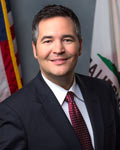
Photo of Eric Linder
R California Assembly · District 60

Asm. Eric Linder

Compare
Total votes
10,705
all sessions
Attendance
93%
514 missed
Lower than 87% of chamber peers
With party
95%
of cast votes
Lower than 81% of chamber peers
Bipartisan score
3%
crosses aisle rarely
Higher than 77% of chamber peers
Sponsored
554
bills & resolutions
Near the chamber average
Committees
0
assignments
554 bills and resolutions

Sponsored bills

Total
554
Primary
66
Co-sponsor
488
This page
554
matching current filters
Primary AB 764
Failed · California Assembly · Lead sponsor
Human Remains.

Existing law, the Cemetery Act, provides for the licensure and regulation of cemeteries, crematories, and their personnel by the Cemetery and Funeral Bureau within the Department of Consumer Affairs. Existing law establishes certified uniform program agencies, which are agencies certified by the Secretary for Environmental Protection to implement a specified unified program relating to hazardous waste and materials in accordance with certain requirements. This bill would, until January 1, 2020, establish a pilot program that would authorize the bureau to issue a limited crematory license to no more than 5 hydrolysis facilities, subject to specified requirements.

Failed Nov 30, 2014 0 co-sponsors
Primary AB 1854
Failed · California Assembly · Lead sponsor
Examination fees: Advanced Placement and International Baccalaureate Examination Fee Grant Program.

Existing law authorizes a system of incentives to encourage high schools to operate International Baccalaureate Diploma Programs, and to encourage pupils in these schools to enroll in, attempt, and pass the International Baccalaureate course of study and examinations that lead to the International Baccalaureate Diploma. Existing law requires the Superintendent of Public Instruction, from funds appropriated for the purpose of the International Baccalaureate Diploma Program, to annually allocate to each school district, on behalf of each high school or middle school within the district that offers the program, up to $25,000 for each participating high school and middle school to cover the costs of professional development required by the program and to help pay the test fees for low- and middle-income pupils in need of financial assistance. Existing law authorizes a school district receiving economic impact aid funds to expend any portion of those funds to pay for all or part of the costs of one or more advanced placement examinations that are charged to economically disadvantaged pupils, as defined. This bill would, subject to appropriation in the annual Budget Act, establish a grant program, administered by the State Department of Education, for the purpose of awarding grants to cover the costs of advanced placement examination fees or International Baccalaureate examination fees, or both, for eligible economically disadvantaged or foster youth high school pupils, as defined. The bill would authorize a school district or charter school to apply to the department for grant funding under the program based on the number of economically disadvantaged or foster youth high school pupils in the school district or charter school who will take the next offered advanced placement or International Baccalaureate examinations and would require that grants be expended only to pay the fees required of eligible economically disadvantaged or foster youth high school pupils to take an advanced placement or International Baccalaureate examination, or both. The bill would authorize an eligible economically disadvantage or foster youth high school pupil enrolled in an advanced placement or International Baccalaureate course, or both, to apply to the designated school district or charter school staff for a grant to pay the examination fee, as provided.

Failed Nov 30, 2014 0 co-sponsors
Primary AB 2651
Failed · California Assembly · Lead sponsor
Vehicle weight fees: transportation bond debt service.

Existing law imposes weight fees on the registration of commercial motor vehicles and provides for the deposit of net weight fee revenues into the State Highway Account. Existing law provides for the transfer of certain weight fee revenues from the State Highway Account to the Transportation Debt Service Account to reimburse the General Fund for payment of debt service on general obligation bonds issued for transportation purposes. Existing law also provides for the transfer of certain weight fee revenues to the Transportation Bond Direct Payment Account for direct payment of debt service on designated bonds, which are defined to be certain transportation general obligation bonds issued pursuant to Proposition 1B of 2006. This bill, notwithstanding these provisions or any other law, effective January 1, 2016, would prohibit weight fee revenue from being transferred from the State Highway Account to the Transportation Debt Service Fund or to the Transportation Bond Direct Payment Account, and from being used to pay the debt service on transportation general obligation bonds.

Failed Nov 30, 2014 0 co-sponsors
Co-sponsor SB 1079
Failed · California Senate · Co-sponsor
California Global Warming Solutions Act of 2006: market-based compliance mechanisms: exemption.

The California Global Warming Solutions Act of 2006 designates the State Air Resources Board as the state agency charged with monitoring and regulating sources of emissions of greenhouse gases. The state board is required to adopt a statewide greenhouse gas emissions limit equivalent to the statewide greenhouse gas emissions level in 1990 to be achieved by 2020, and to adopt rules and regulations in an open public process to achieve the maximum, technologically feasible, and cost-effective greenhouse gas emissions reductions. The act authorizes the state board to include the use of market-based compliance mechanisms. Existing state board regulations require specified entities to comply with a market-based compliance mechanism beginning January 1, 2013, and require additional specified entities to comply with that market-based compliance mechanism beginning January 1, 2015. This bill instead would exempt categories of persons or entities that did not have a compliance obligation, as defined, under a market-based compliance mechanism beginning January 1, 2013, from being subject to that market-based compliance mechanism through December 31, 2020. This bill would declare that it is to take effect immediately as an urgency statute.

Failed Nov 30, 2014 1 co-sponsor
Co-sponsor SCR 141
Failed · California Senate · Co-sponsor
Relative to the CAL FIRE Firefighter Christopher Lee Douglas Memorial Highway.

This measure would designate a 5-mile portion of Interstate 10 as the CAL FIRE Firefighter Christopher Lee Douglas Memorial Highway. The measure would also request the Department of Transportation to determine the cost for appropriate signs showing this special designation and, upon receiving donations from nonstate sources covering that cost, to erect those signs.

Failed Nov 30, 2014 1 co-sponsor
Co-sponsor AB 1451
Failed · California Assembly · Co-sponsor
Public schools: concurrent enrollment in secondary school and community college.

Existing law authorizes the governing board of a school district to allow pupils whom the district has determined would benefit from advanced scholastic or vocational work to attend community college as special part-time or full-time students, subject to parental permission. Existing law, until January 1, 2014, required credit to be awarded to these pupils, as specified, made the authority of a school principal to recommend a pupil for community college summer session contingent upon a determination that the pupil met various criteria, and prohibited the principal from recommending more than 5% of the total number of pupils from any particular grade level who completed that grade immediately before the time of recommendation for summer session attendance, except as specified. This bill would reinstate these provisions until January 1, 2017. The bill would, until July 1, 2020, authorize the governing board of a school district to enter into a concurrent enrollment partnership agreement with a community college district located within its immediate service area to allow pupils to attend community college. The bill would require a community college district and a school district, as a condition of, and before adopting, a concurrent enrollment partnership agreement, to take testimony from the public and approve or disapprove the proposed agreement at a regularly scheduled open public hearing of its respective governing board after having presented the agreement at a prior open public hearing. The bill would require the concurrent enrollment partnership agreement to outline the terms of the partnership, as specified. The bill would prohibit a school district from receiving a state allowance or apportionment for an instructional activity for which a community college district has been, or will be, paid an allowance or apportionment under a concurrent enrollment partnership agreement. The bill would authorize a participating high school to monitor the progress of its pupils attending a community college and to obtain the pupils' records from a community college district to do so. The bill would require, for each concurrent enrollment partnership agreement entered into under the bill, the affected community college district and school district to file an annual report, containing specified data, with the Office of the Chancellor of the California Community Colleges. The bill would also authorize the governing board of a community college district to enter into a partnership with the governing board of a school district located within its service area with the goal of developing seamless pathways from high school to community college for career technical education or preparation for transfer. The bill would require the partnership agreement to outline the terms of the partnership, as specified, and would require copies of the partnership agreement to be filed with the Chancellor of the California Community Colleges and the Superintendent of Public Instruction. The bill would authorize a community college district to limit enrollment in a community college course to solely high school pupils under specified circumstances. The bill would authorize specified high school pupils to enroll in up to 15 units if those units are required for these pupils' partnership programs and specified circumstances are satisfied, and would authorize a community college district to exempt special part-time and full-time students taking up to a maximum of 15 units per term from specified fee requirements. The bill would prohibit a community college district from receiving a state allowance or apportionment for an instructional activity for which a school district has been, or will be, paid an allowance or apportionment under a concurrent enrollment partnership agreement. The bill would require, for each partnership agreement entered into under the bill, the affected community college district and school district to file an annual report, containing specified data, with the Office of the Chancellor of the California Community Colleges. The bill would also make related and conforming changes.

Failed Nov 30, 2014 1 co-sponsor
Co-sponsor AB 2728
Failed · California Assembly · Co-sponsor
Vehicle weight fees: transportation bond debt service.

Existing law imposes weight fees on the registration of commercial motor vehicles and provides for the deposit of net weight fee revenues into the State Highway Account. Existing law provides for the transfer of certain weight fee revenues from the State Highway Account to the Transportation Debt Service Fund to reimburse the General Fund for payment of debt service on general obligation bonds issued for transportation purposes. Existing law also provides for the transfer of certain weight fee revenues to the Transportation Bond Direct Payment Account for direct payment of debt service on designated bonds, which are defined to be certain transportation general obligation bonds issued pursuant to Proposition 1B of 2006. Existing law also provides for loans of weight fee revenues to the General Fund to the extent the revenues are not needed for bond debt service purposes, with the loans to be repaid when the revenues are later needed for those purposes, as specified. This bill, notwithstanding these provisions or any other law, until January 1, 2019, would prohibit weight fee revenues from being transferred from the State Highway Account to the Transportation Debt Service Fund, the Transportation Bond Direct Payment Account, or any other fund or account for the purpose of payment of the debt service on transportation general obligation bonds, and would also prohibit loans of weight fee revenues to the General Fund.

Failed Nov 30, 2014 1 co-sponsor
Co-sponsor AB 690
Signed into law · California Assembly · Co-sponsor
State government: international relations.

Existing law requires the California-Mexico Border Relations Council to, among other things, coordinate activities of state agencies that are related to cross-border programs, initiatives, projects, and partnerships that exist within state government. This bill would repeal and recast those provisions.

Signed into law Sep 28, 2014 1 co-sponsor
Co-sponsor AB 935
Signed into law · California Assembly · Co-sponsor
Driver's licenses: veteran designation.

(1) Under existing law, when the Department of Motor Vehicles determines that an applicant is lawfully entitled to a driver's license, the department is required to issue that license to the applicant. Existing law specifies the contents of a driver's license and requires the application for a driver's license or identification card to contain a space for an applicant to indicate whether he or she has served in the Armed Forces of the United States and to give his or her consent to be contacted regarding eligibility to receive state or federal veterans' benefits. This bill would, commencing November 11, 2015, allow an in-person applicant for a driver's license or identification card to request the driver's license or identification card be printed with the word "VETERAN." The applicant would be required to present verification of veteran status to the Department of Motor Vehicles, on a form developed by the Department of Veterans Affairs in consultation with the California Association of County Veterans Service Officers and the Department of Motor Vehicles. The bill would require county veterans service offices to verify an applicant's veteran status for these purposes, as specified. The department would be required to print the word "VETERAN" on the face of a driver's license or identification card issued to a person who makes that request and presents that verification to the department. (2) Existing law establishes certain fee amounts for the applications for, and renewal of, driver's licenses and identification cards. This bill would require the department to charge an additional one-time fee of $5 to a person who requests that the person's driver's license or identification card be designated as provided above.

Signed into law Sep 27, 2014 1 co-sponsor
Co-sponsor AB 2312
Signed into law · California Assembly · Co-sponsor
Metal theft.

Existing law governs the business of buying, selling, and dealing in secondhand and used machinery and all ferrous and nonferrous scrap metals and alloys, also known as "junk." Existing law requires junk dealers and recyclers to keep a written record of all sales and purchases made in the course of their business, including the name and address of each person to whom junk is sold or disposed of, and to preserve the written record for at least 2 years after making the final entry of any purchase or sale of junk. Existing law provides that it is a crime for a dealer in or collector of junk, metals, or secondhand materials, or the agent, employee, or representative of that dealer or collector, who buys or receives any wire, cable, copper, lead, solder, mercury, iron, or brass that he or she knows or reasonably should know is ordinarily used by or ordinarily belongs to a railroad or other transportation, telephone, telegraph, gas, water, or electric light company or county, city, city and county, or other political subdivision of this state engaged in furnishing public utility service without using due diligence to ascertain that the person selling or delivering the same has a legal right to do so. Existing law, until January 1, 2019, requires the Department of Food and Agriculture to require a recycler or junk dealer who is an applicant for a new weighmaster license or a renewal of a weighmaster license to furnish specified additional information on the application. This bill would require a junk dealer or recycler to request to receive theft alert notifications regarding the theft of commodity metals in the junk dealer's or recycler's geographic region from the theft alert system maintained by the Institute of Scrap Recycling Industries, Inc., unless the institute or its successor requires payment for use of the theft alert system. The bill would require the Department of Food and Agriculture, until January 1, 2019, to require a junk dealer or recycler who is an applicant for a new weighmaster license or a renewal of a weighmaster license to also include a statement on the application indicating that the applicant has requested to receive the theft alert notifications, unless the request requirement does not apply. The bill would also encourage local law enforcement agencies to report thefts of commodity metals that have occurred within their jurisdiction to that theft alert system, in order to ensure that persons using the system receive timely and thorough information regarding metal thefts. The bill would prohibit the institute or its successor from selling subscribers' information to 3rd parties. The bill would state findings and declarations by the Legislature regarding the theft alert system.


Signed into law Sep 26, 2014 1 co-sponsor
Showing 341 to 350 of 554 bills
Previous 1 … 34 35 36 … 56 Next