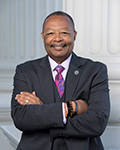
Photo of Reggie Jones-Sawyer
D California Assembly · District 57 · Former member

Asm. Reggie Jones-Sawyer

Contact Email
Compare
Total votes
26,638
all sessions
Attendance
97%
781 missed
Near the chamber average
With party
99%
of cast votes
Near the chamber average
Bipartisan score
0%
crosses aisle rarely
Near the chamber average
Sponsored
2,128
bills & resolutions
Near the chamber average
Committees
0
assignments
2,128 bills and resolutions

Sponsored bills

Total
2,128
Primary
269
Co-sponsor
1,859
This page
2,128
matching current filters
Primary AB 493
Signed into law · California Assembly · Lead sponsor
Crime: victims and witnesses: immigration violations.

Existing law prohibits a peace officer from detaining an individual exclusively for any actual or suspected immigration violation or reporting or turning the individual over to federal immigration authorities whenever an individual who is a victim of or witness to a hate crime, as defined, or who otherwise can give evidence in a hate crime investigation, is not charged with or convicted of committing any crime under state law. This bill would enact a prohibition similar to the one described above that would be applicable whenever an individual is a victim of or witness to a crime, or otherwise can give evidence in a criminal investigation, without regard to whether the crime is a hate crime.

Signed into law Sep 1, 2017 0 co-sponsors
Co-sponsor AB 64
Passed · California Assembly · Co-sponsor
Cannabis: licensure and regulation.

(1) Existing law, the Control, Regulate and Tax Adult Use of Marijuana Act (AUMA) , an initiative measure enacted as Proposition 64 at the November 8, 2016, statewide general election, authorizes a person who obtains a state license under AUMA to engage in commercial adult-use cannabis activity pursuant to that license and applicable local ordinances. Existing law, the Medical Cannabis Regulation and Safety Act (MCRSA) , also authorizes a person who obtains both a state license under MCRSA and the relevant local license to engage in commercial medicinal cannabis activity pursuant to those licenses, as specified. Both MCRSA and AUMA generally divide responsibility for state licensure and regulation between the Bureau of Marijuana Control (bureau) within the Department of Consumer Affairs, which serves as the lead state agency, the Department of Food and Agriculture, and the State Department of Public Health. AUMA requires the licensing authorities to begin issuing licenses to engage in commercial adult-use cannabis activity by January 1, 2018. Senate Bill 94 of the 2017–18 Regular Session (SB 94) , effective immediately upon enactment, would consolidate the provisions providing for the licensure and regulation of commercial medicinal cannabis activity and commercial adult-use cannabis activity under a single regulatory scheme, which would be known as the Medicinal and Adult-Use Regulation and Safety Act (MAUCRSA) , by repealing MCRSA, incorporating certain provisions of MCRSA into the licensing provisions of AUMA, and making a variety of conforming and related changes. AUMA defines "delivery" for the above-described purposes as meaning the commercial transfer of adult-use cannabis or cannabis products to a customer and including the use by a retailer of any technology platform owned and controlled by the retailer, or independently licensed, that enables customers to arrange for or facilitate the commercial transfer by a licensed retailer of adult-use cannabis or cannabis products. Under MAUCRSA, if SB 94 is enacted, "delivery" would no longer include the use by a retailer of any technology platform independently licensed. This bill would expand MAUCRSA's definition of "delivery" to include the use by a retailer of any technology platform owned, leased, or controlled by the retailer. (2) MCRSA and AUMA prohibit, and if SB 94 is enacted, MAUCRSA would prohibit, a person licensed to test cannabis or cannabis products from obtaining licensure for any other commercial cannabis activity. Although MCRSA also prohibits testing licensees from owning or having an ownership interest in any entity or premises licensed under a different category pursuant to MCRSA, and although AUMA also prohibits testing licensees from owning or having an ownership interest in a non-testing facility, SB 94 would repeal these additional prohibitions and instead prohibit a testing licensee from employing an individual who is also employed by any other licensee that does not hold a state testing laboratory license. SB 94 would condition a person's eligibility for more than one license under MAUCRSA upon a requirement that the licensed premises be separate and distinct. This bill, if SB 94 is enacted, would repeal that separate and distinct premises requirement. The bill would also prohibit a testing licensee under MAUCRSA from owning, or having an ownership interest in, a premises licensed under MAUCRSA for any activity except testing. (3) Existing law makes it an infraction punishable by a fine not exceeding $100 for a person to possess not more than one ounce of cannabis while driving a motor vehicle, as specified, unless otherwise authorized by law. SB 94, effective immediately upon enactment, would repeal that provision and instead make it an infraction punishable by a fine not exceeding $100 for a person to possess a receptacle containing cannabis or cannabis product that has been opened, or a seal broken, or to possess loose cannabis flower not in a container, while driving a motor vehicle, with certain exceptions. This bill would require a retailer, microbusiness, or nonprofit licensed under MAUCRSA to display a sign educating its customers on California's laws on transporting cannabis or cannabis products in a vehicle, in accordance with the above-described provisions. (4) Existing law, the Model State Trademark Law, provides for the registration of trademarks and service marks with the Secretary of State and requires the classification of goods and services for those purposes to conform to the classifications adopted by the United States Patent and Trademark Office. This bill, for purposes of marks for which a certificate of registration is issued on or after January 1, 2018, would, notwithstanding those provisions, authorize the use of specified classifications for marks related to cannabis, including medicinal cannabis, goods and services that are lawfully in commerce under state law in the State of California. (5) Existing law exempts qualified medicinal cannabis patients with valid identification cards, the designated primary caregivers of those patients, and persons with identification cards who associate within the State of California in order, collectively or cooperatively, to cultivate cannabis for medicinal purposes from specified criminal liability, including possession, cultivation, and transport of cannabis until one year after the bureau posts a notice on its Internet Web site that licenses for commercial cannabis activity have begun being issued. This bill would authorize these collectives and cooperatives to operate for profit or not for profit. The bill would limit the protection for collectives and collaboratives operating for profit to those collectives and collaboratives that possess a valid seller's permit from the State Board of Equalization and a valid local license, permit, or other authorization. (6) AUMA authorizes the Legislature to amend its provisions by a 23 vote of each house if the amendment furthers its purposes and intent. This bill would state that the bill furthers the purposes and intent of AUMA for specified reasons.


Passed Sep 1, 2017 1 co-sponsor
Co-sponsor AB 420
Passed · California Assembly · Co-sponsor
Personal income tax: deduction: commercial cannabis activity.

Existing law, the Medicinal and Adult-Use Cannabis Regulation and Safety Act (MAUCRSA) , among other things, consolidates the licensure and regulation of commercial medicinal and adult-use cannabis activities and authorizes persons to conduct specified commercial cannabis activities, as defined, in the state. The Personal Income Tax Law and the Corporation Tax Law allow various deductions in computing the income that is subject to the taxes imposed by those laws. The Personal Income Tax Law conforms as of a specified date to federal income tax laws with respect to itemized deductions, including business deductions and items not deductible, except as specifically provided. The Corporation Tax Law does not conform to those federal income tax provisions, but specifically provides for deductions for purposes of that law. The Personal Income Tax Law, by conformity to federal income tax laws, disallows a deduction or credit for business expenses of a trade or business whose activities consist of trafficking specified controlled substances, including marijuana. This bill, for each taxable year beginning on and after January 1, 2018, would specifically provide in the Personal Income Tax Law for nonconformity to that federal law disallowing a deduction or credit for business expenses of a trade or business whose activities consist of trafficking specified controlled substances, only for commercial cannabis activity, as defined, authorized under MAUCRSA, thus allowing deduction of business expenses for a cannabis or marijuana trade or business under the Personal Income Tax Law, as provided. This bill would take effect immediately as a tax levy.

Passed Sep 1, 2017 1 co-sponsor
Co-sponsor AB 175
Passed · California Assembly · Co-sponsor
Cannabis marketing: packaging and labeling.

Existing law, the Medicinal and Adult-Use Cannabis Regulation and Safety Act, which includes the Control, Regulate and Tax Adult Use of Marijuana Act (AUMA) , enacted by the voters at the November 8, 2016, statewide general election, regulates the cultivation, distribution, and use of cannabis for medical purposes and for nonmedical purposes by people 21 years of age and older. Under existing law, the Bureau of Cannabis Control is responsible for licensing and regulating retail sales, distribution, and transportation, and the State Department of Public Health is responsible for licensing and regulating manufacturers. Existing law places restrictions on the packaging and labeling of cannabis and cannabis products, including requirements that the packaging be resealable, child resistant, and not made attractive to children. This bill would require a manufacturer, prior to introducing an edible cannabis product into commerce in California, to submit the packaging and labeling to the State Department of Public Health for approval and would require the department to determine whether the packaging and labeling are in compliance with the requirements of prescribed provisions of law, including the requirements that the packaging be child resistant and not attractive to children, as specified. The bill would authorize the department to charge a manufacturer a fee for the determination, in an amount no greater than the amount required to cover the actual and reasonable costs of administering the approval program. AUMA authorizes the Legislature to amend, by a majority vote, certain provisions of the act to implement specified substantive provisions, provided that the amendments are consistent with and further specified purposes and the intent of the act. This bill would declare that its provisions implement specified substantive provisions of the Control, Regulate and Tax Adult Use of Marijuana Act. The bill would also declare that its provisions further specified purposes and the intent of the Control, Regulate and Tax Adult Use of Marijuana Act.

Passed Sep 1, 2017 1 co-sponsor
Co-sponsor ACR 22
Signed into law · California Assembly · Co-sponsor
Relative to the Detective Sergeant Thomas A. Smith, Jr. Memorial Highway.

This measure would designate a specified portion of Interstate 680 in the City of San Ramon in the County of Contra Costa as the Detective Sergeant Thomas A. Smith, Jr. Memorial Highway. The measure would also request that the Department of Transportation determine the cost of appropriate signs showing this special designation and, upon receiving donations from nonstate sources covering that cost, erect those signs.

Signed into law Aug 30, 2017 1 co-sponsor
Co-sponsor AJR 1
Signed into law · California Assembly · Co-sponsor
Presidential elections: electoral college.

This measure would urge the United States Congress to propose and send to the states for ratification a constitutional amendment to abolish the electoral college and provide for the direct election of the President and Vice President of the United States by the popular vote of all eligible citizens of the United States.

Signed into law Aug 28, 2017 1 co-sponsor
Co-sponsor AJR 14
Signed into law · California Assembly · Co-sponsor
Relative to the 135th anniversary of the Chinese Exclusion Act.

This measure would mark May 6, 2017, as the 135th anniversary of the enactment of the Chinese Exclusion Act in order to recognize the harm caused by racially discriminatory immigration measures, and to honor the contributions of all immigrants and refugees who have enriched our communities. The measure would also declare the opposition of the Legislature to recent executive orders signed by President Trump relating to immigration, call upon the President to revoke those orders, condemn the expansion of deportations being undertaken under the current presidential administration, and reaffirm that the state is open and welcoming to immigrants and refugees who are integral to life in our state.

Signed into law Aug 24, 2017 1 co-sponsor
Showing 1,461 to 1,470 of 2,128 bills