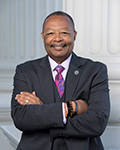
Photo of Reggie Jones-Sawyer
D California Assembly · District 57 · Former member

Asm. Reggie Jones-Sawyer

Contact Email
Compare
Total votes
26,638
all sessions
Attendance
97%
781 missed
Near the chamber average
With party
99%
of cast votes
Near the chamber average
Bipartisan score
0%
crosses aisle rarely
Near the chamber average
Sponsored
2,128
bills & resolutions
Near the chamber average
Committees
0
assignments
2,128 bills and resolutions

Sponsored bills

Total
2,128
Primary
269
Co-sponsor
1,859
This page
2,128
matching current filters
Primary AB 1319
died · California Assembly · Lead sponsor
Sales and Use Tax Law.

The Sales and Use Tax Law imposes a tax on retailers measured by the gross receipts from the sale of tangible personal property sold at retail in this state, or on the storage, use, or other consumption in this state of tangible personal property purchased from a retailer for storage, use, or other consumption in this state and impose the use tax on a lessee's possession of tangible personal property in this state. This bill would make nonsubstantive changes to these provisions.

died Feb 1, 2018 0 co-sponsors
Co-sponsor AB 620
Failed · California Assembly · Co-sponsor
Prisoners: trauma-focused programming.

Existing law authorizes the Board of Parole Hearings to establish and enforce rules and regulations under which inmates committed to state prisons may be allowed to go upon parole outside the prison buildings and enclosures when eligible for parole. Existing law requires the board to meet with each inmate before the inmate's minimum eligible parole date, as specified, for the purposes of reviewing and documenting the inmate's activities and conduct pertinent to parole eligibility. Existing law charges the Department of Corrections and Rehabilitation with administering the state prisons. This bill would require the department to implement a 4-year pilot program at 4 state prisons to offer trauma-focused programming, which includes, among other things, programs that provide tools for coping and dealing with trauma and individual therapy, to qualified incarcerated persons during the 5 years preceding his or her parole date. The bill would require the department, by July 1, 2018, to convene a stakeholder group, as specified, and develop trauma-focused programming for use in the pilot program. The bill would authorize the department to contract with a nonprofit organization to provide trauma-focused programming if a state prison participating in the pilot program does not have a clinical social worker, psychologist, or other qualified professional to provide trauma-focused programming. The bill would authorize the board to consider a qualified incarcerated person's participation in and completion of trauma-focused programming as a performance milestone for purposes of credit reductions from the incarcerated person's term of confinement. The bill would repeal these provisions on January 1, 2023.

Failed Feb 1, 2018 1 co-sponsor
Primary AB 173
Failed · California Assembly · Lead sponsor
School safety: peace officer interactions with pupils and nonpupils.

Existing law, the Interagency School Safety Demonstration Act of 1985, requires school districts and county offices of education to be responsible for the overall development of comprehensive school safety plans for its schools operating kindergarten or any of grades 1 to 12, inclusive. The act establishes the School/Law Enforcement Partnership, comprised of the Superintendent of Public Instruction and the Attorney General, whose duties include, among others, the development of programs and policies necessary to implement the provisions of the Education Code relating to school safety plans. Existing law authorizes the governing board of a school district to establish a school police department under the supervision of a school chief of police and to employ peace officers. Existing law, the Racial and Identity Profiling Act of 2015, requires, among other things, each state and local agency that employs peace officers to annually report to the Attorney General data on all stops, as defined, conducted by the agency's peace officers for the preceding calendar year. Existing law requires the reporting to include specified information for each stop, including the time, date, and location of the stop; the reason for the stop; the perceived race or ethnicity, gender, and approximate age of the person stopped, provided that the identification of these characteristics be based on the observation and perception of the peace officer making the stop, and the information not be requested from the person stopped; and specified actions taken by the peace officer during the stop. This bill would require, on and after January 1, 2019, the governing board of a school district that establishes a school police department, that contracts with or employs peace officers, or that permits a law enforcement agency to assign peace officers or school resource officers to a schoolsite to require the applicable law enforcement agency to report, on a monthly basis, information similar to that reported under the Racial and Identity Profiling Act of 2015 on all stops, as defined, made at a schoolsite. The bill would require the reports to include additional information relating to the law enforcement agency's interactions with pupils and nonpupils, as specified. The bill would require the collection and reporting of data pursuant to the bill to be undertaken in accordance with the Racial and Identity Profiling Act of 2015 and its implementing regulations. The bill would require the governing board of a school district to forward the monthly report to the Attorney General within 30 days of receipt and to present an annual report based on the monthly reports from the prior academic year during an open session of a regularly scheduled public meeting of the governing board of the school district. By imposing additional duties on school districts and local law enforcement agencies, the bill would impose a state-mandated local program. The California Constitution requires the state to reimburse local agencies and school districts for certain costs mandated by the state. Statutory provisions establish procedures for making that reimbursement. This bill would provide that, if the Commission on State Mandates determines that the bill contains costs mandated by the state, reimbursement for those costs shall be made pursuant to the statutory provisions noted above.


Failed Feb 1, 2018 0 co-sponsors
Co-sponsor AB 42
died · California Assembly · Co-sponsor
Bail: pretrial release.

Existing law provides for the procedure of approving and accepting bail, and issuing an order for the appearance and release of an arrested person. Existing law requires that bail be set in a fixed amount, as specified, and requires, in setting, reducing, or denying bail, a judge or magistrate to take into consideration the protection of the public, the seriousness of the offense charged, the previous criminal record of the defendant, and the probability of his or her appearing at trial or at a hearing of the case. Under existing law, the magistrate or commissioner to whom the application is made is authorized to set bail in an amount that he or she deems sufficient to ensure the defendant's appearance or to ensure the protection of a victim, or family member of a victim, of domestic violence, and to set bail on the terms and conditions that he or she, in his or her discretion, deems appropriate, or he or she may authorize the defendant's release on his or her own recognizance. Existing law provides that a defendant being held for a misdemeanor offense is entitled to be released on his or her own recognizance, unless the court makes a finding on the record that his or her release would compromise public safety or would not reasonably ensure the appearance of the defendant as required. This bill would state the intent of the Legislature to enact legislation to safely reduce the number of people detained pretrial, while addressing racial and economic disparities in the pretrial system, to ensure that people are not held in pretrial detention simply because of their inability to afford money bail. This bill would implement a revised pretrial release procedure. The bill would require, except when a person is arrested for certain felonies, that a pretrial services agency conduct a pretrial risk assessment on an arrested person and prepare a pretrial services report that includes the results of the pretrial risk assessment and recommendations on conditions of release for the person immediately upon booking. The bill would require the pretrial services agency to transmit the report to a magistrate, judge, or court commissioner and the magistrate, judge, or court commissioner, within an unspecified number of hours, to issue an oral or written order to release the person, with or without release conditions, subject to the person signing a specified release agreement. The bill would require, if a person is in custody at the time of his or her arraignment, the judge or magistrate to consider the pretrial services report and any relevant information provided by the prosecuting attorney or the defendant and to order the pretrial release of the person, with or without conditions, subject to the person signing a specified release agreement. If the judge or magistrate determines that pretrial release, with or without conditions, will not reasonably ensure the appearance of the person in court as required, the bill would require the judge or magistrate to set monetary bail at the least restrictive level necessary to ensure the appearance of the defendant in court as required. The bill would authorize, if the judge or magistrate has set monetary bail, the person to execute an unsecured appearance bond, execute a secured appearance bond, or deposit a percentage of the sum mentioned in the order setting monetary bail. The bill would authorize a prosecuting attorney to file a motion seeking the pretrial detention of a person in certain circumstances, including when the person has been charged with a capital crime and the prosecuting attorney alleges that the facts are evident or the presumption great. The bill would require, if this motion has been filed, a hearing to be held to determine whether to release the person pending trial, unless the person waives the hearing. The bill would authorize the person to be detained pretrial only if the court makes one of several specified findings. The bill would require each county to establish a pretrial services agency that would be responsible for gathering information about newly arrested persons, conducting pretrial risk assessments, preparing individually tailored recommendations to the court regarding release options and conditions, and providing pretrial services and supervision to persons on pretrial release. The bill would require an unspecified agency to take certain actions relating to the implementation of the revised pretrial release procedure, including, among others, selecting a pretrial risk assessment tool to be used in conducting pretrial risk assessments that meets specified requirements and reviewing collected data to monitor compliance with state law and guidelines relating to pretrial release. The bill would also authorize that agency to take certain actions relating to the implementation of the revised pretrial release procedure, including, among other things, providing training and assistance to judges, prosecutors, defense attorneys, pretrial services agencies, jail staff, and law enforcement agencies. The bill would require the Board of State and Community Corrections, in consultation with that unspecified agency, to develop a plan that establishes statewide requirements for counties relating to annual reporting of pretrial release and detention information. By imposing additional duties on local agencies, this bill would impose a state-mandated local program. The California Constitution requires the state to reimburse local agencies and school districts for certain costs mandated by the state. Statutory provisions establish procedures for making that reimbursement. This bill would provide that, if the Commission on State Mandates determines that the bill contains costs mandated by the state, reimbursement for those costs shall be made pursuant to the statutory provisions noted above.
died Feb 1, 2018 1 co-sponsor
Primary AB 955
Failed · California Assembly · Lead sponsor
Bribery.

Existing law makes it a felony punishable by imprisonment in the state prison for 2, 3, or 4 years to give or offer to give a bribe to a Member of the Legislature, to a member of the legislative body of a city, county, city and county, school district, or other special district, or to another person for the member, or to attempt by menace, deceit, suppression of truth, or any corrupt means, to influence a member in giving or withholding his or her vote, or in not attending the house or any committee of which he or she is a member. Existing law also makes it a felony punishable by imprisonment in the state prison for 2, 3, or 4 years and subject to a specified fine, for those members to ask, receive, or agree to receive, any bribe, as specified, or to give, or offer or promise to give, any official vote in consideration that another member shall give this vote either upon the same or another question. This bill would increase the term of imprisonment in the state prison to 5, 6, or 7 years for those crimes.

Failed Feb 1, 2018 0 co-sponsors
Co-sponsor AB 9
Failed · California Assembly · Co-sponsor
Sales and use taxes: exemption: sanitary napkins: tampons: menstrual sponges and menstrual cups.

Existing sales and use tax laws impose a tax on retailers measured by the gross receipts from the sale of tangible personal property sold at retail in this state, or on the storage, use, or other consumption in this state of tangible personal property purchased from a retailer for storage, use, or other consumption in this state. Those laws provide various exemptions from those taxes. This bill, on and after January 1, 2018, would exempt from those taxes the gross receipts from the sale in this state of, and the storage, use, or other consumption in this state of, tampons, sanitary napkins, menstrual sponges, and menstrual cups. The Bradley-Burns Uniform Local Sales and Use Tax Law authorizes counties and cities to impose local sales and use taxes in conformity with the Sales and Use Tax Law, and existing laws authorize districts, as specified, to impose transactions and use taxes in accordance with the Transactions and Use Tax Law, which generally conforms to the Sales and Use Tax Law. Amendments to the Sales and Use Tax Law are automatically incorporated into the local tax laws. Existing law requires the state to reimburse counties and cities for revenue losses caused by the enactment of sales and use tax exemptions. This bill would provide that, notwithstanding Section 2230 of the Revenue and Taxation Code, no appropriation is made and the state shall not reimburse any local agencies for sales and use tax revenues lost by them pursuant to this bill. This bill would take effect immediately as a tax levy.

Failed Feb 1, 2018 1 co-sponsor
Co-sponsor AB 1559
Failed · California Assembly · Co-sponsor
Community engagement: gun violence prevention: grants.

Under existing law, the Office of Emergency Services contracts for and regulates specified programs addressing community violence prevention and conflict resolution. This bill would create the Community Engagement and Gun Violence Prevention Grant Program to provide grants to local law enforcement agencies to allow those agencies to subscribe to gunshot detection technologies designed to aid law enforcement in responding to and preventing gun violence. The Office of Emergency Services would implement and maintain the grant program, as provided.

Failed Feb 1, 2018 1 co-sponsor
Primary AB 95
Failed · California Assembly · Lead sponsor
Public postsecondary education: California State University: Baccalaureate Degree Pilot Program.

Existing law establishes a system of public elementary and secondary schools operated by local educational agencies throughout the state. Existing law also establishes a system of public postsecondary education in this state that has 3 segments: the California Community Colleges, the California State University, and the University of California. This bill would require the Trustees of the California State University to establish a Baccalaureate Degree Pilot Program with the goal of creating a model of articulation and coordination among K–12 schools, community colleges, and campuses of the California State University that would allow students to earn a baccalaureate degree for a total cost not exceeding $10,000, including the cost of textbooks. The Baccalaureate Degree Pilot Program would include campuses of the California State University, community college districts, and county offices of education in up to 7 areas of the state, but would only include institutions that explicitly request inclusion in the program. The bill would require the public postsecondary educational institutions and local educational agencies participating in the pilot program to coordinate their efforts to expedite the progress of participating students from high school to community college to the California State University. The bill would authorize participating high school students to earn an unlimited number of Advanced Placement course credits under the pilot program, and would provide these students with priority enrollment at participating community colleges. The bill would impose grade point average and time requirements on participating students at the community college stage of the pilot program. The bill would require a participating California State University campus to accept a minimum of 60 semester units earned by a participating student at a high school or community college. The bill would require a participating student to receive priority enrollment status at a participating California State University campus, and would require the participating student to enroll at that California State University campus either in the summer term or the fall semester immediately succeeding the pupil's completion of the required community college coursework. The bill would limit bachelor's degrees awarded at the participating California State University campus to a participating student under the program to baccalaureate degrees in one or more of specified fields of study. The bill would prohibit the mandatory systemwide fees and tuition and mandatory campus-based fees charged to a participating student from being increased during the first 2 academic years of his or her attendance at a California State University campus under the pilot program. The bill would authorize the institutions participating in the pilot program, in consultation with the appropriate private entities, to develop summer internships for participating students relating to their fields of study for academic credit.

Failed Feb 1, 2018 0 co-sponsors
Showing 1,381 to 1,390 of 2,128 bills