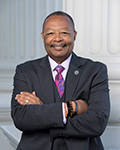
Photo of Reggie Jones-Sawyer
D California Assembly · District 57 · Former member

Asm. Reggie Jones-Sawyer

Contact Email
Compare
Total votes
26,638
all sessions
Attendance
97%
781 missed
Near the chamber average
With party
99%
of cast votes
Near the chamber average
Bipartisan score
0%
crosses aisle rarely
Near the chamber average
Sponsored
2,128
bills & resolutions
Near the chamber average
Committees
0
assignments
2,128 bills and resolutions

Sponsored bills

Total
2,128
Primary
269
Co-sponsor
1,859
This page
2,128
matching current filters
Co-sponsor ACR 216
Signed into law · California Assembly · Co-sponsor
Relative to 529 College Savings Day.

This measure would designate May 29, 2018, as 529 College Savings Day, to raise awareness about the importance of saving for college with the help of 529 college savings plans.

Signed into law Jun 1, 2018 1 co-sponsor
Primary AB 1941
Signed into law · California Assembly · Lead sponsor
Misdemeanors.

Existing law provides that a crime punishable with death, by imprisonment in the state prison, or by imprisonment in a county jail for more than one year is a felony and all other offenses, except those that are classified as infractions, are misdemeanors. Existing law further provides that a crime that is punishable, in the discretion of the court, as a felony or as a misdemeanor is a misdemeanor under certain circumstances, including when the court grants a defendant probation without imposing a sentence and, at the time of granting probation or on application of the defendant or probation officer thereafter, the court declares the offense to be a misdemeanor. This bill would make that condition authorizing the court to declare the offense to be a misdemeanor applicable regardless of whether the court imposes a sentence.

Signed into law Jun 1, 2018 0 co-sponsors
Primary AB 2706
In committee · California Assembly · Lead sponsor
Juvenile wards: discharge.

Existing law allows the Board of Juvenile Hearings to set a date on which a ward is to be discharged from the jurisdiction of the Department of Corrections and Rehabilitation, Division of Juvenile Justice under the supervision of the probation department of, and the jurisdiction of the court of, the committing county, or to deny discharge and hold the person for a total period of time that does not exceed the maximum term of physical confinement set by the juvenile court. Existing law requires the division, not less than 60 days prior to the scheduled discharge consideration hearing of a ward, to provide to the probation department and the court of the committing county, and the ward's counsel, if known, the most recent written review, as specified. This bill would authorize the probation department of the committing county to participate in the ward's reentry case conference with the Division of Juvenile Justice, in person or by video conferencing. The bill would also make technical and conforming changes.

In committee May 31, 2018 0 co-sponsors
Co-sponsor SB 1392
Failed · California Senate · Co-sponsor
Sentencing.

Existing law imposes an additional 3-year sentence for each prior separate prison term served by a defendant where the prior and current offense was a violent felony, as defined. If that provision does not apply, existing law instead imposes a one-year term for each prior separate prison term or county jail felony term under the law, except under specified circumstances. This bill would delete the provision that requires an additional one-year term. The bill would make additional technical, nonsubstantive changes.

Failed May 31, 2018 1 co-sponsor
Co-sponsor AB 2500
Failed · California Assembly · Co-sponsor
California Financing Law: consumer loans: charges.

(1) The California Financing Law (CFL) provides for the licensure and regulation of finance lenders and brokers by the Commissioner of Business Oversight. The CFL prohibits anyone from engaging in the business of a finance lender or broker without obtaining a license. A willful violation of the CFL is a crime, except as specified. Under existing law, a licensee who lends any sum of money is authorized to contract for and receive charges at a maximum rate that does not exceed specified sums on the unpaid principal balance per month, ranging from 2 12% to 1%, based on the consumer loan amount, as specified. This provision, however, does not apply to any loan of a bona fide principal amount of $2,500 or more, as determined in accordance with a provision governing regulatory ceilings and evasion of the CFL. The CFL also authorizes a licensee, as an alternative to the above-described rate charges for consumer loan amounts, to instead contract for and receive charges at the greater of a rate not exceeding 1.6% per month on the unpaid principal balance or a rate not exceeding 56 of 1% per month, plus a specified percentage per month, as established by the Federal Reserve Bank of San Francisco, on advances to member banks under federal law, or if there is no single determinable rate, the closest counterpart of this rate. Under existing law, these provisions do not apply to a loan of a bona fide principal amount of $2,500 or more, as specified. The CFL authorizes a licensee to contract for and receive an administrative fee of a specified amount that varies with the bona fide principal amount of the loan, including authorizing a licensee to receive an administrative fee of $75 with respect to a loan of a bona fide principal amount in excess of $2,500. This bill would authorize a licensee, with respect to a loan of a bona fide principal amount of $2,500 or more but less than $5,000, to contract for or receive no more than moneys paid for specified insurance and for charges, inclusive of an administrative fee that does not exceed $75, which in the aggregate amount exceed an annual simple interest rate of 36%. The bill would also authorize a licensee, as an alternative to these provisions, to contract for or receive no more than moneys paid for an administrative fee that does not exceed $90 and for charges, which in the aggregate amount do not exceed an annual simple interest rate of 36% or the sum of 30.75% plus the United States Prime Rate. (2) Existing law prohibits licensees subject to the CFL from entering into a contract for a consumer loan that provides for a scheduled repayment of principal over more than the maximum terms set forth in relation to the respective size of the loan. Among other things, this provision prohibits a loan of $3,000 but less than $5,000 from exceeding a maximum term of 60 months and 15 days. This bill would increase the maximum principal loan amount under the above schedule to $10,000. The bill would also prohibit a licensee from entering into a contract for a consumer loan that is in excess of $2,500 but less than $10,000 that provides for a scheduled repayment of principal that is less than 12 months. By expanding the application of the CFL to cover more loans, the bill would expand the scope of an existing crime, thereby imposing a state-mandated local program. (3) The CFL requires a statement showing in clear and distinct terms specified information relating to the loan to be delivered to the buyer when it is made. This bill would also require each licensee, prior to disbursement of loan proceeds in connection with certain loans exceeding $2,500 but less than $10,000, to offer a free credit education program or seminar to each borrower in accordance with certain conditions. (4) The CFL requires a licensed finance lender to permit payment to be made in advance in any amount on any contract of any loan at any time and authorizes the licensee to apply that payment first to any agreed prepayment penalty. This bill would prohibit a licensee from charging, imposing, or receiving any penalty for the prepayment of a loan, except as specified, and would make conforming changes to that effect. The bill would also make certain moneys paid to, and commissions and benefits received by, a licensee in connection with a loan that a buyer separately authorized as optional subject to adjustment and rebate if a loan contract is paid in full, as prescribed. (5) The CFL defines charges for its purposes to include aggregate interest, fees, bonuses, commissions, brokerage, discounts, expenses, and other forms of costs charged, contracted for, or received by a licensee or any other person in connection with the investigating, arranging, negotiating, procuring, guaranteeing, making, servicing, collecting, and enforcing of a loan or forbearance of money, credit, goods, or things in action, or any other service rendered. Existing law also specifies that charges do not include, among other things, fees paid to a licensee for the privilege of participating in an open-end-credit program, which fees are to cover administrative costs and are imposed upon executing the open-end loan agreement and on annual renewal dates or anniversary dates. This bill would delete the above exception for fees paid to a licensee for the privilege of participating in an open-end credit program, as specified. (6) The California Constitution requires the state to reimburse local agencies and school districts for certain costs mandated by the state. Statutory provisions establish procedures for making that reimbursement. This bill would provide that no reimbursement is required by this act for a specified reason.


Failed May 31, 2018 1 co-sponsor
Co-sponsor AB 1940
Failed · California Assembly · Co-sponsor
Parole: reintegration credits.

Under existing law, except as otherwise exempted, a person completing a term of imprisonment in the state prison shall be released for a period of supervised parole. Existing law specifies the length of parole for various classifications of inmates. Under existing law, an inmate is released to the county of his or her residence before incarceration or, when the interest of public safety is best served, to another location specified by the Board of Parole Hearings. Existing law authorizes the Board of Parole Hearings to establish and enforce rules and regulations governing parole. Existing regulations prohibit a parolee from traveling more than 50 miles from his or her residence without the approval of a parole agent. This bill would create a program under which the length of a parolee's period of parole would be reduced through the successful completion of specified education, training, or treatment programs, or by participating in volunteer service, while adhering to the conditions of parole. The bill would make this program inapplicable to a person who is required to register as a sex offender. The bill would also increase the 50-mile travel restriction for a parolee who successfully participates in the program, subject to certain restrictions. The bill would require the Department of Corrections and Rehabilitation and the Board of Parole Hearings to adopt regulations to carry out the program.

Failed May 31, 2018 1 co-sponsor
Co-sponsor AB 2995
Failed · California Assembly · Co-sponsor
Civil actions: injury to property: lead-based paint.

Existing law provides that an injury to property consists in depriving its owner of the benefit of it, which is done by taking, withholding, deteriorating, or destroying it. Existing law requires an action seeking relief based on an injury to property to be commenced within 3 years after the time that the cause of action has accrued. This bill would provide that the presence of lead paint on the surfaces of a residence or other building constitutes a physical injury to property. The bill would provide that an action to recover damages for that injury would not accrue until three years from the date the aggrieved party has actual knowledge of the presence of lead-based paint in or on that property, as specified. The bill would provide that receipt or knowledge of disclosures that residences built before 1978 are presumed to contain lead-based paint are not alone sufficient to establish that knowledge. The bill would make related findings and declarations. The bill would make these provisions retroactive. The bill would make these provisions severable.

Failed May 31, 2018 1 co-sponsor
Co-sponsor AJR 35
Passed · California Assembly · Co-sponsor
Relative to a Polish law on speech related to the Holocaust.

This measure would urge lawmakers in Poland to reverse or revise a recent Polish law on speech related to the Holocaust, would call on Congress to join that effort, and would call for a renewed commitment to Holocaust education in California.

Passed May 30, 2018 1 co-sponsor
Co-sponsor SCR 137
Signed into law · California Senate · Co-sponsor
Relative to Foster Care Month.

This measure would recognize the month of May 2018 as Foster Care Month as an opportunity to raise awareness about the challenges that children, and particularly lesbian, gay, bisexual, transgender, queer, and questioning (LGBTQ) youth, face in the foster care system, as specified.

Signed into law May 29, 2018 1 co-sponsor
Showing 1,281 to 1,290 of 2,128 bills