

Existing law, the Ralph C. Dills Act (Dills Act) , governs collective bargaining between the state and recognized state public employee organizations. Existing law excludes certain employees from coverage under the Dills Act, including, among others, managerial employees, supervisory employees, and confidential employees, as defined. Existing law creates the Public Employment Relations Board and authorizes it, among other things, to determine appropriate state employee bargaining units, as specified. This bill would enact the Legislature Employer-Employee Relations Act, to provide employees of the Legislature the right to form, join, and participate in the activities of employee organizations of their own choosing for the purpose of representation on all matters of employer-employee relations. The bill would prescribe rights, duties, and prohibitions in this context that parallel those in the Dills Act. The bill would prohibit the Public Employment Relations Board from including employees of the Legislature in a bargaining unit that includes employees other than those of the Legislature. The bill would make it a misdemeanor for any person to willfully resist, prevent, impede, or interfere with any member of the board, or any of its agents, in the performance of duties pursuant to its provisions. By expanding the definition of a crime, this bill would impose a state-mandated local program. The bill would provide that the provisions of the Legislature Employer-Employee Relations Act are severable. The bill would become operative on July 1, 2024. The California Constitution requires the state to reimburse local agencies and school districts for certain costs mandated by the state. Statutory provisions establish procedures for making that reimbursement. This bill would provide that no reimbursement is required by this act for a specified reason.
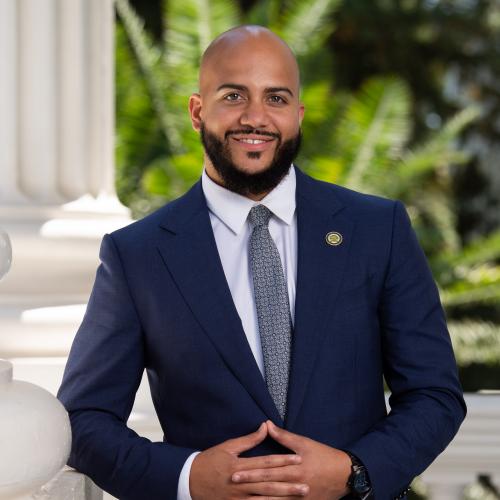
Asm. Isaac Bryan
Sponsored bills
Existing law establishes the Department of Housing and Community Development in the Business, Consumer Services, and Housing Agency and makes the department responsible for administering various housing programs throughout the state, including, among others, the Multifamily Housing Program, the Housing for a Healthy California Program, and the California Emergency Solutions Grants Program. Upon appropriation by the Legislature for this express purpose, this bill would require the department to create the Reentry Housing and Workforce Development Program, and would require the department to take specified actions to provide grants to applicants, as defined, for innovative or evidence-based housing, housing-based services, and employment interventions to allow people with recent histories of incarceration to exit homelessness and remain stably housed. The bill would require the department to establish a process, in collaboration with the Department of Corrections and Rehabilitation and with counties in which recipients are operating, for referral of participants, in accordance with certain guidelines and procedures. The bill would require the department to score applicants to the program competitively according to specified criteria. The bill would require recipients of funds from the program to use those funds for, among other things, long-term rental assistance in permanent housing, incentives to landlords, and innovative or evidence-based services to assist participants in accessing permanent supportive housing. The bill would require the department to distribute funds allocated by executing contracts with awarded entities for a term of 5 years, subject to automatic renewal. The bill would require a recipient of the program to submit an annual report to the department. The bill would require the department to hire an independent evaluator to assess outcomes from the program and would require the department to submit the analysis of that assessment to specified committees of the Legislature.
This measure would celebrate the history and culture of cruising and encourage local officials and law enforcement to work with local car clubs to conduct safe cruising events.
The Personal Income Tax Law authorizes various credits against the taxes imposed by that law, including a credit for qualified renters in the amount of $120 for spouses filing joint returns, heads of household, and surviving spouses if adjusted gross income is $50,000, as adjusted, or less, and in the amount of $60 for other individuals if adjusted gross income is $25,000, as adjusted, or less. This bill would require the Franchise Tax Board to prepare a written report by April 1, 2023, on the number of taxpayers claiming the credit, and the average credit amount on returns claiming the credit.
This measure would commend the Congress of the United States for enacting legislation that will alleviate and remedy the congestion of California's ports. The measure also would urge the Congress of the United States to enact further legislation to ensure that the state's importing and exporting capabilities are returned to prepandemic levels.
This measure would proclaim December 8, 2022, as Latina Equal Pay Day in California, in recognition of the need to eliminate the gender gap in earnings by women and to promote policies to ensure equal pay for all.
This measure would urge the President and the Congress of the United States to amend specified provisions of the federal Social Security Act to allow recipients of disabled adult child benefits under the act to continue to receive those benefits upon marriage.
This measure, among other things, would declare the last week of September 2022, and each year thereafter, as Sacramento-San Joaquin Delta Week, with the purpose of expanding the acknowledgment of the Sacramento-San Joaquin Delta region's contributions to a higher quality of life for all Californians.
This measure would designate a specified portion of State Route 710 in the City of Long Beach as the Long Beach International Gateway Bridge. The measure would request the Department of Transportation to determine the cost for appropriate signs showing this special designation and, upon receiving donations from nonstate sources covering that cost, to erect those signs.
This measure would recognize October 12, 2021, as the 20th anniversary of the enactment of the exemption from nonresident tuition for qualified students during the 2001–02 Regular Session. The measure would also call on the United States Congress to pass the American Families Plan and provide financial resources for undocumented students through the budget reconciliation process, and to adopt comprehensive immigration reform.