

Passed Sep 6, 2023
1 co-sponsor
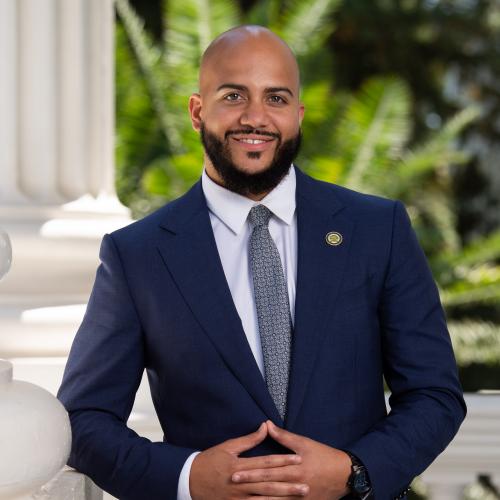
Asm. Isaac Bryan
Total votes
17,249
all sessions
Attendance
93%
744 missed
Near the chamber average
With party
99%
of cast votes
Near the chamber average
Bipartisan score
0%
crosses aisle rarely
Near the chamber average
Sponsored
1,230
bills & resolutions
Near the chamber average
Committees
12
assignments
1,230 bills and resolutions
Sponsored bills
Total
1,230
Primary
117
Co-sponsor
1,113
This page
1,230
matching current filters
Relative to the 50th anniversary of hip hop.
This measure would recognize the 50th anniversary of hip hop on August 11, 2023, as a time of celebration, pride, and nostalgia for the citizens of California.
Signed into law Sep 5, 2023
1 co-sponsor
Passed Sep 5, 2023
1 co-sponsor
Political Reform Act of 1974: disclosures: candidate experience.
(1) Existing law requires candidates to submit specified filings to declare their intent to run for elective office. Existing law, the Political Reform Act of 1974, additionally requires candidates for elective office to make various disclosures relating to a campaign for elective office. This bill would require, beginning on the January 1 after the Secretary of State certifies a CAL-ACCESS Replacement, a candidate for elective office to file, when the candidate files a declaration of candidacy, a form to disclose the candidate's prior education and work history, and history of military service, if any. The filing would contain a statement, signed under penalty of perjury, that the information contained in the form is accurate to the best of the candidate's knowledge. The bill would require the Fair Political Practices Commission to create a form for this purpose. The bill would require the Secretary of State to post on its internet website a copy of completed forms submitted by candidates, making such forms available to the public for 4 years from the date of the election associated with the filing. The bill would establish penalties and enforcement procedures for these requirements, as specified. The bill would state that it is the intent of the Legislature that a violation of these provisions be considered grounds for disqualification from elective office, and that a governing body with the power to remove an elected officer from an office may consider violation of this chapter as grounds for such removal. (2) The bill would include findings that changes proposed by this bill address a matter of statewide concern rather than a municipal affair and, therefore, apply to all cities, including charter cities. (3) A violation of the Political Reform Act of 1974 is punishable as a misdemeanor, and reports and statements filed under the act are required to be signed under the penalty of perjury. By expanding the scope of existing crimes, this bill would impose a state-mandated local program. The California Constitution requires the state to reimburse local agencies and school districts for certain costs mandated by the state. Statutory provisions establish procedures for making that reimbursement. This bill would provide that no reimbursement is required by this act for a specified reason. (4) The Political Reform Act of 1974, an initiative measure, provides that the Legislature may amend the act to further the act's purposes upon a 23 vote of each house of the Legislature and compliance with specified procedural requirements. This bill would declare that it furthers the purposes of the act.
Passed Sep 1, 2023
1 co-sponsor
Child welfare agencies: enforcement.
Existing law delegates to the Department of Child Support Services and local child support agencies the responsibility for collecting and enforcing child support obligations, including child support delinquencies, as defined. Existing law requires the State Department of Social Services to promulgate regulations for county child welfare departments, including, but not limited to, any case of separation or desertion of a parent from a child that results in foster care assistance payments, payments for a minor child placed in the same home as a minor or nonminor dependent parent, and California Work Opportunity and Responsibility to Kids (CalWORKs) payments to a caretaker relative of a child who comes within the jurisdiction of the juvenile court. Existing law requires those regulations to require the county child welfare department to determine whether it is in the best interests of the child or nonminor to have the case referred to the local child support agency for child support services. Existing law, on or before October 1, 2023, further requires those regulations to require the county child welfare department to presume that the payment of support by the parent is likely to pose a barrier to the proposed reunification. This bill would, on or before January 1, 2025, require the Department of Child Support Services to identify all child support referrals made pursuant to the above-described provisions prior to January 1, 2023. The bill would require the department to direct local child support agencies to cease enforcement of arrearages assigned to the state for the reimbursement of foster care placements and seek modification of child support orders when necessary to eliminate ongoing obligations, including the cancellation of all arrears owed to the state and any accrued interest. The bill would also require the department, on or before June 1, 2024, to implement these provisions by means of departmental letters or similar written instructions. By increasing the duties of the county child welfare department and the local child support agency, the bill would impose a state-mandated local program. The California Constitution requires the state to reimburse local agencies and school districts for certain costs mandated by the state. Statutory provisions establish procedures for making that reimbursement. This bill would provide that no reimbursement is required by this act for a specified reason.
Passed Sep 1, 2023
0 co-sponsors
Infractions: warrants and penalties.
(1) Existing law makes it a misdemeanor to willfully fail to appear in court, as specified. Existing law, when a person has failed to appear and has not posted bail, requires the magistrate to issue a warrant for the person's arrest within 20 days of the failure to appear. This bill would make those sections only apply when the underlying charge is not an infraction. (2) Existing law authorizes the issuance of a bench warrant of arrest when a person fails to appear in court as promised in specified criminal proceedings. This bill would prohibit the issuance of a bench warrant of arrest when the underlying crime is an infraction. (3) Existing law makes it a misdemeanor to willfully fail to appear in court for a violation of the Vehicle Code, and requires the court to report a conviction of this offense to the Department of Motor Vehicles. This bill would make that misdemeanor only apply when the underlying charge is not an infraction. The bill would also remove the requirement for the court to report a conviction of this offense to the department. (4) Existing law authorizes the imposition of a civil assessment or the issuance of an arrest warrant when a person fails to make an installment payment on bail imposed by the court for an infraction violation of the Vehicle Code. Existing law also makes it a misdemeanor to fail to pay bail in installments or to fail to pay a fine imposed for the violation of a state or local traffic law, and requires the court to report a conviction of this offense to the department. This bill would repeal the misdemeanor for failure to pay a bail installment or fine. The bill would remove the authorization to issue an arrest warrant for failure to pay a bail installment. The bill would also remove the requirement for the court to report a conviction of these offenses to the department. (5) Existing law, if a defendant does not appear at the time the case is called for a violation of the Vehicle Code, authorizes the court to declare the bail forfeited and order that no further proceedings be had in the case, or to issue a warrant for the arrest of the defendant. However, if a defendant is charged with specified crimes, including disposing of a flaming or glowing substance on or near a road and littering a highway, has previously been convicted of the same crime, and fails to appear at the time the case is called to trial, existing law authorizes the court to declare the bail forfeited and requires the court to issue a bench warrant for the arrest of the person charged, unless the magistrate finds that undue hardship will be imposed by requiring the defendant to appear. This bill would remove the requirement that the magistrate issue a bench warrant when the person has committed one of the crimes specified above.
Passed Sep 1, 2023
1 co-sponsor
Passed Sep 1, 2023
1 co-sponsor
Alternatives to cobalt mined in Africa using child slave labor.
This measure would declare that the Legislature should pass laws that halt the importation of cobalt or any product using cobalt mined in Africa using child slave labor and encourage the production of cobalt and other critical minerals ethically sourced from within the United States.
Signed into law Sep 1, 2023
1 co-sponsor
Prisons: visitation.
(1) Under existing law, a person sentenced to imprisonment in a state prison or in a county jail for a felony offense, as specified, may, during that period of confinement, be deprived of only those rights as is reasonably related to legitimate penological interests. Existing law enumerates certain civil rights of these prisoners, including the right to purchase, receive, and read newspapers, periodicals, and books accepted for distribution by the United States Post Office. This bill would include the right to personal visits by an intimate partner or a family member, as those terms are defined, as a civil right, as specified. The bill would provide that these civil rights may not be infringed, except as necessary and only if narrowly tailored to further a compelling security interest of the government, and would provide that any governmental action related to these civil rights may be reviewed in court for legal or factual error. (2) Existing law authorizes the Secretary of the Department of Corrections and Rehabilitation to prescribe and amend rules and regulations for the administration of prisons and requires regulations, which are adopted by the Department of Corrections and Rehabilitation and may impact the visitation of inmates. Existing law requires these regulations to recognize and consider the value of inmate visitation as a means of increasing safety in prisons, maintaining family and community connections, and preparing inmates for successful release and rehabilitation. Existing regulations create the framework for establishing a visitation process in prisons that is conducted in as accommodating a manner as possible, subject to the need to maintain order, the safety of persons, the security of institutions and facilities, and required prison activities and operations. This bill would additionally require those regulations pertaining to inmate visits to recognize and consider the right to personal visits as a civil right. The bill would prohibit the department from denying or restricting in-person contact visits except as specified, including as a disciplinary sanction against the incarcerated person who has committed a listed offense during a personal visit. The bill would require the department to inform both the visitor and the incarcerated person of the specific reason for any denial of a visit, as specified. The bill would require the department to provide at least 3 days of in-person visiting per week, with a minimum of 7 visiting hours per day.
Passed Sep 1, 2023
1 co-sponsor
Relative to outdoor workers.
This measure would recognize July 17, 2023, to July 23, 2023, as Outdoor Worker Appreciation Week.
Signed into law Aug 30, 2023
1 co-sponsor
Ask Maddy
·
AI policy assistant
Ask Maddy about Isaac Bryan
Scope: california
Hi! I can help you understand Isaac Bryan's legislative record. What would you like to know?
Try one of these
i
Maddy answers using official bill text and legislative records. Always verify before sharing.
Sources cited inline