

(1) Existing law requires the Natural Resources Agency, in implementing actions to achieve the goal to conserve at least 30% of the state's lands and coastal waters by 2030 established by executive order, to prioritize specified actions. Existing law requires the Secretary of the Natural Resources Agency to prepare and submit an annual report to the Legislature on the progress made during the prior calendar year toward achieving that goal, as provided. Existing law requires that annual report to include certain information, including, among other information, the progress made in the prior calendar year to address equity as part of the above-described goal. This bill, the Wildlife Connectivity and Climate Adaptation Act of 2024, would additionally require the agency, as part of that report, to include an update on the state's progress towards addressing the priority wildlife corridors, as defined, identified in the Restoring California's Wildlife Connectivity report by the Department of Fish and Wildlife, and goals for wildlife corridor protection in the next five years. The bill would also make related findings and declarations. (2) The Wildlife Conservation Law of 1947 requires the Wildlife Conservation Board to acquire real property, rights in real property, water, or water rights as necessary for a program to acquire lands and facilities suitable for recreational purposes and adaptable for the conservation, propagation, and utilization of state fish and game resources. The law establishes the program and makes a policy statement regarding the program and its purposes. This bill would additionally make it the policy of the state to preserve, protect, and restore wildlife habitats and biodiversity through the acquisition and restoration of blocks of habitat and natural lands that are connected by wildlife corridors, as defined, and the infrastructure that supports wildlife corridors. This bill would also require the board to identify priority projects for the acquisition, development, rehabilitation, restoration, protection, and expansion of wildlife corridors and open space. The bill would authorize the board to give priority for this purpose to projects that protect wildlife corridors, including wildlife corridors threatened by urban development, as specified. (3) Existing law requires the Department of Fish and Wildlife, contingent upon funding being provided by the Wildlife Conservation Board, or from other appropriate bond funds, upon appropriation by the Legislature, to investigate, study, and identify those areas in the state that are most essential as wildlife corridors and habitat linkages, as specified. Under existing law, it is the policy of the state to encourage, wherever feasible and practicable, voluntary steps to protect the functioning of wildlife corridors through various means, as specified. Existing law authorizes those means to include, but not be limited to, acquisition or protection of wildlife corridors as open space through conservation easements. This bill would remove from the contingency requirement that appropriate funds be from bonds and would specify that the department not only investigate, study, and identify, but also track the protection and conservation of the above-described areas. The bill would also revise and recast various provisions involving voluntary steps to protect the functioning of these wildlife corridors to additionally include, among other means, acquisition or protection of wildlife corridors as open space through fee title acquisitions.
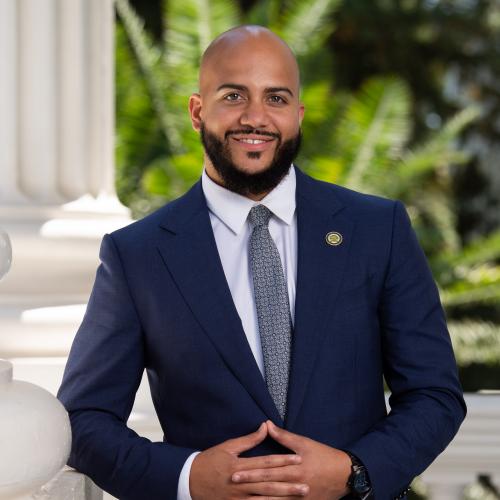
Asm. Isaac Bryan
Sponsored bills
Maddy summaryThis California Assembly resolution encourages the U.S. Congress to pass legislation creating a National Infrastructure Bank to fund critical repairs and upgrades for roads, bridges, dams, and other public works. The bill cites reports from the American Society of Civil Engineers highlighting billions of dollars in investment gaps and poor conditions affecting California's transportation and water systems. It advocates for a financing model that uses existing federal debt rather than new taxes, aiming to stimulate the economy, create jobs, and prioritize projects in disadvantaged communities. The resolution formally requests that federal leaders adopt this approach to address the state's urgent infrastructure needs.
Maddy summaryThis California House Resolution condemns the July 13, 2024, assassination attempt on former President Donald J. Trump and calls for an end to political violence. The measure highlights the event where Trump was wounded while speaking at a rally in Butler, Pennsylvania, and notes that one attendee died and others were injured while trying to protect him. It urges the state to foster a political environment based on respectful discourse and nonviolence. The resolution is a formal statement of the Assembly's stance and does not create new laws or change existing policies.
This measure would recognize the importance of California Native American Day, celebrated this year on September 27, 2024, and the annual California Indian Cultural Awareness Conference, to the enhancement of awareness of California Indian culture.
(1) The Personal Income Tax Law and the Corporation Tax Law allow various credits against the taxes imposed by those laws. This bill would, for taxable years beginning on or after January 1, 2025, and before January 1, 2030, allow a credit against the taxes imposed by those laws for portions of the costs for qualified services paid or incurred by a qualified taxpayer. The bill would define "qualified taxpayer" for this purpose to mean an eligible local news organization or a qualified broadcast station, as those terms are defined. The bill would require a taxpayer to request a tentative credit reservation from the Franchise Tax Board in the form and manner prescribed by the Franchise Tax Board, and would limit the amount of credit allocated by the Franchise Tax Board per calendar year. The bill would require the Franchise Tax Board to prioritize reservations by qualified small publications, as defined and specified. The bill would allow a payment from the continuously appropriated Tax Relief and Refund Account for an allowable credit in excess of tax liability to a qualified renter, as provided. By authorizing new payments from the Tax Relief and Refund Account in excess of personal income tax liabilities, the bill would make an appropriation. (2) The Personal Income Tax Law and Corporation Tax Law impose taxes measured by income. Those taxes are administered by the Franchise Tax Board pursuant to specified law, the violation of which is a crime. This bill, for taxable years beginning on or after January 1, 2026, and in addition to the taxes imposed under the Personal Income Tax Law and the Corporation Tax Law, would impose a tax upon gross receipts derived from data extraction transactions at a rate of 7.25% of those gross receipts in excess of $2,500,000,000. The bill would define a "data extraction transaction" for these purposes to mean a transaction where a person sells user information or access to users to advertisers and the person engages in a barter by providing services to a user in full or partial exchange for the ability to display advertisements to the user or collect data about the user, except as provided. The bill would exclude a news media entity, as defined, from the provisions of this tax as either a taxpayer or a user. The bill would establish the Data Extraction Mitigation Fee Fund in the State Treasury, and would direct all revenues from the tax, less refunds and reimbursements, be deposited into the fund, as specified. The bill would appropriate $15,000,000 for journalism fellowships, as specified, and would require the remaining moneys in the fund, except as provided, to be used, upon appropriation, for grants to eligible nonprofit local news organizations administered by the Franchise Tax Board, as specified. The bill would require the Franchise Tax Board to administer this tax in accordance with existing franchise and income tax law provisions, the violation of which is a crime. By expanding the crimes related to the franchise and income tax laws, this bill would impose a state-mandated local program. (3) The Personal Income Tax Law and Corporation Tax Law, in modified conformity with federal income tax laws, generally allow various deductions in computing the income that is subject to tax imposed under those laws, including miscellaneous itemized deductions that are allowed only to the extent that the aggregate amount of those deductions exceeds 2% of adjusted gross income. This bill, for taxable years beginning on or after January 1, 2026, would allow a deduction in computing the income that is subject to those laws equal to the amount of taxes paid by the taxpayer under the above-described data extraction transaction tax. (4) Existing law requires any bill authorizing a new tax expenditure to contain, among other things, specific goals that the tax expenditure will achieve, detailed performance indicators, and data collection requirements. This bill would include additional information required for any bill authorizing a new tax expenditure. (5) This bill would make findings and declarations related to a gift of public funds. (6) The California Constitution requires the state to reimburse local agencies and school districts for certain costs mandated by the state. Statutory provisions establish procedures for making that reimbursement. This bill would provide that no reimbursement is required by this act for a specified reason. (7) This bill would declare that it is to take effect immediately as an urgency statute.
Maddy summaryThis bill establishes Filipino American History Month to recognize the long-standing contributions of Filipinos to California and the United States. It directly affects state officials and the public by designating a specific month for commemoration and education. The resolution highlights historical milestones, including early Spanish-era interactions, the development of Filipino communities in cities like Stockton and San Francisco, and the significant roles Filipinos played in agriculture, shipbuilding, and military service during World War II. By formally acknowledging these events, the bill aims to promote awareness of Filipino American heritage within the state.
Existing law provides for the inadmissibility of certain evidence as a matter of public policy. This bill would provide that participation in and communications made during a restorative justice process are inadmissible and not subject to discovery in civil, criminal, juvenile, administrative, or other proceedings, except as specified. The California Constitution provides for the Right to Truth-in-Evidence, which requires a 23 vote of the Legislature to exclude any relevant evidence from any criminal proceeding, as specified. This bill would prohibit communications made during a restorative justice process from being used in a criminal proceeding, thereby requiring a 23 vote.
Maddy summaryThis bill designates November 22, 2024, as Kimchee Day in California to honor the traditional Korean dish and its cultural significance. It acknowledges the long history of kimchee, the contributions of Korean Americans, and the dish's recognized health benefits and growing popularity in the United States. The resolution directs the Assembly's Chief Clerk to send copies of the document to the author for distribution.
Maddy summaryThis bill is a House Resolution that formally recognizes Diwali as a significant cultural and religious holiday for Indian Americans and South Asian Americans in California. It acknowledges the festival's importance to Hindus, Sikhs, Buddhists, and Jains by highlighting its historical roots and the specific meanings it holds for each group. The resolution expresses the Assembly's respect for these communities and encourages Californians to participate in the celebration of lights on November 1, 2024. As a commemorative measure, the bill does not alter laws or funding but serves to officially honor the occasion within the state legislature.
Maddy summaryThis bill designates the week of June 3, 2024, as Sacramento Valley Ecosystem Awareness Week to highlight the region's unique natural and agricultural resources. The measure acknowledges the area's importance for migratory birds, endangered fish species, and rice farming while promoting efforts to restore local ecosystems. It expresses legislative support for the Floodplain Forward Coalition, a group working to improve water management and environmental health in the valley. The resolution serves as a formal recognition of these ecological values rather than creating new laws or funding.