This measure would declare April 28, 2022, as Take Our Daughters and Sons to Work Day, and would recognize the goals of introducing our daughters and sons to the workplace and commend all participants of Take Our Daughters And Sons To Work Day.
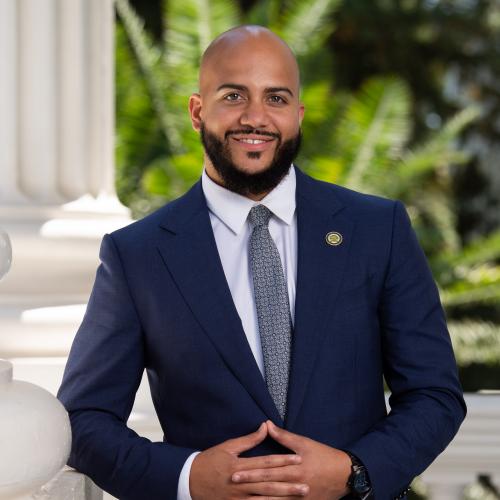
Asm. Isaac Bryan
Sponsored bills
This measure would designate the week of May 1, 2022, through May 7, 2022, as Compost Awareness Week.
This measure would proclaim, in perpetuity, the month of April as California Wines: Down to Earth Month, to celebrate the sustainable leadership of California wineries and winegrape growers throughout the month of April.
Existing law, referred to as the Medical Injury Compensation Reform Act of 1975 (MICRA) , prohibits an attorney from contracting for or collecting a contingency fee for representing any person seeking damages in connection with an action for injury or damage against a health care provider based upon alleged professional negligence in excess of specified limits. This bill would recast those provisions and base the amount of contingency fee that may be contracted for upon whether recovery is pursuant to settlement agreement and release of all claims executed before a civil complaint or demand for arbitration is filed, or pursuant to settlement, arbitration, or judgment after a civil complaint or demand for arbitration is filed, as specified. The bill would add and revise definitions for these purposes. Existing law provides that in any action against a health care provider based upon professional negligence, the injured plaintiff is entitled to recover noneconomic losses to compensate for pain, suffering, inconvenience, physical impairment, disfigurement, and other nonpecuniary damage. Existing law limits the amount of damages for noneconomic losses in an action for injury against a health care provider based on professional negligence to $250,000. This bill would remove the $250,000 limit on noneconomic damages and expand the recast provisions to include an action for injury against a health care institution, as defined. The bill would increase the applicable limitation based upon whether the action for injury involved wrongful death. The bill would specify that these limitations would increase by $40,000 each January 1st for 10 years and beginning on January 1, 2034, the applicable limitations on noneconomic damages for personal injury and for wrongful death would be adjusted for inflation on January 1st of each year by 2%. Existing law specifies that in any action for injury or damages against a provider of health care services, a superior court shall, at the request of either party, enter a judgment ordering that money damages or its equivalent for future damages of the judgment creditor be paid in whole or in part by periodic payments rather than by a lump-sum payment if the award equals or exceeds $50,000. This bill would increase the minimum amount of the judgment required to request periodic payments to $250,000. Existing law makes statements, writings, or benevolent gestures expressing sympathy or a general sense of benevolence relating to the pain, suffering, or death of a person involved in an accident and made to that person, or to the family of that person, inadmissible as evidence of an admission of liability in a civil action. This bill would specify that statements, writings, or benevolent gestures expressing sympathy, regret, a general sense of benevolence, or suggesting, reflecting, or accepting fault relating to the pain, suffering, or death of a person, or to an adverse patient safety event or unexpected health care outcome, as specified, shall be confidential, privileged, protected, not subject to subpoena, discovery, or disclosure, and shall not be used or admitted into evidence in any civil, administrative, regulatory, licensing, or disciplinary board, agency, or body action or proceeding, and shall not be used or admitted in relation to any sanction, penalty, or other liability, as evidence of an admission of liability or for any other purpose.

Existing law, generally, punishes the violation of serious felonies by incarceration in the state prison. This bill would create the Commission on Alternatives to Incarceration within the California Health and Human Services Agency to study alternatives to incarceration, alternative crisis response models, and the effects of family separation in the jail and state prison systems. The bill would require the commission to report its findings and make recommendations to the Legislature no later than February 1, 2024, as specified.
The Personal Income Tax Law and the Corporation Tax Law allow various credits against the taxes imposed by those laws. This bill, for each taxable year beginning on or after January 1, 2023, and before January 1, 2028, would allow a credit against the taxes imposed under both laws to a qualified taxpayer, as defined, that employs an eligible individual in a prescribed amount, not exceeding $30,000, based on the number of hours an eligible individual worked for the eligible employer during the taxable year. The bill would define the term "eligible individual" to mean a person who is at least 16 years of age but not older than 26 years of age, who spent time in foster care on or after becoming 13 years of age, and who is verified by a county child welfare agency or the State Department of Social Services, as provided. By expanding the duties of a county child welfare agency, this bill would impose a state-mandated local program. Existing law requires a bill that would authorize a new tax expenditure under the Personal Income Tax Law or the Corporation Tax Law to identify specific goals, purposes, and objectives that the tax expenditure will achieve and detailed performance indicators and data collection requirements for determining whether the tax expenditure achieves these goals, purposes, and objectives. This bill would include additional information required for a bill authorizing a new tax expenditure. The California Constitution requires the state to reimburse local agencies and school districts for certain costs mandated by the state. Statutory provisions establish procedures for making that reimbursement. This bill would provide that, if the Commission on State Mandates determines that the bill contains costs mandated by the state, reimbursement for those costs shall be made pursuant to the statutory provisions noted above. This bill would take effect immediately as a tax levy.
Existing law establishes the California Health and Human Services Agency and further establishes various departments and committees in the agency. Existing law also establishes various mental health programs, including, among others, the Lanterman-Petris-Short Act and the Children's Mental Health Services Act. This bill would, contingent upon appropriation and to be operative for one fiscal year following the appropriation, establish the Survivor Support and Harm Prevention Pilot Program, to be administered by the agency, with the purpose of funding noncarceral, nonpunitive, prevention-oriented, and therapeutic programs that support survivors of crime and otherwise support individuals who have experienced violence or trauma of any nature. The bill would require the agency to solicit applications from counties interested in hosting the pilot program and would require the agency to work with no more than 5 counties, as specified. The bill would require the Counties of Los Angeles and Alameda to be participating counties. The bill would require participating counties to establish an Office of Survivor Support and Harm Reduction, as specified. The bill would authorize a county Office of Survivor Support and Harm Reduction to provide or contract with community-based organizations to provide various services, including housing support options. The bill would require participating counties to meet certain requirements, including ensuring that programs and services funded by the county are provided through a noncarceral approach to safety. The bill would require law enforcement officers in participating counties to provide specified advice to victims of crime. The bill would require the Office of Survivor Support and Harm Reduction to provide at least 90% of grant funds to qualifying community-based organizations. The bill would require the agency to convene a stakeholder workgroup to oversee the program to be made up of specified members. The bill would require the agency to convene monthly meetings with the stakeholder workgroup and to post a yearly summary of the meetings on its internet website. The bill would require the agency to create a uniform mechanism for participating counties to collect and report, to the agency, data necessary to most effectively provide services and ensure community safety, and would require participating counties to provide that data to the best of their abilities. By imposing new duties on the Counties of Los Angeles and Alameda, the bill would impose a state-mandated local program. The California Constitution requires the state to reimburse local agencies and school districts for certain costs mandated by the state. Statutory provisions establish procedures for making that reimbursement. This bill would provide that, if the Commission on State Mandates determines that the bill contains costs mandated by the state, reimbursement for those costs shall be made pursuant to the statutory provisions noted above.
This measure would respectfully memorialize the President of the United States and the Congress of the United States to take action to restore honor to Bernard B. James, and to take the necessary actions to ensure the treatment of Bernard B. James is rectified by a full exoneration, including having the military record of Bernard B. James cleared of any court judgment and less-than-honorable discharge.