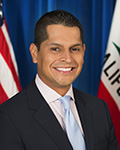
Photo of Miguel Santiago
D California Assembly · District 54 · Former member

Asm. Miguel Santiago

Contact Email
Compare
Total votes
24,138
all sessions
Attendance
98%
333 missed
Higher than 98% of chamber peers
With party
99%
of cast votes
Higher than 90% of chamber peers
Bipartisan score
0%
crosses aisle rarely
Lower than 93% of chamber peers
Sponsored
1,963
bills & resolutions
Higher than 76% of chamber peers
Committees
0
assignments
1,963 bills and resolutions

Sponsored bills

Total
1,963
Primary
251
Co-sponsor
1,712
This page
1,963
matching current filters
Co-sponsor ACR 216
Signed into law · California Assembly · Co-sponsor
Relative to 529 College Savings Day.

This measure would designate May 29, 2018, as 529 College Savings Day, to raise awareness about the importance of saving for college with the help of 529 college savings plans.

Signed into law Jun 1, 2018 1 co-sponsor
Co-sponsor AJR 35
Passed · California Assembly · Co-sponsor
Relative to a Polish law on speech related to the Holocaust.

This measure would urge lawmakers in Poland to reverse or revise a recent Polish law on speech related to the Holocaust, would call on Congress to join that effort, and would call for a renewed commitment to Holocaust education in California.

Passed May 30, 2018 1 co-sponsor
Primary AB 2306
In committee · California Assembly · Lead sponsor
Student financial aid: Cal Grant Program.

Existing law, the Cal Grant Program, establishes the Cal Grant A and B Entitlement Awards, the California Community College Transfer Entitlement Awards, the Competitive Cal Grant A and B Awards, the Cal Grant C Awards, and the Cal Grant T Awards under the administration of the Student Aid Commission, and establishes eligibility requirements for awards under these programs for participating students attending qualifying institutions. The program prohibits an applicant from receiving one or a combination of program awards in excess of the amount equivalent to the award level for a total of a 4-year period of full-time attendance in an undergraduate program, except as provided. This bill would increase this generally applicable maximum for total Cal Grant awards to a community college applicant to the award level for a 6-year period of full-time attendance. The bill would provide that this 6-year period of Cal Grant eligibility shall carry over to any 4-year qualifying institution if the applicant transfers from a community college to a 4-year qualifying institution, but shall not exceed the 6-year maximum in total.

In committee May 25, 2018 0 co-sponsors
Co-sponsor AB 2216
In committee · California Assembly · Co-sponsor
Human trafficking victims assistance: grants.

Existing law creates the Human Trafficking Victims Assistance Fund in the State Treasury. Existing law makes the Office of Emergency Services responsible for awarding grants, based on specified criteria, to qualified nonprofit organizations that provide services to victims of human trafficking. This bill would also require the office to conduct a prevalence study to better understand human trafficking in California and a comprehensive audit and evaluative study of qualified nonprofit organizations that are awarded grants pursuant to these provisions. The bill would also state the intent of the Legislature to annually enact legislation in the Budget Act that would appropriate $15,000,000 from the General Fund to the Office of Emergency Services for the purpose of awarding grants to support programs for victims of human trafficking, increasing technical assistance provided to, and training of, qualified nonprofit organizations, and conducting the studies described above.

In committee May 25, 2018 1 co-sponsor
Primary AB 1949
In committee · California Assembly · Lead sponsor
Explosives: flamethrowing devices.

Existing law prohibits a person from using or possessing a flamethrowing device without a valid flamethrowing device permit, as issued by the State Fire Marshal if specified conditions are met. Existing law provides that any person who uses or possesses any flamethrowing device without a valid flamethrowing device permit is guilty of a public offense, as provided. Existing law defines a flamethrowing device as any nonstationary and transportable device designed or intended to emit or propel a burning stream of combustible or flammable liquid a distance of at least 10 feet. This bill would instead define a Tier I flamethrowing device as any nonstationary and transportable device designed or intended to emit or propel a burning stream of combustible or flammable liquid a distance of at least 10 feet and would require additional conditions to be met before the State Fire Marshal could issue or renew a permit to use and possess a Tier I flamethrowing device, including that the applicant or permitholder have a valid pyrotechnic operator license. The bill would also define a Tier II flamethrowing device as either any stationary, nonstationary, or transportable device designed or intended to emit or propel a burning stream of combustible or flammable liquid a distance of at least 2 feet, but not exceeding 10 feet, or any stationary, nonstationary, or transportable device designed or intended to emit or propel a burning stream of combustible or flammable gas a distance of at least 10 feet. The bill would prohibit a seller of a Tier I flamethrowing device, subject to criminal penalty, from selling the device to a person who does not possess a valid Tier I flamethrowing device permit. By expanding the scope of a crime, the bill would create a state-mandated local program. The bill would, as of January 1, 2018, prohibit a person from distributing, selling, or offering for sale a Tier II flamethrowing device in California unless the device bears a specified safety warning. The bill would also provide that a person who sells a flamethrowing device in violation of these provisions is jointly and severally liable in any civil action for damages caused by that device. The bill would also make conforming changes. The California Constitution requires the state to reimburse local agencies and school districts for certain costs mandated by the state. Statutory provisions establish procedures for making that reimbursement. This bill would provide that no reimbursement is required by this act for a specified reason.

In committee May 25, 2018 0 co-sponsors
Co-sponsor AB 1789
In committee · California Assembly · Co-sponsor
Occupational safety and health: Valley Fever.

The California Occupational Safety and Health Act of 1973 provides the Division of Occupational Safety and Health within the Department of Industrial Relations with the power, jurisdiction, and supervision over all employment and places of employment necessary to enforce and administer all occupational health and safety laws,and standards and to protect employees. The Occupational Safety and Health Standards Board, an independent entity within the department, has the exclusive authority to adopt occupational safety and health standards within the state. Existing law requires every employer to comply with those standards. A violation of these standards and regulations under specific circumstances is a crime. This bill would require the board to adopt occupational safety and health standards for state public works projects to prevent and control coccidioidomycosis, more commonly known as Valley Fever. By expanding the definition of an existing crime, this bill would impose a state-mandated local program. The California Constitution requires the state to reimburse local agencies and school districts for certain costs mandated by the state. Statutory provisions establish procedures for making that reimbursement. This bill would provide that no reimbursement is required by this act for a specified reason.

In committee May 25, 2018 1 co-sponsor
Co-sponsor AB 2066
In committee · California Assembly · Co-sponsor
Personal income taxes: credit: earned income: eligible individual.

The Personal Income Tax Law, beginning on or after January 1, 2015, in modified conformity with federal income tax laws, allows an earned income tax credit against personal income tax and a payment from the Tax Relief and Refund Account for an allowable credit in excess of tax liability, to an eligible individual that is equal to that portion of the earned income tax credit allowed by federal law as determined by the earned income tax credit adjustment factor, as specified. An "eligible individual" is defined to include specified individuals, and provides that, if a person does not have a qualifying child, he or she must be between 25 and 65 years of age at the end of the taxable year. Additionally existing law, in conformity with federal income tax laws, requires the taxpayer and the qualifying child to have a social security number to be eligible for the credit. This bill, for each taxable year beginning on or after January 1, 2019, would revise the age requirement for the definition of an "eligible individual," with regard to persons who do not have a qualifying child, to require solely that the person must have attained 18 years of age. The bill, for each taxable year beginning on or after January 1, 2019, would require the taxpayer and the qualifying child to have a social security number or a federal individual taxpayer identification number in order to be eligible for the earned income tax credit. Existing law establishes the continuously appropriated Tax Relief and Refund Account and provides that payments required to be made to taxpayers or other persons from the Personal Income Tax Fund are to be paid from that account, including any amount to be paid as an earned income tax credit in excess of any tax liabilities. This bill, for each taxable year beginning on or after January 1, 2019, would authorize new payments from that account, upon appropriation by the Legislature, for additional amounts in excess of personal income tax liabilities. This bill would take effect immediately as a tax levy.


In committee May 25, 2018 1 co-sponsor
Primary AB 2817
In committee · California Assembly · Lead sponsor
Firearms: emergency transfers.

Existing law requires the transfer of a firearm, including the loan of a firearm, to be conducted through a licensed dealer, except as exempted. Existing law requires a dealer processing the transfer of a firearm to, among other requirements and subject to certain exemptions, hold the firearm for a specified period of time before transfer, obtain a background check of the person receiving the firearm, and report the transfer to the Department of Justice. Existing law also requires a person purchasing or receiving a firearm to possess a firearm safety certificate or handgun safety certificate. This bill would exempt from those requirements the temporary transfer of a firearm that is voluntarily made for the purpose of preventing a suicide attempt using that firearm, as specified. The bill would make other conforming changes.

In committee May 25, 2018 0 co-sponsors
Showing 1,431 to 1,440 of 1,963 bills