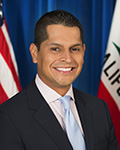
Photo of Miguel Santiago
D California Assembly · District 54 · Former member

Asm. Miguel Santiago

Contact Email
Compare
Total votes
24,138
all sessions
Attendance
98%
333 missed
Higher than 98% of chamber peers
With party
99%
of cast votes
Higher than 90% of chamber peers
Bipartisan score
0%
crosses aisle rarely
Lower than 93% of chamber peers
Sponsored
1,963
bills & resolutions
Higher than 76% of chamber peers
Committees
0
assignments
1,963 bills and resolutions

Sponsored bills

Total
1,963
Primary
251
Co-sponsor
1,712
This page
1,963
matching current filters
Co-sponsor ACR 86
Signed into law · California Assembly · Co-sponsor
Relative to Juneteenth.

This measure would recognize June 19, 2019, as Juneteenth and would urge the people of California to join in celebrating Juneteenth as a day to honor and reflect on the significant role that African Americans have played in the history of the United States and how they have enriched society through their steadfast commitment to promoting unity and equality.

Signed into law Jul 23, 2019 1 co-sponsor
Co-sponsor AJR 8
Signed into law · California Assembly · Co-sponsor
Invasive species: federal Nutria Eradication and Control Act of 2003.

The federal Nutria Eradication and Control Act of 2003 authorizes the Secretary of the Interior, subject to the availability of appropriations, to provide financial assistance to the State of Maryland and the State of Louisiana for a program to implement measures to eradicate or control nutria and restore marshland damaged by nutria. Under the federal act, the federal share of the costs of the program is prohibited from exceeding 75% of the total costs of the program. This measure would urge the United States Congress to reauthorize and specifically add California to the Nutria Eradication and Control Act of 2003 and to authorize an appropriation of $4,000,000 to help the state implement a nutria eradication program.

Signed into law Jul 18, 2019 1 co-sponsor
Co-sponsor SJR 4
Signed into law · California Senate · Co-sponsor
Relative to Title X.

This measure would urge the United States Department of Health and Human Services to rescind the new Title X regulations that will impede access to essential, time-sensitive health care for low-income individuals across California and the nation.

Signed into law Jul 15, 2019 1 co-sponsor
Co-sponsor ACR 4
Signed into law · California Assembly · Co-sponsor
Relative to the CHP Officer Kirk Griess Memorial Highway.

This measure would designate the portion of Interstate 505 between the Interstate 80 interchange and the Vaca Valley Parkway in the County of Solano as the CHP Officer Kirk Griess Memorial Highway. The measure would request the Department of Transportation to determine the cost of appropriate signs showing this special designation and, upon receiving donations from nonstate sources covering that cost, to erect those signs.

Signed into law Jul 8, 2019 1 co-sponsor
Co-sponsor AB 4
Passed · California Assembly · Co-sponsor
Medi-Cal: eligibility.

Existing law establishes the Medi-Cal program, which is administered by the State Department of Health Care Services and under which qualified low-income individuals receive health care services. The Medi-Cal program is, in part, governed and funded by federal Medicaid program provisions. Federal law prohibits payment to a state for medical assistance furnished to an alien who is not lawfully admitted for permanent residence or otherwise permanently residing in the United States under color of law. Existing law requires individuals under 19 years of age enrolled in restricted-scope Medi-Cal at the time the Director of Health Care Services makes a determination that systems have been programmed for implementation of these provisions to be enrolled in the full scope of Medi-Cal benefits, if otherwise eligible, pursuant to an eligibility and enrollment plan, which includes outreach strategies. Existing law makes the effective date of enrollment for those individuals the same day that systems are operational to begin processing new applications pursuant to the director's determination, and requires the department to seek any necessary federal approvals to obtain federal financial participation for purposes of implementing the requirements. Existing law requires that benefits for services under these provisions be provided with state-only funds only if federal financial participation is not available for those services. Existing law requires the department, until the director makes the above-described determination, to provide monthly updates to specified legislative committees on the status of the implementation of these provisions. This bill would extend eligibility for full-scope Medi-Cal benefits to individuals of all ages, if otherwise eligible for those benefits, but for their immigration status, and would delete provisions delaying eligibility and enrollment until the director makes the determination described above. The bill would require the department to provide, indefinitely, the above-described monthly updates to the legislative committees. The bill would expand the requirements of the eligibility and enrollment plan, such as ensuring that an individual maintains their primary care provider without disruption, as specified. The bill would require the department to collaborate with the counties and designated public hospitals to maximize federal financial participation and to work with designated public hospitals to mitigate any financial losses related to the implementation of these requirements. The bill would condition the implementation of its provisions on an appropriation by the Legislature in the annual Budget Act or other measure for that purpose. Because counties are required to make Medi-Cal eligibility determinations and this bill would expand Medi-Cal eligibility, the bill would impose a state-mandated local program. The California Constitution requires the state to reimburse local agencies and school districts for certain costs mandated by the state. Statutory provisions establish procedures for making that reimbursement. This bill would provide that, if the Commission on State Mandates determines that the bill contains costs mandated by the state, reimbursement for those costs shall be made pursuant to the statutory provisions noted above.

Passed Jul 2, 2019 1 co-sponsor
Co-sponsor AJR 4
Signed into law · California Assembly · Co-sponsor
Relative to firearms.

This measure would urge Congress to swiftly enact House Resolution 8, the Bipartisan Background Checks Act of 2019, to require background checks for all firearm sales.

Signed into law Jul 2, 2019 1 co-sponsor
Co-sponsor AJR 9
Signed into law · California Assembly · Co-sponsor
Immigration enforcement tactics.

This measure would urge the federal government to stop using ruses against immigrants, revise the tactics used by United States Immigration and Customs Enforcement (ICE) , cease the unjust detention of undocumented immigrants, end blanket raids against individuals thought to be without documents, and adopt a standard uniform for ICE officers that clearly identifies them as ICE when operating in California.

Signed into law Jul 2, 2019 1 co-sponsor
Primary AB 1784
Passed · California Assembly · Lead sponsor
Elections: open-source paper ballot voting systems.

Existing law prohibits the use of a voting system unless it has been certified or conditionally approved by the Secretary of State, or approved by the Secretary of State as part of a pilot program, prior to the election at which it is to be used. This bill, the Secure the VOTE Act, would authorize the Secretary of State to award up to $16,000,000 in matching funds, upon appropriation by the Legislature, to counties for the development of open-source paper ballot voting systems.

Passed Jul 1, 2019 0 co-sponsors
Co-sponsor SB 630
Signed into law · California Senate · Co-sponsor
Human trafficking.

Existing law requires specified businesses and other establishments, including, among others, airports, intercity passenger rail or light rail stations, bus stations, and truck stops, to post a notice, as developed by the Department of Justice, that contains information relating to slavery and human trafficking, including information regarding specified nonprofit organizations that a person can call for services or support in the elimination of slavery and human trafficking. Existing law also requires, on or before January 1, 2021, specified businesses or other establishments that operate an intercity passenger rail, light rail, or bus station to provide training to new and existing employees who may interact with, or come into contact with, a victim of human trafficking or who are likely to receive, in the course of their employment, a report from another employee about suspected human trafficking, in recognizing the signs of human trafficking and how to report those signs to the appropriate law enforcement agency, as specified. Existing law makes a business or establishment that fails to comply with the requirements of these provisions liable for a civil penalty of $500 for a first offense, and $1,000 for each subsequent offense. This bill would specify that these provisions do not prevent a local governing body from adopting and enforcing a local ordinance, rule, or regulation to prevent slavery or human trafficking, as specified.


Signed into law Jul 1, 2019 1 co-sponsor
Showing 1,221 to 1,230 of 1,963 bills