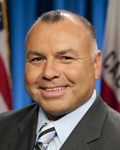
Photo of Freddie Rodriguez
D California Assembly · District 53 · Former member

Asm. Freddie Rodriguez

Contact Email
Compare
Total votes
23,465
all sessions
Attendance
95%
988 missed
Near the chamber average
With party
99%
of cast votes
Near the chamber average
Bipartisan score
0%
crosses aisle rarely
Near the chamber average
Sponsored
2,071
bills & resolutions
Near the chamber average
Committees
0
assignments
2,071 bills and resolutions

Sponsored bills

Total
2,071
Primary
239
Co-sponsor
1,832
This page
2,071
matching current filters
Co-sponsor ACR 145
Signed into law · California Assembly · Co-sponsor
Relative to Maternal Health Awareness Day.

This measure would proclaim January 23, 2020, as Maternal Health Awareness Day, to draw attention to the efforts that have improved maternal health in California and to highlight the need for continued improvement of maternal health for all women.

Signed into law Feb 20, 2020 1 co-sponsor
Primary AB 2392
In committee · California Assembly · Lead sponsor
Government Operations Agency: State Geographic Information Officer.

Existing law establishes the Department of Technology within the Government Operations Agency, which is supervised by the Director of Technology. Existing law authorizes the director and the department to exercise various powers in creating and managing the information and technology policy of the state. Existing law includes among the director's duties the duty to perform enterprise information technology functions and services, including, but not limited to, implementing Geographic Information Systems (GIS) and sharing services, applications, and program and project management activities in partnership with other agencies. This bill would establish the position of the State Geographic Information Officer (State GIO) within the Government Operations Agency. The bill would task the State GIO with analyzing the geospatial data collected statewide to identify gaps or areas of duplication and coordinating the state's geographic information projects, among other duties. The bill would also establish the California Geographic Information System Advisory Council composed of state GIS users, for the purpose of advising the State GIO on issues of policy and implementation. Specifically, the bill would require the council to be responsible for determining rules and policies involving defining GIS standards and responsibilities, identifying strategies for sharing within the statewide GIS platform, and recommending strategies for collaborative GIS projects.

In committee Feb 19, 2020 0 co-sponsors
Co-sponsor AB 2011
In committee · California Assembly · Co-sponsor
West San Bernardino County Rail Construction Authority.

Existing law creates the Metro Gold Line Foothill Extension Construction Authority for the purpose of awarding and overseeing all design and construction contracts for completion of the Los Angeles-Pasadena Foothill Extension Gold Line light rail project extending from Union Station in the City of Los Angeles to Sierra Madre Villa Boulevard in the City of Pasadena and any mass transit guideway that may be planned east of Sierra Madre Villa Boulevard along the rail right-of-way extending to the City of Montclair. This bill would create the West San Bernardino County Rail Construction Authority for purposes of awarding and overseeing all design and construction contracts for completion of an extension of the Metro Gold Line light rail project from the City of Montclair to the Ontario International Airport. The bill would prescribe the powers and duties of the construction authority. The bill would require the construction authority to be governed by a board consisting of 7 voting members and one nonvoting member. The city councils of the Cities of Montclair, Ontario, Rancho Cucamonga, and Upland would each appoint one member to the governing board and the Los Angeles County Metropolitan Transportation Authority (LACMTA) , the Ontario International Airport Authority (OIAA) , and the San Bernardino County Transportation Authority (SBCTA) would each appoint one member. The nonvoting member would be appointed by the Governor. The bill would require the construction authority and the SBCTA to enter into an agreement for the construction authority to hold in trust all real property interests held by the SBCTA that are necessary for the planning, design, and construction of the project at no cost to the construction authority. The bill would require the construction authority to enter into a memorandum of understanding with the SBCTA that specifically authorizes the SBCTA to review any significant changes in the scope of the design or construction, or both design and construction, of the project, as specified. The bill would require the construction authority to coordinate its work in the City of Montclair with the Metro Gold Line Foothill Extension Construction Authority, as specified, and would require the construction authority to coordinate its work in the City of Ontario with the OIAA. The bill would prohibit the construction authority from encumbering the project with any obligation that is transferable to LACMTA or the SBCTA upon completion of the design and construction of the project without the consent of those entities, except the bill would require the SBCTA to assume responsibility for operating all completed phases of the project. The bill would require the construction authority to be dissolved upon completion of the project. This bill would create a state-mandated local program by imposing these duties on local government entities. The California Constitution requires the state to reimburse local agencies and school districts for certain costs mandated by the state. Statutory provisions establish procedures for making that reimbursement. This bill would provide that, if the Commission on State Mandates determines that the bill contains costs mandated by the state, reimbursement for those costs shall be made pursuant to the statutory provisions noted above.

In committee Feb 14, 2020 1 co-sponsor
Co-sponsor ACR 110
Passed · California Assembly · Co-sponsor
Relative to reproductive care and abortion services.

This measure, among other things, would declare that California is a Reproductive Freedom State for All and provide that the Legislature is committed to guaranteeing the constitutionally protected right to an abortion and supporting efforts to increase access to the best available reproductive and pregnancy-related care for women and pregnant individuals.

Passed Feb 12, 2020 1 co-sponsor
Co-sponsor AB 505
Failed · California Assembly · Co-sponsor
Student financial aid: Cal Grant B, Cal Grant C, and federal Pell Grant awards: financial aid book advance program.

Existing federal law establishes the federal Pell Grant Program under Title IV of the federal Higher Education Act of 1965 to provide need-based grant awards to low-income students in order to promote access to postsecondary education. Existing law, known as the Ortiz-Pacheco-Poochigian-Vasconcellos Cal Grant Program, establishes, among other programs, the Cal Grant B program and the Cal Grant C program under the administration of the Student Aid Commission and establishes eligibility requirements for awards under those programs. This bill, beginning with the 2020–21 academic year, would require an institution of higher education, as a condition of its participation in the Cal Grant Program, to implement a financial aid book advance program that would provide a line of credit for the purchase of books and educational materials at bookstores owned by or located on the campus of the institution to each student who is owed a credit balance for certain financial aid awards and who has not opted out of the program. The bill would provide for a reduction in the amount of the award moneys disbursed to the student based upon the amount of credit expended by the student at the institution's bookstores and would provide for reimbursement to the institution's bookstores for that amount. The bill would exempt from these requirements an institution that does not have a bookstore and an institution that provides its students with all of their financial aid award moneys that the institution disburses on or before the 7th day of the academic semester or term.

Failed Feb 3, 2020 1 co-sponsor
Primary AB 27
Failed · California Assembly · Lead sponsor
Emergency Ambulance Employee Safety and Preparedness Act.

Existing law, the Emergency Ambulance Employee Safety and Preparedness Act, an initiative measure enacted by the voters by Proposition 11 at the November 6, 2018, statewide general election, requires every emergency ambulance employee to annually receive employer-paid training relating to, among other things, responding to active shooter and mass casualty incidents and preventing violence against emergency ambulance employees and patients. Existing law requires the training to be provided free of charge to an emergency ambulance employee and requires the employee to be compensated at the employee's regular hourly rate of pay while participating in the training. This bill would additionally require every current emergency ambulance employee, on or before July 1, 2020, and every new employee hired on or after January 1, 2020, within 6 months of being hired, to attend a 6-hour training on violence prevention that includes, among other things, understanding types of anger, proven and effective verbal deescalation skills, and hands-on demonstrations, workshops, and role-playing scenarios. The bill would require an emergency ambulance employee, following the completion of the 6-hour violence prevention training, to receive a one-hour refresher course each calendar year thereafter. The bill would require the training to be provided free of charge to an emergency ambulance employee and would require the employee to be compensated at the employee's regular hourly rate of pay while participating in the training. Under existing law, every emergency ambulance employee is entitled to employer-paid mental health services through an employee assistance program (EAP) . Existing law requires the EAP coverage to provide up to 10 mental health treatments per issue, per calendar year. This bill would require an emergency ambulance employee who requests mental health treatment for critical incident stress management, as defined, or post-traumatic stress disorder (PTSD) , to receive in-person treatment from a qualified professional who is trained in the areas of critical incident stress management or PTSD. The act permits amendment by the Legislature by a 45 vote of each house if the amendment is consistent with, and furthers the purposes of, the act.


Failed Feb 3, 2020 0 co-sponsors
Showing 1,001 to 1,010 of 2,071 bills