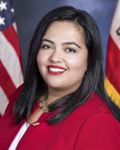
Photo of Wendy Carrillo
D California Assembly · District 52 · Former member

Asm. Wendy Carrillo

Contact Email
Compare
Total votes
22,342
all sessions
Attendance
97%
347 missed
Higher than 83% of chamber peers
With party
99%
of cast votes
Higher than 90% of chamber peers
Bipartisan score
0%
crosses aisle rarely
Lower than 93% of chamber peers
Sponsored
1,612
bills & resolutions
Near the chamber average
Committees
0
assignments
1,612 bills and resolutions

Sponsored bills

Total
1,612
Primary
171
Co-sponsor
1,441
This page
1,612
matching current filters
Co-sponsor SCR 96
Signed into law · California Senate · Co-sponsor
Relative to anniversary of Los Angeles Riots.

This measure would recognize the 30th anniversary of the Los Angeles Riots on April 29, 2022, as a time of building and reflection for the citizens of Los Angeles and the citizens of California.

Signed into law May 27, 2022 1 co-sponsor
Co-sponsor SCR 99
Signed into law · California Senate · Co-sponsor
Relative to Take Our Daughters And Sons To Work Day.

This measure would declare April 28, 2022, as Take Our Daughters and Sons to Work Day, and would recognize the goals of introducing our daughters and sons to the workplace and commend all participants of Take Our Daughters And Sons To Work Day.

Signed into law May 27, 2022 1 co-sponsor
Co-sponsor AB 2713
In committee · California Assembly · Co-sponsor
Tenant protections: just cause termination: rent caps.

Existing law, until January 1, 2030, prohibits an owner, as defined, of residential real property from terminating a tenancy without just cause, stated in the written notice to terminate the tenancy, after a tenant has continuously and lawfully occupied a residential real property for 12 months. Existing law defines "just cause" to mean certain at-fault just causes, including default in the payment of rent, and certain no-fault just causes, including intent to occupy the residential real property by the owner or the owner's spouse, domestic partner, children, grandchildren, parents, or grandparents, as prescribed, withdrawal of the residential real property from the rental market, and intent to demolish or to substantially remodel the residential real property. This bill would revise the intent to occupy just-cause provision described above to mean a good faith intent to occupy the residential real property by the owner or the owner's spouse, domestic partner, children, grandchildren, parents, or grandparents for at least 3 consecutive years. The bill would, among other things, prohibit an owner from terminating a tenancy under that provision if the same owner or relative already occupies a unit on the residential real property or if there is a vacancy on the residential real property. The bill would define the term "owner" for purposes of that provision to mean an owner who is a natural person who has at least a 51% recorded ownership interest in the property. This bill would revise the withdrawal of the residential real property from the rental market just-cause provision described above to mean withdrawal of all of the rental units at the residential real property from the rental market for the purpose of changing the property's use from residential use to nonresidential use or for the purpose of selling each unit on the property for owner-occupancy, only if both of certain criteria are true and described with particularity in a notice to the tenant required to terminate the tenancy, including the owner has previously provided the tenant with a written notice of intent to withdraw the unit from the rental market and describing the intended use of the property 180 days before serving the notice to terminate the tenancy. This bill would revise the intent to demolish or to substantially remodel the residential real property just-cause provision described above by, among other things, requiring an owner to, before issuing a notice to terminate a tenancy based on that just cause, obtain any necessary permits for the demolition or substantial remodel from the applicable governmental agencies. Existing law, until January 1, 2030, prohibits an owner of residential real property from, over the course of any 12-month period, increasing the gross rental rate for a dwelling or a unit more than 5% plus the percentage change in the cost of living, or 10%, whichever is lower, of the lowest gross rental rate charged for that dwelling or unit at any time during the 12 months before the effective date of the increase, as prescribed. This bill would make unenforceable any lease provision that would result in an increase in the gross rental rate for a dwelling unit that exceeds those limits, as specified.

In committee May 26, 2022 1 co-sponsor
Co-sponsor AB 2820
Passed · California Assembly · Co-sponsor
The California Online Community College.

Existing law establishes the California Community Colleges, under the administration of the Board of Governors of the California Community Colleges, as one of the segments of public postsecondary education in this state. The board of governors appoints the Chancellor of the California Community Colleges as the chief executive officer of the segment. Existing law establishes the California Online Community College, under the administration of the board of governors, for purposes of creating an organized system of accessible, flexible, and high-quality online content, courses, and programs focused on providing industry-valued credentials compatible with the vocational and educational needs of Californians who are not currently accessing higher education. This bill would make the California Online Community College Act inoperative on January 1, 2024. On or before January 1, 2024, the bill would appropriate the California Online Community College's funding for specified purposes at the California Community Colleges, as provided.

Passed May 25, 2022 1 co-sponsor
Co-sponsor SCR 90
Signed into law · California Senate · Co-sponsor
Relative to Women and Girls in STEM Week.

This measure would designate April 3, 2022, to April 9, 2022, inclusive, as Women and Girls in STEM Week and would encourage all citizens and community organizations to support the observance of California's Women and Girls in STEM Week by encouraging and celebrating women in the STEM fields.

Signed into law May 24, 2022 1 co-sponsor
Co-sponsor SCR 88
Signed into law · California Senate · Co-sponsor
Relative to California Wines: Down to Earth Month.

This measure would proclaim, in perpetuity, the month of April as California Wines: Down to Earth Month, to celebrate the sustainable leadership of California wineries and winegrape growers throughout the month of April.

Signed into law May 24, 2022 1 co-sponsor
Co-sponsor AB 35
Signed into law · California Assembly · Co-sponsor
Civil damages: medical malpractice.

Existing law, referred to as the Medical Injury Compensation Reform Act of 1975 (MICRA) , prohibits an attorney from contracting for or collecting a contingency fee for representing any person seeking damages in connection with an action for injury or damage against a health care provider based upon alleged professional negligence in excess of specified limits. This bill would recast those provisions and base the amount of contingency fee that may be contracted for upon whether recovery is pursuant to settlement agreement and release of all claims executed before a civil complaint or demand for arbitration is filed, or pursuant to settlement, arbitration, or judgment after a civil complaint or demand for arbitration is filed, as specified. The bill would add and revise definitions for these purposes. Existing law provides that in any action against a health care provider based upon professional negligence, the injured plaintiff is entitled to recover noneconomic losses to compensate for pain, suffering, inconvenience, physical impairment, disfigurement, and other nonpecuniary damage. Existing law limits the amount of damages for noneconomic losses in an action for injury against a health care provider based on professional negligence to $250,000. This bill would remove the $250,000 limit on noneconomic damages and expand the recast provisions to include an action for injury against a health care institution, as defined. The bill would increase the applicable limitation based upon whether the action for injury involved wrongful death. The bill would specify that these limitations would increase by $40,000 each January 1st for 10 years and beginning on January 1, 2034, the applicable limitations on noneconomic damages for personal injury and for wrongful death would be adjusted for inflation on January 1st of each year by 2%. Existing law specifies that in any action for injury or damages against a provider of health care services, a superior court shall, at the request of either party, enter a judgment ordering that money damages or its equivalent for future damages of the judgment creditor be paid in whole or in part by periodic payments rather than by a lump-sum payment if the award equals or exceeds $50,000. This bill would increase the minimum amount of the judgment required to request periodic payments to $250,000. Existing law makes statements, writings, or benevolent gestures expressing sympathy or a general sense of benevolence relating to the pain, suffering, or death of a person involved in an accident and made to that person, or to the family of that person, inadmissible as evidence of an admission of liability in a civil action. This bill would specify that statements, writings, or benevolent gestures expressing sympathy, regret, a general sense of benevolence, or suggesting, reflecting, or accepting fault relating to the pain, suffering, or death of a person, or to an adverse patient safety event or unexpected health care outcome, as specified, shall be confidential, privileged, protected, not subject to subpoena, discovery, or disclosure, and shall not be used or admitted into evidence in any civil, administrative, regulatory, licensing, or disciplinary board, agency, or body action or proceeding, and shall not be used or admitted in relation to any sanction, penalty, or other liability, as evidence of an admission of liability or for any other purpose.


Signed into law May 23, 2022 1 co-sponsor
Co-sponsor AB 1941
In committee · California Assembly · Co-sponsor
State Supplementary Program for the Aged, Blind, and Disabled: supplemental aid.

Existing law establishes the State Supplementary Program for the Aged, Blind, and Disabled (SSP) , which requires the State Department of Social Services to contract with the United States Secretary of Health and Human Services to make payments to SSP recipients to supplement Supplemental Security Income (SSI) payments made available pursuant to the federal Social Security Act. Under existing law, benefit payments under SSP are calculated by establishing the maximum level of nonexempt income and federal SSI and state SSP benefits for each category of eligible recipient. The state SSP payment is the amount required, when added to the nonexempt income and SSI benefits available to the recipient, to provide the maximum benefit payment. Existing law, commencing January 1, 2022, requires the amount of aid paid under SSP that is in effect on December 31, 2021, less the federal benefit portion received, to be increased by a percentage increase that the State Department of Social Services and the Department of Finance determines can be accomplished with $291,287,000, and, subject to an appropriation in the Budget Act of 2023, requires an additional grant increase commencing January 1, 2024, subject to the same calculations, notifications, and implementation as the first increase. Existing law continuously appropriates funds for the implementation of SSP. This bill would, if there is a surplus in the state budget and subject to an appropriation in the annual Budget Act, require a recipient of aid paid under SSP to receive a monthly supplemental payment in the amount of $600 for the following calendar year. The bill would provide that the continuous appropriation would not be made for purposes of implementing these provisions.

In committee May 19, 2022 1 co-sponsor
Primary AB 2276
In committee · California Assembly · Lead sponsor
Dental assistants.

Existing law, the Dental Practice Act, establishes a Dental Assisting Council of the Dental Board of California to regulate the examination, licensure, and permitting of dental assistants. Existing law authorizes a dental assistant to perform basic supportive dental procedures, including the application of topical fluoride under the direct supervision of a supervising licensed dentist. This bill would additionally authorize dental assistants to polish the coronal surfaces of teeth or apply pit and fissure sealants under the direct supervision of a licensed dentist when the dental assistant has completed specified training and provided evidence of the completion of that training to the board. The bill would require the supervising dentist and dental practice where the procedure is performed to be responsible for determining the competency of the dental assistant. The bill would also require the dentist practice to maintain a record of compliance with the training requirements for a minimum of 2 years after the dental assistant leaves the dental practice.

In committee May 19, 2022 0 co-sponsors
Showing 681 to 690 of 1,612 bills
Previous 1 … 68 69 70 … 162 Next