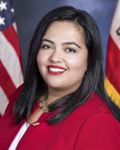
Photo of Wendy Carrillo
D California Assembly · District 52 · Former member

Asm. Wendy Carrillo

Contact Email
Compare
Total votes
22,342
all sessions
Attendance
97%
347 missed
Higher than 83% of chamber peers
With party
99%
of cast votes
Higher than 90% of chamber peers
Bipartisan score
0%
crosses aisle rarely
Lower than 93% of chamber peers
Sponsored
1,612
bills & resolutions
Near the chamber average
Committees
0
assignments
1,612 bills and resolutions

Sponsored bills

Total
1,612
Primary
171
Co-sponsor
1,441
This page
1,612
matching current filters
Co-sponsor ACR 206
Passed · California Assembly · Co-sponsor
Relative to India's Independence Day.

This measure would recognize August 15, 2022, as India's Independence Day and urge all Californians to join in celebrating India's independence.

Passed Aug 16, 2022 1 co-sponsor
Primary AB 2501
Passed · California Assembly · Lead sponsor
Before and after school programs: California Universal Afterschool Program Workgroup.

The After School Education and Safety Program Act of 2002, an initiative statute approved by the voters as Proposition 49 at the November 5, 2002, statewide general election, establishes the After School Education and Safety (ASES) Program under which participating public schools receive grants to operate before and after school programs serving pupils in kindergarten or any of grades 1 to 9, inclusive. Existing federal law establishes the 21st Century Community Learning Centers program to provide pupils with academic enrichment and other activities during nonschool hours or periods when school is not in session, as provided. Existing law establishes the Expanded Learning Opportunities Program to provide funds to school districts and certain charter schools to offer, outside of any instructional time, expanded learning opportunities, as defined, to pupils enrolled in classroom-based instructional programs in kindergarten and grades 1 to 6, inclusive, under specified funding methodologies and program conditions. This bill would establish the California Universal Afterschool Program Workgroup within the State Department of Education composed of certain members, including members appointed by the department, to evaluate policy and regulatory impediments to ensuring the quality of and increased access to after school programs and any access impediments faced by pupils and their families, develop legislative and regulatory recommendations and specific proposals to reduce those impediments, and develop a roadmap for providing universal access to after school programs to all schoolage children, as provided. The bill would appropriate an unspecified amount from the General Fund to the department to support the workgroup's activities, and would require the workgroup to, among other things, provide a final report to the Legislature and the department on or before October 1, 2024. The bill would require the workgroup to be maintained through December 31, 2024, and would repeal these provisions on January 1, 2025.

Passed Aug 11, 2022 0 co-sponsors
Co-sponsor AB 2507
Passed · California Assembly · Co-sponsor
The Universal Afterschool and Expanded Learning Opportunities Program: the After School Education and Safety Program: the 21st Century Community Learning Centers Program.

(1) Existing law establishes the Expanded Learning Opportunities Program to provide funds to school districts and certain charter schools to offer, outside of any instructional time, expanded learning opportunities, as defined, to pupils enrolled in classroom-based instructional programs in kindergarten and grades 1 to 6, inclusive, under specified funding methodologies and program conditions. This bill would rename the Expanded Learning Opportunities Program as the Universal Afterschool and Expanded Learning Opportunities Program and would change references to "expanded learning opportunity programs" to instead refer to "afterschool programs." The bill would express the intent of the Legislature to commit more public funding to provide pupils in grades 7 to 12, inclusive, with a welcoming and enriching space through afterschool programs. (2) The After School Education and Safety Program Act of 2002, an initiative statute approved by the voters as Proposition 49 at the November 5, 2002, statewide general election, establishes the After School Education and Safety (ASES) Program under which participating public schools receive grants to operate before and after school programs serving pupils in kindergarten or any of grades 1 to 9, inclusive. The act requires an amount not to exceed $550,000,000 to be continuously appropriated to the State Department of Education from the General Fund in each fiscal year for purposes of the program, and requires the amount to be allocated to public elementary, middle, and junior high schools according to a specified priority scheme, as provided. The act authorizes the Legislature to amend the provisions containing that priority scheme only by a statute, enacted by a 23 vote of each house and signed by the Governor, that furthers the purposes of the act. If the Legislature appropriates at least $5,000,000,000 for a fiscal year in the annual Budget Act or any other statute for purposes of funding the Universal Afterschool and Expanded Learning Opportunities Program, this bill would require, notwithstanding any other law, at least a certain percentage of the total amount appropriated pursuant to the act or by the Legislature in the annual Budget Act or another statute or for purposes of the ASES program to be allocated on a priority basis for programs serving middle school pupils, as provided. The bill would set forth a legislative finding and declaration that the bill furthers the purposes of the act. (3) Existing federal law establishes the 21st Century Community Learning Centers Program to provide pupils with academic enrichment and other activities during nonschool hours or periods when school is not in session, as provided. Under the program, of the total amount appropriated for after school grants to community learning centers, at least 50% is required to be allocated on a priority basis to community learning centers serving high school pupils and at least 40% is required to be allocated on a priority basis to community learning centers serving elementary and middle school pupils, as provided. In any fiscal year in which the total appropriation exceeds the 2008–09 fiscal year's total appropriation for the program, the excess amount is required to be allocated on a priority basis as 35% to community learning centers serving high school pupils, 50% to community learning centers serving elementary and middle school pupils, and 15% to community learning centers with summer programs serving elementary and middle school pupils, as provided. If the Legislature appropriates at least $5,000,000,000 for a fiscal year in the annual Budget Act or any other statute for purposes of funding the Universal Afterschool and Expanded Learning Opportunities Program, this bill instead would require, of the total amount appropriated pursuant to the program, regardless of that total amount exceeding the program's total 2008–09 fiscal year appropriation, to be allocated on a priority basis with at least 60% to community learning centers serving high school pupils, at least 20% to community learning centers serving middle school pupils, and at least 15% to those centers serving elementary school pupils. (4) Commencing with the 2023–24 fiscal year, the bill would require the department, each fiscal year, to provide an add-on to a grant received under the After School Education and Safety Program of 2002 or the 21st Century Community Learning Centers Program to increase the grant by a specified cost-of-living adjustment, as provided. Commencing with the 2023–24 fiscal year, the bill would, each fiscal year, appropriate an amount necessary to implement these add-on grant provisions from the General Fund to the department for purposes of these provisions. (5) This bill would also make nonsubstantive and conforming changes. (6) Funds appropriated by this bill would be applied toward the minimum funding requirements for school districts and community college districts imposed by Section 8 of Article XVI of the California Constitution.


Passed Aug 11, 2022 1 co-sponsor
Primary AB 2100
Passed · California Assembly · Lead sponsor
CalFresh: Restaurant Meals Program.

Existing federal law provides for the federal Supplemental Nutrition Assistance Program (SNAP) , known in California as CalFresh, under which supplemental nutrition assistance benefits allocated to the state by the federal government are distributed to eligible individuals by each county. Existing federal law authorizes eligible counties to participate in the Restaurant Meals Program (RMP) , which allows eligible homeless, elderly, and disabled recipients to purchase meals at qualified restaurants. Existing law specifies that, for the purposes of these provisions, a restaurant includes, but is not necessarily limited to, an on-campus qualifying food facility, an eat-in establishment, a grocery store delicatessen, and a takeaway-only restaurant, unless it is specifically excluded from participation in the RMP by federal law or guidance. This bill would, to the extent permitted by federal law, make all CalFresh recipients eligible to participate in the RMP, and would require the State Department of Social Services to seek all necessary waivers to implement the expanded eligibility. The bill would also replace most uses of the term "restaurant" with the term "establishment," and would explicitly include within the meaning of an establishment a military commissary and all locations within a grocery store where one can purchase ready-to-eat foods.

Passed Aug 11, 2022 0 co-sponsors
Co-sponsor AB 1862
Passed · California Assembly · Co-sponsor
Tribally Approved Homes Compensation Program.

Existing federal law, the Indian Child Welfare Act of 1978 (ICWA) , governs the proceedings for determining the placement of an Indian child when that child is removed from the custody of the child's parent or guardian. Existing law specifies that the state is committed to protecting the essential tribal relations and best interest of an Indian child by promoting practices in accordance with ICWA. Existing law authorizes a federally recognized tribe to approve a home for the purpose of foster or adoptive placement of an Indian child pursuant to ICWA and authorizes a tribe to designate a tribal organization to do the same. This bill would establish the Tribally Approved Homes Compensation Program to provide funding to eligible tribes and tribal organizations in California to assist in funding the costs associated with recruiting and approving homes for the purpose of foster or adoptive placement of an Indian child pursuant to ICWA, as described above. The bill would, subject to an appropriation for this purpose in the annual Budget Act, require the State Department of Social Services to provide annual allocations of $75,000 to eligible tribes and tribal organizations in each fiscal year and would require a tribe or tribal organization to submit to the department a letter of intent for funding, as specified, in order to be eligible for the funding allocation. The bill would require a tribe or tribal organization that receives funding pursuant to the program to submit a progress report to the department following the close of the fiscal year in which an allocation was received that includes details about how many homes were approved, recruitment efforts, and challenges experienced during the fiscal year that was funded and would require the department to annually compile those progress reports and submit a report to the Legislature, as specified.

Passed Aug 11, 2022 1 co-sponsor
Co-sponsor SB 21
Passed · California Senate · Co-sponsor
Specialized license plates: mental health awareness.

Under existing law, a state agency is authorized to apply to the Department of Motor Vehicles (DMV) to sponsor a specialized license plate program, and the DMV is required to issue those license plates if the agency meets certain requirements. Existing law also requires the DMV to charge specified fees for certain services related to the issuance of those plates. This bill would require the State Department of Education to apply to the DMV to sponsor a mental health awareness license plate program, and would require the DMV to issue the license plates if the State Department of Education meets certain requirements. The bill would also establish the Mental Health Awareness Fund in the State Treasury and would require the revenue generated from the license plates to be deposited in the fund for use, upon appropriation by the Legislature to the State Department of Education, for mental health services in public schools.

Passed Aug 11, 2022 1 co-sponsor
Showing 591 to 600 of 1,612 bills
Previous 1 … 59 60 61 … 162 Next