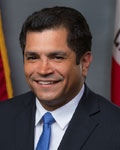
Photo of Jimmy Gomez
D California Assembly · District 51

Asm. Jimmy Gomez

Compare
Total votes
12,855
all sessions
Attendance
97%
270 missed
Near the chamber average
With party
99%
of cast votes
Near the chamber average
Bipartisan score
0%
crosses aisle rarely
Near the chamber average
Sponsored
644
bills & resolutions
Lower than 88% of chamber peers
Committees
0
assignments
644 bills and resolutions

Sponsored bills

Total
644
Primary
99
Co-sponsor
545
This page
644
matching current filters
Co-sponsor SCR 88
Signed into law · California Senate · Co-sponsor
Relative to Human Trafficking Awareness Month.

This measure would proclaim the month of January 2016 as Human Trafficking Awareness Month, encourage all Californians to become educated about human trafficking and work to eradicate these criminal practices within and beyond our borders, and encourage Members of the Legislature, as well as organizations, businesses, and individuals, to host or sponsor and attend community events in order to bring visibility and support to efforts made by nongovernmental organizations to recognize and combat human trafficking.

Signed into law Feb 1, 2016 1 co-sponsor
Primary AB 757
Vetoed · California Assembly · Lead sponsor
Healing arts: clinical laboratories.

Existing law provides for the licensure, registration, and regulation of clinical laboratories and various clinical laboratory personnel by the State Department of Public Health, with specified exceptions. A violation of those provisions is a crime. Existing law authorizes a person who is licensed under those provisions to perform certain laboratory tests. This bill, until January 1, 2019, would authorize a person with specified qualifications to perform a total protein refractometer test using an automatic, button-operated refractometer with a digital readout in a licensed plasma collection facility in this state. Because a violation of those provisions would be a crime, the bill would impose a state-mandated local program. The California Constitution requires the state to reimburse local agencies and school districts for certain costs mandated by the state. Statutory provisions establish procedures for making that reimbursement. This bill would provide that no reimbursement is required by this act for a specified reason.

Vetoed Jan 15, 2016 0 co-sponsors
Primary AB 88
Vetoed · California Assembly · Lead sponsor
Sales and use taxes: exemption: energy or water efficient home appliances.

(1) Existing sales and use tax laws impose a tax on retailers measured by the gross receipts from their sales of tangible personal property sold at retail in this state, or on the storage, use, or other consumption of tangible personal property purchased from a retailer for storage, use, or other consumption in this state, and specify certain exemptions from the amount of tax imposed. This bill, until January 1, 2021, would exempt from these taxes the gross receipts from the sale of, and the storage, use, or other consumption in this state of, an energy or water efficient home appliance purchased by a public utility that is provided at no cost to a low-income participant in a federal, state, or ratepayer-funded energy or water efficiency program for use by that low-income participant in the energy efficiency program. The bill would define terms for its purposes. (2) The Bradley-Burns Uniform Local Sales and Use Tax Law authorizes counties and cities to impose local sales and use taxes in conformity with the Sales and Use Tax Law, and existing law authorizes districts, as specified, to impose transactions and use taxes generally in accordance with the Transactions and Use Tax Law, which generally conforms to the Sales and Use Tax Law. Amendments to state sales and use taxes are incorporated into these laws. Section 2230 of the Revenue and Taxation Code provides that the state will reimburse counties and cities for revenue losses caused by the enactment of sales and use tax exemptions. This bill would provide that, notwithstanding Section 2230 of the Revenue and Taxation Code, no appropriation is made and the state shall not reimburse any local agencies for sales and use tax revenues lost by them pursuant to this bill. (3) This bill would take effect immediately as a tax levy, but its operative date would depend on its effective date.

Vetoed Jan 15, 2016 0 co-sponsors
Primary AB 1230
Signed into law · California Assembly · Lead sponsor
California Americans With Disabilities Small Business Capital Access Loan Program.

Existing law provides various programs to expand access to persons with disabilities and promote compliance with the federal Americans with Disabilities Act of 1990. Existing law establishes the Capital Access Loan Program, which is administered by the California Pollution Control Financing Authority (authority) to assist small businesses to finance the costs of complying with environmental mandates and the remediation of contamination on their properties. This bill would establish the California Americans with Disabilities Act Small Business Capital Access Loan Program within the Capital Access Loan Program, to create a self-sustaining program to provide loans to assist small businesses in financing the costs of projects that alter or retrofit existing small business facilities, meeting specified criteria, to comply with the federal Americans with Disabilities Act. This bill would authorize the authority to administer the program, including adopting regulations, and controlling funds appropriated for the program, as specified. This bill would establish the California Americans with Disabilities Act Small Business Capital Access Loan Program Fund, as a continuously appropriated fund, and require the authority to use the fund for all its purposes. This bill would also transfer $10,000,000 from the General Fund to the California Americans with Disabilities Act Small Business Capital Access Loan Program Fund.

Signed into law Oct 11, 2015 0 co-sponsors
Primary AB 1431
Signed into law · California Assembly · Lead sponsor
Local Agency Public Construction Act: job order contracting.

Existing law, the Local Agency Public Construction Act, authorizes job order contracting, as provided, by the Los Angeles Unified School District (LAUSD) , until December 31, 2020. This bill would repeal the provisions relating to the LAUSD and would instead authorize job order contracting in a similar manner for school districts until January 1, 2022. The bill would restrict job order contracting pursuant to the bill to school districts that have entered into a project labor agreement or agreements, as defined, that will apply to all public works in excess of $25,000 undertaken by the school district through at least December 31, 2021, regardless of what contracting procedure is used to award that work. The bill would require job order contractors to submit a questionnaire to the school district containing specified information verified under oath. By expanding the crime of perjury, this bill would impose a state-mandated local program. The California Constitution requires the state to reimburse local agencies and school districts for certain costs mandated by the state. Statutory provisions establish procedures for making that reimbursement. This bill would provide that no reimbursement is required by this act for a specified reason.

Signed into law Oct 10, 2015 0 co-sponsors
Co-sponsor SB 4
Signed into law · California Senate · Co-sponsor
Health care coverage: immigration status.

Existing law provides for the Medi-Cal program, which is administered by the State Department of Health Care Services, under which qualified low-income individuals receive health care services. The Medi-Cal program is, in part, governed and funded by federal Medicaid program provisions. Existing law extends eligibility for full-scope Medi-Cal benefits to individuals under 19 years of age who do not have, or are unable to establish, satisfactory immigration status, commencing after the Director of Health Care Services determines that systems have been programmed for implementation of this extension, but in no case sooner than May 1, 2016. Existing law requires these individuals to enroll in a Medi-Cal managed care health plan in those counties in which a Medi-Cal managed care health plan is available. This bill would require individuals under 19 years of age enrolled in restricted-scope Medi-Cal at the time the director makes the above-described determination to be enrolled in the full scope of Medi-Cal benefits, if otherwise eligible, pursuant to an eligibility and enrollment plan, as specified. The bill would require the department, beginning January 31, 2016, and until the director makes the above-described determination, to provide monthly updates to the policy and fiscal committees of the Legislature, as specified. The bill would also require that an individual who is eligible pursuant to these provisions enroll in a Medi-Cal managed care health plan. The bill would not preclude a beneficiary from being enrolled in any other children's Medi-Cal specialty program that he or she would otherwise be eligible for.

Signed into law Oct 9, 2015 1 co-sponsor
Primary AB 1177
Signed into law · California Assembly · Lead sponsor
Primary care clinics: written transfer agreements.

Existing regulations require primary care clinics to maintain a written transfer agreement with one or more nearby hospitals and other facilities as appropriate to meet medical emergencies. Existing law authorizes certain clinics to request that the State Department of Public Health waive this requirement. This bill would provide that a licensed primary care clinic is not required to enter into a written transfer agreement pursuant to those provisions as a condition of licensure, except as provided for a primary care clinic that provides services as an alternative birth center, as specified. The bill would require a primary care clinic, except as specified, to send with each patient at the time of transfer, or in the case of an emergency, as promptly as possible, copies of all medical records related to the patient's transfer, and would require the medical records to include, among other things, current medical findings and a brief summary of the course of treatment provided prior to the patient's transfer. The bill would require the department to repeal related regulations.

Signed into law Oct 9, 2015 0 co-sponsors
Primary AB 1391
Signed into law · California Assembly · Lead sponsor
Pupil instruction: adopted course of study: elementary school: physical education: complaints.

Existing law requires the adopted course of study for grades 1 to 6, inclusive, to include instruction in specified areas of study, including physical education, with emphasis upon the physical activities for the pupils that may be conducive to health and vigor of body and mind, for a total period of time of not less than 200 minutes each 10 schooldays, exclusive of recesses and the lunch period. Notwithstanding that provision, existing law provides that instruction in physical education in an elementary school maintaining any of grades 1 to 8, inclusive, shall be for a total period of time of not less than 200 minutes each 10 schooldays, exclusive of recesses and the lunch period. This bill would authorize a complaint that a school district or county superintendent of schools has not complied with the instructional minute requirements of the physical education adopted course of study for pupils in those grades to be filed with the school district or county superintendent of schools pursuant to the Uniform Complaint Procedures, as specified. To the extent this bill would impose additional duties on school district or county office of education officials, the bill would impose a state-mandated local program. The bill also would state the Legislature's finding and declaration that the provisions prescribing the requirements for the adopted course of study for grades 1 to 6, inclusive, and for instructional time for physical education in an elementary school maintaining any of grades 1 to 8, inclusive, were not intended to create a private right of action, but would provide that nothing in those provisions is to restrict or expand the existing right of any party to seek relief from noncompliance with them pursuant to a writ of mandate. The California Constitution requires the state to reimburse local agencies and school districts for certain costs mandated by the state. Statutory provisions establish procedures for making that reimbursement. This bill would provide that, if the Commission on State Mandates determines that the bill contains costs mandated by the state, reimbursement for those costs shall be made pursuant to these statutory provisions. This bill would declare that it is to take effect immediately as an urgency statute.

Signed into law Oct 9, 2015 0 co-sponsors
Co-sponsor AB 1390
Signed into law · California Assembly · Co-sponsor
Groundwater: comprehensive adjudication.

The California Constitution requires that the water resources of the State be put to beneficial use to the fullest extent of which they are capable. Under the Sustainable Groundwater Management Act, which applies to all groundwater basins in the state, all basins designated as high- or medium-priority basins by the Department of Water Resources as basins that are subject to critical conditions of overdraft, as specified, are required to be managed under a groundwater sustainability plan or coordinated groundwater sustainability plans by January 31, 2020. This bill would establish special procedures for a comprehensive adjudication, which is defined as an action filed in superior court to comprehensively determine rights to extract groundwater in a basin. The bill would authorize the court to determine all groundwater rights of a basin, whether based on appropriation, overlying right, or other basis of right, and use of storage space in the basin. The bill would provide that these special procedures governing comprehensive adjudications do not apply in certain cases that do not involve a comprehensive allocation of a basin's groundwater supply. The bill would authorize a judge of the superior court to determine if the action is a comprehensive adjudication, as specified. This bill would require the plaintiff in a comprehensive adjudication to provide notice of the comprehensive adjudication within a specified amount of time after filing the complaint to certain persons including a city, county, or city and county that overlies the basin or a portion of the basin. The bill would require a draft notice and draft form answer, as specified, to be lodged by the plaintiff with the court when filing the complaint. Within 30 days of the assignment of a judge by the Chairperson of the Judicial Council, the bill would require the plaintiff to file a motion for approval of the draft notice and draft form answer. Following a court order approving the notice and form answer and authorizing service of landowners, as specified, the bill would require the plaintiff to identify the assessor parcel numbers and physical addresses of all real property in the basin and the names and addresses of all holders of fee title to real property in the basin, as specified; mail the notice, complaint, and form answer to all holders of fee title to real property in the basin, as specified; and publish the notice in one or more newspapers of general circulation, as specified. The bill would require the plaintiff to file with the court a notice of the completion of the mailing. The bill would deem fulfillment of the service and publication provisions as effective service of process of the complaint and notice on all interested parties of the comprehensive adjudication for purposes of establishing in rem jurisdiction and the comprehensive effect of the comprehensive adjudication. This bill would authorize a groundwater sustainability agency for the basin or a portion of the basin, a city, county, or city and county that overlies the basin or a portion of the basin, and certain persons to intervene in a comprehensive adjudication. This bill would require the court to convene a case management conference and would authorize the court to consider certain matters, including dividing the case into phases to resolve legal and factual issues, in the initial case management conference or as soon as practicable. In addition, the bill would require each party to serve within 6 months of appearing in the comprehensive adjudication, specified initial disclosures made under penalty of perjury to all other named parties and a special master, if one has been appointed in the action. By expanding the scope of an existing crime, the bill would impose a state-mandated local program. The bill would authorize the court to appoint one or more special masters in a comprehensive adjudication, whose duties could include, among other things, investigating technical and legal issues, as directed by the court, and compiling a report of the findings, as specified. The bill would authorize the court to request the State Water Resources Control Board or the Department of Water Resources to recommend candidates for appointment as a special master or to review the qualifications of candidates. This bill would authorize the court, upon a showing that the basin is in a condition of long-term overdraft, to issue a preliminary injunction that could include, among other things, a moratorium on new or increased appropriations of water. The bill would provide that a judgment in a comprehensive adjudication is binding on the parties to the action, their agents and employees, and all their successors in interest. The bill would also provide the court with continuing jurisdiction to modify or amend a final judgment in a comprehensive adjudication in specified instances. This bill would require the Department of Water Resources and each county and groundwater sustainability agency that overlies the basin or a portion of the basin to post and maintain the notice and form answer on their Internet Web sites, as specified. By requiring counties to take certain actions related to the comprehensive adjudication, the bill would impose a state-mandated local program. The California Constitution requires the state to reimburse local agencies and school districts for certain costs mandated by the state. Statutory provisions establish procedures for making that reimbursement. This bill would provide that with regard to certain mandates no reimbursement is required by this act for a specified reason. With regard to any other mandates, this bill would provide that, if the Commission on State Mandates determines that the bill contains costs so mandated by the state, reimbursement for those costs shall be made pursuant to the statutory provisions noted above. This bill would provide that it will only become effective if SB 226 is enacted and becomes effective.


Signed into law Oct 9, 2015 1 co-sponsor
Showing 281 to 290 of 644 bills
Previous 1 … 28 29 30 … 65 Next