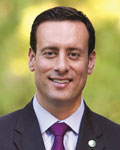
Photo of Roger Hernández
D California Assembly · District 48

Asm. Roger Hernández

Compare
Total votes
13,497
all sessions
Attendance
89%
1,261 missed
Near the chamber average
With party
99%
of cast votes
Near the chamber average
Bipartisan score
0%
crosses aisle rarely
Near the chamber average
Sponsored
648
bills & resolutions
Higher than 77% of chamber peers
Committees
0
assignments
648 bills and resolutions

Sponsored bills

Total
648
Primary
131
Co-sponsor
517
This page
648
matching current filters
Primary AB 55
Failed · California Assembly · Lead sponsor
State holidays: Native American Day.

Existing law recognizes various holidays. Existing law requires the Governor to proclaim annually the 4th Friday in September to be Native American Day. This bill would recognize the 4th Friday in September as a state holiday to be known as Native American Day.

Failed Feb 3, 2014 0 co-sponsors
Primary AB 1363
Failed · California Assembly · Lead sponsor
Public safety services.

Existing law provides for the creation and regulation of cities. Existing law specifies the powers of the legislative bodies of cities. This bill would prohibit the legislative body of a general law city from eliminating its entire police or fire protection department except by an ordinance that is approved by a majority of the voters voting on the issue at a local election.

Failed Feb 3, 2014 0 co-sponsors
Primary AB 1350
Failed · California Assembly · Lead sponsor
Electricity: direct transactions.

The Public Utilities Act requires the Public Utilities Commission, pursuant to electrical restructuring, to authorize and facilitate direct transactions between electricity suppliers and retail end-use customers. Existing law, enacted during the energy crisis of 2000–01, authorized the Department of Water Resources, until January 1, 2003, to enter into contracts for the purchase of electricity, and to sell electricity to retail end-use customers at not more than the department's acquisition costs and to recover those costs through the issuance of bonds to be repaid by ratepayers. That law suspended the right of retail end-use customers, other than community choice aggregators and a qualifying direct transaction customer, as defined, to acquire service through a direct transaction until the Department of Water Resources no longer supplies electricity under that law. Existing law continues the suspension of direct transactions except as expressly authorized, until the Legislature, by statute, repeals the suspension or otherwise authorizes direct transactions. Existing law requires the commission to authorize direct transactions for nonresidential end-use customers subject to a reopening schedule that will phase in over a period of not less than 3 years and not more than 5 years, and is subject to an annual maximum allowable total kilowatthour limit established, as specified, for each electrical corporation. This bill would require the commission to adopt and implement a schedule that implements a second phase-in period for expanding direct transactions, as specified, over a reasonable time commencing not later than July 1, 2014. The bill would establish as a condition precedent to the second phase-in of the expansion of direct transactions that the commission find that other providers supplying electricity through a direct transaction are procuring eligible renewable energy resources sufficient to meet their procurement requirements pursuant to the California Renewables Portfolio Standard Program. Under existing law, a violation of the Public Utilities Act or any order, decision, rule, direction, demand, or requirement of the commission is a crime. Because the provisions of this bill would be a part of the act and because a violation of an order or decision of the commission implementing its requirements would be a crime, the bill would impose a state-mandated local program by creating a new crime. The California Constitution requires the state to reimburse local agencies and school districts for certain costs mandated by the state. Statutory provisions establish procedures for making that reimbursement. This bill would provide that no reimbursement is required by this act for a specified reason.

Failed Feb 3, 2014 0 co-sponsors
Primary AB 1357
Failed · California Assembly · Lead sponsor
Emergency departments: diversion of patients.

Existing law establishes the State Department of Public Health and sets forth its powers and duties, including, but not limited to, the licensing and regulations of health facilities, including, but not limited to, health facilities operating emergency departments. Existing law requires a health facility maintaining or operating an emergency department to provide emergency services and care to any person requesting those services and care for any condition in which the person is in danger of loss of life, or serious injury or illness. Violation of these provisions is a crime. This bill would require emergency room funds in the County of Los Angeles that were approved by voter initiative, which are collected from properties within the San Gabriel Valley, to remain in that geographic region of the county. This bill would establish a task force to study and audit the funds collected from properties in the San Gabriel Valley since the passage of the local voter initiative, and to report its findings to the Legislature by January 1, 2015.

Failed Feb 3, 2014 0 co-sponsors
Primary AB 185
Failed · California Assembly · Lead sponsor
Open and public meetings: televised meetings.

The Ralph M. Brown Act requires that an audio or video recording of an open and public meeting made at the direction of a local agency is subject to inspection pursuant to the California Public Records Act and may be erased or destroyed 30 days after the recording. Existing law requires that any inspection of an audio or video recording shall be provided without charge on equipment made available by the local agency. The Digital Infrastructure and Video Competition Act of 2006 provides that cities, counties, cities and counties, or joint powers authorities receive state franchise fees in exchange for the use of public rights-of-way for the delivery of cable and video services provided within their jurisdictions, based on gross revenues, pursuant to a specified formula, from state franchise holders that provide public, educational, and governmental access (PEG) channels. The bill would provide that an audio or video recording of an open and public meeting made at the direction of a local agency may be erased or destroyed 2 years after the recording. The bill would require a local agency that collects a franchise fee from the holder of a state franchise that provides PEG channels to televise the open and public meetings of its legislative body and planning commission, unless doing so would result in a financial hardship, as defined, in which case the local agency would be required to broadcast the meetings via an audio-visual electronic medium or an audio medium, as specified. The bill would also authorize the use of the franchise fees to televise the open and public meetings of the local agency and to cover the necessary expenses, as defined, for implementing the televising of the local agency's open and public meetings. The bill would authorize, if franchise fee moneys in excess of that necessary to televise these meetings are available, the use of such fees to provide live streaming of these meetings on the Internet. By imposing new duties on local public officials to televise open and public meetings, the bill would impose a state-mandated local program. The California Constitution requires the state to reimburse local agencies and school districts for certain costs mandated by the state. Statutory provisions establish procedures for making that reimbursement. This bill would provide that no reimbursement is required by this act for a specified reason.

Failed Feb 3, 2014 0 co-sponsors
Co-sponsor AB 28
Failed · California Assembly · Co-sponsor
Economic development: enterprise zones.

The Enterprise Zone Act provides for the designation and oversight by the Department of Housing and Community Development of various types of economic development areas throughout the state, including enterprise zones, targeted tax areas, and manufacturing enhancement areas, collectively known as geographically targeted economic development areas, or G-TEDAs. Pursuant to these provisions, qualifying entities in those areas may receive certain tax and regulatory incentives. This bill would revise various definitions for purposes of the act and modify specified requirements for designating and administering enterprise zones and G-TEDAs, collectively. The bill would impose new requirements on the Department of Housing and Community Development with respect to the enterprise zone program and modify department and Franchise Tax Board reporting requirements. Existing law, the Enterprise Zone Act, authorizes the Department of Housing and Community Development to assess a fee of not more than $15 on each enterprise zone and manufacturing enhancement area for each application for issuance of a certificate pursuant to specified tax credit provisions. This bill would instead authorize the department to charge a fee for those applications not to exceed the reasonable cost of administering the Enterprise Zone Act, but not to exceed $20. The bill would require any increase in the fee higher than the amount that was charged by the department as of January 1, 2014, to be adopted by regulation. This bill would declare that it is to take effect immediately as an urgency statute.

Failed Feb 3, 2014 1 co-sponsor
Co-sponsor AB 1164
died · California Assembly · Co-sponsor
Liens: employees and workers.

Existing law grants specified persons, including laborers, as defined, who contribute labor, skill, or services to a work of improvement the right to record a mechanic's lien upon the property so improved. This bill would, with certain exceptions, authorize an employee to record and enforce a wage lien upon real and personal property of an employer, or a property owner, as specified, for wages, other compensation, and related penalties and damages owed the employee. The bill would prescribe requirements relating to the recording and enforcement of the wage lien and for its cancellation and removal. The bill would require a notice of lien on real property to be executed under penalty of perjury. By expanding the scope of the crime of perjury, this bill would impose a state-mandated local program. The California Constitution requires the state to reimburse local agencies and school districts for certain costs mandated by the state. Statutory provisions establish procedures for making that reimbursement. This bill would provide that no reimbursement is required by this act for a specified reason.

died Feb 3, 2014 1 co-sponsor
Co-sponsor SB 640
In committee · California Senate · Co-sponsor
Medi-Cal: reimbursement: provider payments.

The Medi-Cal Act establishes the Medi-Cal program, which is administered by the State Department of Health Care Services, under which qualified low-income individuals receive health care services. The Medi-Cal program is, in part, governed and funded by federal Medicaid Program provisions. Existing law requires, except as otherwise provided, Medi-Cal provider payments to be reduced by 1% or 5%, and provider payments for specified non-Medi-Cal programs to be reduced by 1%, for dates of service on and after March 1, 2009, and until June 1, 2011. Existing law requires, except as otherwise provided, Medi-Cal provider payments and payments for specified non-Medi-Cal programs to be reduced by 10% for dates of service on and after June 1, 2011. This bill would instead require that, to the extent permitted by federal law, this payment reduction not apply to skilled nursing facilities or subacute care units that are a distinct part of a general acute care hospital, intermediate care or other specified facilities serving developmentally disabled individuals, or specified Medi-Cal provider payments for fee-for-service benefits, including payments to pharmacies, for dates of service on or after June 1, 2011. The bill would also provide that this payment reduction shall not apply to managed health care plans for dates of service after the effective date of the bill. This bill would declare that it is to take effect immediately as an urgency statute.

In committee Feb 3, 2014 1 co-sponsor
Co-sponsor AB 350
Failed · California Assembly · Co-sponsor
Timber harvesting plans: exempt activities.

The Z'berg-Nejedly Forest Practice Act of 1973 prohibits a person from conducting timber operations unless a timber harvesting plan prepared by a registered professional forester has been submitted to the Department of Forestry and Fire Protection. The act authorizes the State Board of Forestry and Fire Protection to exempt from those provisions of the act a person engaging in specified forest management activities, including, among other things, the harvesting of only trees less than 18 inches in stump diameter, measured at 8 inches above ground level. However, existing law permits the removal of trees less than 24 inches in stump diameter to achieve the goal of fuel reduction if the removal of any such tree is within 500 feet of a legally permitted structure, or in an area prioritized as a shaded fuel break in a community wildfire protection plan approved by a public fire agency, if the goal of fuel reduction cannot be achieved by removing only trees less than 18 inches in stump diameter. This bill would, instead, exempt the removal of trees less than 28 inches in stump diameter, measured at 8 inches above ground level. However, the bill would permit the removal of trees less than 28 inches in stump diameter to achieve the goal of fuel reduction if the removal of any such tree is within 500 feet of a legally permitted structure, in an area prioritized as a shaded fuel break in a community wildfire protection plan approved by a public fire agency, if the goal of fuel reduction cannot be achieved by removing only trees less than 28 inches in stump diameter.

Failed Feb 3, 2014 1 co-sponsor
Primary AB 1300
Failed · California Assembly · Lead sponsor
Credit cards: oral disclosures.

Existing state and federal laws regulate the provision of credit and the use of credit cards. Existing federal law requires a card issuer to disclose, in either electronic form or in a prominent location on the application or solicitation, certain information, including, but not limited to, the annual percentage rate, penalty rates, cash advance fees, late payment fees, and over-the-limit fees, to the extent applicable, on or with an application or solicitation that is initiated by the card issuer and provided to the consumer in person. Existing federal law imposes special rules applicable to credit cards offered to college students. Existing state law requires a card issuer of a secured credit card, as defined, in every advertisement or solicitation to prospective cardholders, to expressly identify the credit instrument offered as a secured credit card and disclose that credit extended under the secured credit card is secured. Existing state law also requires an application form or preapproved written solicitation for an open-end credit card account to be used for certain purposes that is mailed to a consumer in this state to contain specified disclosures, including, among other things, any periodic rate or rates that may be applied to the account, any membership or participation fee that may be imposed for availability of a credit card account, and any per transaction fee that may be imposed on purchases, as specified. This bill would require that prior to the issuance of a credit card on the campus of an institution of higher education to a cardholder who is 18 years of age or older the cardholder be provided with an oral disclosure, by the credit card issuer soliciting on the campus of an institution of higher education, containing certain information, including, but not limited to, the annual percentage rate, penalty rates, cash advance fee, late payment fee, and over-the-limit fee, in a specified manner. The bill would also require the card issuer to orally (1) provide a cardholder with an example of how long it would take a cardholder to pay off the average credit card debt if the cardholder only makes minimum payments, (2) explain how the credit card interest rates are compounded, and (3) explain the adverse effect of a late credit card payment, as specified. The bill would require a cardholder to initial and sign a written document to be provided by the card issuer indicating receipt of the oral disclosures, example, and explanations, as specified. The bill would require the credit card issuer to provide the oral disclosures, example, and explanation and the written document to a non-English speaking cardholder in the cardholder's native language. The bill would specify that these provisions are not applicable to credit card applications submitted online.


Failed Feb 3, 2014 0 co-sponsors
Showing 331 to 340 of 648 bills
Previous 1 … 33 34 35 … 65 Next