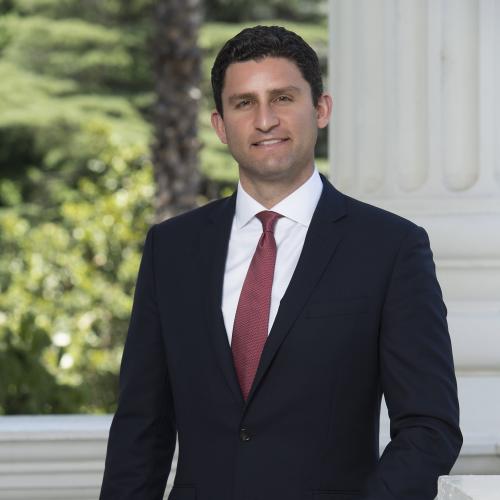
Photo of Jesse Gabriel
D California Assembly · District 46 On the 2026 ballot

Asm. Jesse Gabriel

Compare
Total votes
20,973
all sessions
Attendance
94%
986 missed
Near the chamber average
With party
99%
of cast votes
Near the chamber average
Bipartisan score
0%
crosses aisle rarely
Near the chamber average
Sponsored
1,612
bills & resolutions
Higher than 98% of chamber peers
Committees
5
assignments
1,612 bills and resolutions

Sponsored bills

Total
1,612
Primary
259
Co-sponsor
1,353
This page
1,612
matching current filters
Co-sponsor ACR 214
Signed into law · California Assembly · Co-sponsor
Relative to India's Independence Day.

Maddy summaryThis bill recognizes August 15, 2024, as India's Independence Day and encourages all Californians to participate in celebrations honoring the occasion. It directly affects the residents of California, particularly the state's large Indian American community, by formally acknowledging the historical significance of the date when India gained independence from British rule. The measure does not create new laws or change government operations; instead, it serves as a symbolic gesture to highlight the cultural contributions of Indian Americans and the shared values of democracy and nonviolence between the two nations.

Signed into law Aug 19, 2024 1 co-sponsor
Co-sponsor ACR 209
Signed into law · California Assembly · Co-sponsor
Relative to the 2024 International Day of Yoga.

Maddy summaryThis bill officially recognizes June 21, 2024, as the 2024 International Day of Yoga within the state of California. It does not create new laws or change existing regulations but serves as a formal acknowledgment of the global event. The measure is intended to highlight the history and benefits of yoga as a wellness practice.

Signed into law Aug 19, 2024 1 co-sponsor
Primary AB 1659
Passed · California Assembly · Lead sponsor
Sale of small electronic devices: charging devices.

Existing law regulates various business activities and practices, including the sale of telephones. Existing law requires a smartphone, as defined, that is manufactured on or after July 1, 2015, and sold in California after that date, to provide certain functionality, as specified. This bill would prohibit a manufacturer from selling a small electronic device, as defined, for the first time, and first sold in California, on or after January 1, 2026, unless that small electronic device meets certain criteria, including being equipped with a USB Type-C receptacle, as specified. The bill would require a wholesaler or retailer of a small electronic device manufactured on or after January 1, 2026, to offer to make the sale without a charging device, and to display, as specified, certain information depending on the existence and specifications of an included charging device. The bill also would require the wholesaler or retailer to provide a specified purchaser with certain information relating to the wired charging devices that can be used with the small electronic device, as specified. The bill would exempt from its provisions the sale of a secondhand small electronic device, the sale of a laptop before July 1, 2026, and the sale of a small electronic device of a specified size. The bill would authorize an action brought exclusively by the Attorney General, a district attorney, a county counsel, or a city attorney. The bill would entitle a prevailing plaintiff in the action to injunctive relief and reasonable attorney's fees and costs. The bill would state that any waiver of these provisions is contrary to public policy and is void and unenforceable. The bill would state that its provisions are severable. The bill would also make related findings and declarations.

Passed Aug 15, 2024 0 co-sponsors
Co-sponsor AB 2918
Passed · California Assembly · Co-sponsor
Pupil instruction: ethnic studies.

(1) Existing law requires a pupil to complete designated coursework while in grades 9 to 12, inclusive, in order to receive a diploma of graduation from high school. These graduation requirements include, commencing for pupils graduating in the 2029–30 school year, the completion of a one-semester course in ethnic studies meeting specified requirements. Under existing law, the requirement to complete an ethnic studies course may be fulfilled by the completion of, among others, a course based on the model curriculum developed by the Instructional Quality Commission, an ethnic studies course taught as part of a course that has been approved as meeting the A–G requirements of the University of California and the California State University, or a locally developed ethnic studies course approved by the governing board of a school district or the governing body of a charter school. This bill, among other things, would require a school district or charter school to develop an ethnic studies course or any instructional materials for an ethnic studies course with teachers, classified staff, parents, guardians, and community members, as provided. The bill would require a majority of the stakeholders in the development process to be classroom teachers, as provided, and would also authorize the development process to include a piloting process consistent with the guidelines set forth in the "Guidance for Local Instructional Materials Adoptions" adopted by the State Board of Education. The bill would also require a district superintendent and the governing board of a school district or the governing body of a charter school to submit a signed certification to the State Department of Education and the state board that the proposed, adopted, or revised course or instructional materials meets certain requirements, as provided. The bill would require the curriculum, instruction, and instructional materials for an ethnic studies course to additionally foster respect and acceptance and to focus on the experiences of communities of the United States. To the extent these requirements impose additional duties on local educational agencies, the bill would create a state-mandated local program. (2) The California Constitution requires the state to reimburse local agencies and school districts for certain costs mandated by the state. Statutory provisions establish procedures for making that reimbursement. This bill would provide that, if the Commission on State Mandates determines that the bill contains costs mandated by the state, reimbursement for those costs shall be made pursuant to the statutory provisions noted above.


Passed Aug 15, 2024 1 co-sponsor
Primary AB 2550
Passed · California Assembly · Lead sponsor
Business establishments: building standards: retail food safety.

(1) Existing law, the California Building Standards Law, establishes the California Building Standards Commission within the Department of General Services. Existing law requires the commission to approve and adopt building standards and to codify those standards in the California Building Standards Code. Existing law requires the commission to publish the code every 3 years, and, in intervening periods, supplements, as necessary. This bill, to be known as the Neighborhood Restaurant Relief Act, would require the commission, as part of the next triennial update of the California Building Standards Code that occurs on or after January 1, 2025, to adopt specified building standards for business establishments, including, among other things, standards authorizing (A) a business establishment that is takeout only to operate without providing customer restrooms; (B) a business establishment with a maximum occupancy of 100 occupants to operate without drinking fountains; and (C) a business establishment to operate cooking equipment, for the purpose of baking, that does not produce cooking odors, smoke, grease, or vapor without installing a Type 1 hood, as described in specified regulations, over the cooking equipment. (2) Existing law, the California Retail Food Code, establishes uniform health and sanitation standards for retail food facilities. Under existing law, local health agencies are primarily responsible for enforcing these standards. Under existing law, a person who violates any provision of the California Retail Food Code is guilty of a misdemeanor, except as otherwise provided. Existing law prohibits a food facility from locating a grease trap or grease interceptor in a food handling area, unless approved by an enforcement agency. Existing law exempts from the prohibition a food facility with an approved grease trap or grease interceptor that was in operation before the effective date of the code. This bill would instead prohibit a food facility from locating a grease trap or grease interceptor in a food preparation area. The bill would additionally exempt an aboveground grease trap installed under a 3-compartment sink, as specified, from this prohibition. Existing law limits the size of a passthrough window service opening to 216 square inches. Existing law authorizes a passthrough window of up to 432 square inches if equipped with an air curtain device. This bill would authorize a passthrough window service opening that is larger than 432 square inches if equipped with both a self-closing device and an air curtain device. Existing law requires a food facility's walls and ceilings to be durable, smooth, nonabsorbent, and easily cleanable. Existing law exempts from this requirement walls and ceilings of bar areas in which alcoholic beverages are sold or served directly to the consumers, except wall areas adjacent to bar sinks and areas where food is prepared, among other things. Existing law also exempts from this requirement restrooms that are used exclusively by the consumers, except that the walls and ceilings in the restrooms shall be of a nonabsorbent and washable surface. This bill would instead exempt walls and ceilings of bar areas in which beverages are sold, served, or dispensed directly to the consumers. The bill would also instead exempt restrooms that are used exclusively by employees or consumers. Existing law requires temporary food facilities to be equipped with overhead protection for all food preparation, food storage, and warewashing areas. Existing law requires overhead protection to be made of wood, canvas, or other materials that protect the facility from precipitation, dust, bird and insect droppings, and other contaminants. Existing law exempts from these requirements a temporary food facility that is approved for limited food preparation if flying insects, vermin, birds, and other pests are absent due to the location of the facility or other limiting conditions. This bill would additionally exempt a temporary food facility that is approved for limited food preparation from these requirements if environmental factors that could contaminate the food are absent due to the location of the facility or other limiting conditions. By revising the standards that must be enforced by local health agencies and by expanding the scope of existing crimes, the bill would impose a state-mandated local program. (3) The California Constitution requires the state to reimburse local agencies and school districts for certain costs mandated by the state. Statutory provisions establish procedures for making that reimbursement. This bill would provide that with regard to certain mandates no reimbursement is required by this act for a specified reason. With regard to any other mandates, this bill would provide that, if the Commission on State Mandates determines that the bill contains costs so mandated by the state, reimbursement for those costs shall be made pursuant to the statutory provisions noted above.
Passed Aug 15, 2024 0 co-sponsors
Primary AB 2728
Passed · California Assembly · Lead sponsor
Planning and zoning: housing development: independent institutions of higher education and religious institutions.

The Planning and Zoning Law requires each county and city to adopt a comprehensive, long-term general plan that includes, among other mandatory elements, a housing element. That law requires the city's or county's planning agency, after the legislative body has adopted a general plan, to submit an annual report to the legislative body, the Office of Planning and Research, and the Department of Housing and Community Development. Existing law, the Affordable Housing on Faith and Higher Education Lands Act of 2023 (the act) , requires a housing development project on certain lands owned by an independent institution of higher education or a religious institution to be a use by right if the development project satisfies specified criteria, including that a specified percentage of the development project's total units are for lower income households. This bill would require a local government to include in the annual report specified information relating to housing development projects under the act, including the number of applications submitted and the total number of building permits issued under the act. The bill would require the Department of Housing and Community Development, by July 1, 2025, to develop and publish a list of existing state grants and financial incentives available for the planning, construction, and operation of very low, low-, and moderate-income housing on land owned by religious institutions and independent institutions of higher education, and a set of model partnership agreements that can be used by those institutions when they partner with an affordable housing builder. By requiring a local agency to include additional information in their annual reports, this bill would impose a state-mandated local program. The California Constitution requires the state to reimburse local agencies and school districts for certain costs mandated by the state. Statutory provisions establish procedures for making that reimbursement. This bill would provide that no reimbursement is required by this act for a specified reason.

Passed Aug 15, 2024 0 co-sponsors
Co-sponsor HR 110
Passed · California Assembly · Co-sponsor
Relative to infrastructure.

Maddy summaryThis California Assembly resolution encourages the U.S. Congress to pass legislation creating a National Infrastructure Bank to fund critical repairs and upgrades for roads, bridges, dams, and other public works. The bill cites reports from the American Society of Civil Engineers highlighting billions of dollars in investment gaps and poor conditions affecting California's transportation and water systems. It advocates for a financing model that uses existing federal debt rather than new taxes, aiming to stimulate the economy, create jobs, and prioritize projects in disadvantaged communities. The resolution formally requests that federal leaders adopt this approach to address the state's urgent infrastructure needs.

Passed Aug 15, 2024 1 co-sponsor
Co-sponsor HR 116
Passed · California Assembly · Co-sponsor
Relative to the assassination attempt on former President Donald J. Trump.

Maddy summaryThis California House Resolution condemns the July 13, 2024, assassination attempt on former President Donald J. Trump and calls for an end to political violence. The measure highlights the event where Trump was wounded while speaking at a rally in Butler, Pennsylvania, and notes that one attendee died and others were injured while trying to protect him. It urges the state to foster a political environment based on respectful discourse and nonviolence. The resolution is a formal statement of the Assembly's stance and does not create new laws or change existing policies.

Passed Aug 15, 2024 1 co-sponsor
Showing 431 to 440 of 1,612 bills
Previous 1 … 43 44 45 … 162 Next