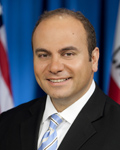
Photo of Adrin Nazarian
D California Assembly · District 46 · Former member

Asm. Adrin Nazarian

Compare
Total votes
23,010
all sessions
Attendance
96%
714 missed
Near the chamber average
With party
99%
of cast votes
Near the chamber average
Bipartisan score
0%
crosses aisle rarely
Near the chamber average
Sponsored
1,694
bills & resolutions
Near the chamber average
Committees
0
assignments
1,694 bills and resolutions

Sponsored bills

Total
1,694
Primary
253
Co-sponsor
1,441
This page
1,694
matching current filters
Co-sponsor ACR 156
Signed into law · California Assembly · Co-sponsor
Rosa Parks Day in California: 20th Anniversary.

This measure would memorialize the achievements of Rosa Parks in the Civil Rights Movement and would commemorate the 20th Anniversary of Rosa Parks Day in California on February 4, 2020.

Signed into law Mar 4, 2020 1 co-sponsor
Primary AB 2411
In committee · California Assembly · Lead sponsor
Healing arts licensees: remuneration: drug or device companies: disclosure.

Existing law provides for the licensure and regulation of various healing arts licensees by boards within the Department of Consumer Affairs. Under existing law, it is unlawful for healing arts licensees, except as specified, to offer, deliver, receive, or accept any rebate, refund, commission, preference, patronage dividend, discount, or other consideration, in the form of money or otherwise, as compensation or inducement for referring patients, clients, or customers to any person, subject to certain exceptions. Existing law also prohibits specified healing arts licensees from charging, billing, or otherwise soliciting payment from a patient on behalf of, or referring a patient to, an organization in which the licensee, or the licensee's immediate family, has a significant beneficial interest, unless the licensee first makes specified disclosures in writing to the patient. Existing law makes a violation of these and other provisions governing unearned rebates, refunds, and discounts, unprofessional conduct and grounds for suspension or revocation of a license and a misdemeanor, as specified. This bill would require a healing arts licensee who receives remuneration from a drug or device company to disclose the amount and source orally and in writing to each patient before the intended use or prescription of a drug or device manufactured or distributed. The bill would also require a healing arts licensee to obtain a signature from the patient on the written disclosure. By expanding a crime, the bill would impose a state-mandated local program. The California Constitution requires the state to reimburse local agencies and school districts for certain costs mandated by the state. Statutory provisions establish procedures for making that reimbursement. This bill would provide that no reimbursement is required by this act for a specified reason.

In committee Mar 2, 2020 0 co-sponsors
Primary AB 2786
In committee · California Assembly · Lead sponsor
Hospital emergency departments: HIV testing.

Existing law requires that every patient who has blood drawn at a primary care clinic, as defined, and who has consented to the test, be offered a human immunodeficiency virus (HIV) test that is consistent with the United States Preventive Services Task Force recommendations for screening for HIV infection. Existing law specifies the manner in which the results of that test are provided. Existing law authorized, from March 1, 2017, to February 28, 2019, a pilot project, administered by the State Department of Public Health, to assess and make recommendations regarding the effectiveness of the routine offering of an HIV test in the emergency department of a hospital. Existing law required the department to select 4 hospitals, or fewer under specified circumstances, that have emergency departments to voluntarily participate in the pilot project. Existing law required the participating hospitals to offer an HIV test to any patient in the hospital emergency department, as provided, to collect specified information, and to report the information to the department. Existing law required the department, by December 1, 2019, to complete a report to the Legislature on the findings of the hospitals in the pilot project and make recommendations about routine HIV testing in hospital emergency departments. This bill would require the department to develop protocols for hospital emergency departments to implement an HIV testing program for emergency department patients. The bill would require the department's protocols to address integration of opt-out HIV testing into the emergency department standard of care, streamlining HIV testing consent procedures, and structural strategies to minimize the need for provider intervention.

In committee Mar 2, 2020 0 co-sponsors
Primary AB 2453
In committee · California Assembly · Lead sponsor
Long-term care insurance and accelerated death benefits.

Existing law provides for the regulation of insurers by the Department of Insurance, including insurers issuing policies of long-term care insurance and policies providing accelerated death benefits. Existing law requires every insurer or other entity marketing long-term care insurance to, among other things, develop and use suitability standards to determine whether the purchase or replacement of long-term care insurance is appropriate for the needs of the applicant. Existing law also requires the agent and insurer, when determining whether the applicant meets those standards, to develop procedures that take into consideration, among other things, the applicant's ability to pay for the proposed coverage and other pertinent financial information related to the purchase of the coverage, and the applicant's goals or needs with respect to long-term care and the advantages and disadvantages of insurance to meet those goals or needs. Existing law makes these provisions inapplicable to life insurance policies that accelerate benefits for long-term care. This bill would remove that exclusion for life insurance policies that accelerate benefits for long-term care, and would, with respect to those policies, require the procedures to also take into consideration the applicant's goals or needs with respect to life insurance, and to take into consideration the advantages and disadvantages of the proposed insurance coverage compared to the advantages and disadvantages of a stand-alone long-term care insurance policy. The bill would require a written summary of the comparison to be presented to the applicant at the time of application and to be made part of the applicant's file. Under existing law, if an applicant for long-term care insurance declines to provide the financial information necessary to determine the applicant's financial suitability, the issuer is authorized to use some other method to verify the applicant's intent. This bill, instead, would require the issuer, if the applicant declines to provide the financial information and the issuer does not reject the application, to use some other method to determine if the proposed coverage is suitable for the applicant. Existing law requires an insurer to ensure that agents offering, marketing, or selling accelerated death benefits on their behalf are able to describe the differences between benefits provided under an accelerated death benefit and benefits provided under long-term care insurance, including, among other things, the benefits under the accelerated death benefit or long-term care insurance if benefits are never needed or if benefits are needed. Under existing law, completion of California agent education or continuing education for long-term care insurance meets this requirement. This bill, instead, would require an insurer to ensure that those agents complete California agent education or continuing education for long-term care insurance in order to meet the above requirement. The bill would require an insurer or other entity marketing accelerated death benefits to develop and use suitability standards, similar to the suitability standards described above for the purchase or replacement of long-term care insurance, to determine whether the purchase or replacement of an accelerated death benefit, or the replacement of long-term care insurance, is appropriate for the needs of the applicant. The bill would require an insurer to report annually to the commissioner the total number of applications for accelerated death benefits received from residents of this state, the number of applicants who declined to provide requested information, the number of applicants who did not meet the suitability standards, and the number of applicants who chose to purchase the proposed insurance coverage.

In committee Mar 2, 2020 0 co-sponsors
Primary AB 2430
In committee · California Assembly · Lead sponsor
Professional fiduciaries: prelicensing and renewal or restoration: education.

Existing law, the Professional Fiduciaries Act, provides for the licensure and regulation of professional fiduciaries and provides for the administration of those provisions by the Professional Fiduciaries Bureau, which is under the jurisdiction of the Department of Consumer Affairs. The act requires an applicant to complete 30 hours of prelicensing education courses provided by an educational program approved by the bureau as a condition of licensure. The act also requires a licensee to complete 15 hours of continuing education courses each year as a condition of license renewal or restoration. This bill, beginning January 1, 2022, would require the prelicensing education courses to include at least one hour of instruction in LGBT cultural competency, as defined by the bill. The bill, beginning January 1, 2022, would also require a licensee to complete at least one hour of instruction in LGBT cultural competency every 3 years as a condition of license renewal or restoration.

In committee Feb 27, 2020 0 co-sponsors
Primary AB 2900
In committee · California Assembly · Lead sponsor
Publicly funded health care programs.

Existing law provides that a person with private health care coverage is not entitled to receive health care items or services furnished or paid for by a publicly funded health care program if those health care items or services are covered by that private health care coverage. This bill would make technical, nonsubstantive changes to those provisions.

In committee Feb 24, 2020 0 co-sponsors
Primary AB 3166
In committee · California Assembly · Lead sponsor
Public health: organ donation.

Existing law authorizes specified organ procurement organizations to establish a not-for-profit entity to establish and maintain the Altruistic Living Donor Registry, which contains information regarding persons who have identified themselves as altruistic living kidney donors. This bill would make a technical, nonsubstantive change to those provisions.

In committee Feb 24, 2020 0 co-sponsors
Primary AB 3081
In committee · California Assembly · Lead sponsor
California State University Contract Law: public notice.

The California State University Contract Law provides for the construction of public works by the Trustees of the California State University. That law prescribes the manner of advertisement for bids for a contract for a project estimated to not exceed $15,000. This bill would make nonsubstantive changes to that provision.

In committee Feb 24, 2020 0 co-sponsors
Primary AB 2330
In committee · California Assembly · Lead sponsor
State Board of Equalization: California Department of Tax and Fee Administration: Franchise Tax Board: Office of Tax Appeals: transfer of duties.

The California Constitution establishes the State Board of Equalization (board) consisting of the Controller and 4 other members elected from districts, and provides for the election, recall, impeachment, filling of vacancies, and salaries and benefits of those board members elected from districts. The California Constitution vests the board with various powers, duties, and responsibilities related to the administration of taxes imposed on property, insurance, and alcoholic beverages. Existing law establishes, in the Government Operations Agency, the California Department of Tax and Fee Administration (department) and transferred to the department the duty to administer various statutory taxes and fees that had previously been administered by the board. Under existing law, all laws prescribing the duties, powers, and responsibilities of the board to which the department succeeds, together with all lawful rules and regulations established under those laws, are expressly continued in force, including, but not limited to, existing processes and remedies available to a taxpayer or feepayer, such as settlement options and appeals processes. Existing law establishes, in the Government Operations Agency, the Franchise Tax Board consisting of the Controller, the Director of Finance, and the Chairman of the State Board of Equalization. Existing law prescribes various powers and duties to the Franchise Tax Board, including, among other things, the administration of state personal income taxes and corporation franchise and income taxes. Existing law establishes the Office of Tax Appeals (office) in state government and transfers to the office the duty to conduct appeals hearings for the various taxes and fees administered by the department and for the administrative appeals of state personal income taxes and corporation franchise and income taxes. This bill, beginning January 1, 2023, would vest the powers, duties, and responsibilities of the board related to the administration of taxes imposed on insurance and alcoholic beverages in the department. The bill, beginning January 1, 2023, would vest the powers, duties, and responsibilities of the board related to the administration of taxes imposed on property in the Franchise Tax Board. The bill, beginning January 1, 2023, would vest the powers, duties, and responsibilities of the board to conduct appeals hearings in the office. The bill would, for these purposes, also provide for the transfer to the department, the Franchise Tax Board, and the office of the board's employees serving in civil service, the rights and property of the board, and the board's funding, as provided. This bill would additionally remove the Chairperson of the State Board of Equalization from the membership of the Franchise Tax Board, and would instead make the Treasurer a member of the Franchise Tax Board. This bill would become operative only if ACA 2 of the 2019–20 Regular Session is approved by the voters.


In committee Feb 24, 2020 0 co-sponsors
Showing 541 to 550 of 1,694 bills
Previous 1 … 54 55 56 … 170 Next