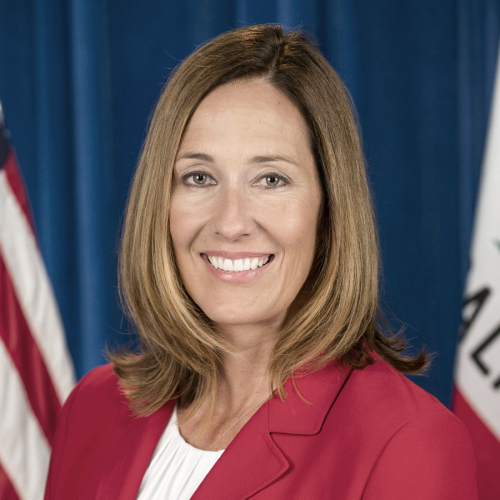
Photo of Jacqui Irwin
D California Assembly · District 42

Asm. Jacqui Irwin

Compare
Total votes
26,022
all sessions
Attendance
93%
1,558 missed
Near the chamber average
With party
98%
of cast votes
Near the chamber average
Bipartisan score
1%
crosses aisle rarely
Near the chamber average
Sponsored
2,145
bills & resolutions
Near the chamber average
Committees
13
assignments
2,145 bills and resolutions

Sponsored bills

Total
2,145
Primary
284
Co-sponsor
1,861
This page
2,145
matching current filters
Co-sponsor ACR 109
Passed · California Assembly · Co-sponsor
Relative to Red Ribbon Week.

This measure would proclaim the period of October 23, 2017, to October 31, 2017, inclusive, as Red Ribbon Week and would encourage all Californians to help build drug-free communities and to participate in drug prevention activities.

Passed Jan 3, 2018 1 co-sponsor
Primary AB 693
Signed into law · California Assembly · Lead sponsor
Firearms.

Existing law generally requires that a firearms transaction be conducted through a licensed firearms dealer and prohibits the transfer of a firearm unless the person has been issued a firearms license. Existing law provides various exceptions to this requirement, including for firearms sold or transferred to an authorized law enforcement representative for use by the law enforcement agency. This bill would exempt the loan of a firearm from the requirement that the transaction be conducted through a dealer or by a dealer if the loan is made to a person enrolled in the course of basic training prescribed by the Commission on Peace Officer Standards and Training, or any other course certified by the commission, for purposes of participation in the course. Existing law, as amended by the Safety for All Act of 2016, approved by voters as Proposition 63 at the November 8, 2016, statewide general election, generally prohibits the possession of a large-capacity magazine regardless of the date the magazine was acquired. Existing law makes this prohibition inapplicable to the possession of a large-capacity magazine by a sworn peace officer or federal law enforcement officer who is authorized to carry a firearm in the course and scope of his or her duties. The Safety for All Act of 2016 also requires, commencing January 1, 2018, the sale of ammunition to be conducted by or processed through a licensed ammunition vendor. Existing law exempts the sale, delivery, or transfer of ammunition to specified individuals, including a sworn peace officer or sworn federal law enforcement officer who is authorized to carry a firearm in the course and scope of the officer's duties. A violation of this provision is a misdemeanor. Proposition 63 allows its provisions to be amended by a vote of 55% of the Legislature so long as the amendments are consistent with and further the intent of the act. This bill would make the prohibition on large-capacity magazines inapplicable to the sale, gift, or loan of a large-capacity magazine to a person enrolled in the course of basic training prescribed by the Commission on Peace Officer Standards and Training, or any other course certified by the commission, or to the possession of, or purchase by, the person, for purposes of participation in the course during his or her period of enrollment. The bill would exempt from the above-described ammunition purchasing requirement a person in the basic training academy for peace officers or any other course certified by the Commission on Peace Officer Standards and Training, an instructor of the academy or course, or a staff member of the academy or entity providing the course, who is purchasing the ammunition for the purpose of participation or use in the course. The bill would amend the proposition by adding these new exemptions to the prohibition on large-capacity magazines and the requirement of buying ammunition through a licensed vendor. This bill would declare that it is to take effect immediately as an urgency statute.

Signed into law Oct 14, 2017 0 co-sponsors
Primary AB 1022
Signed into law · California Assembly · Lead sponsor
Information technology: Technology Recovery Plans: inventory.

The California Emergency Services Act sets forth the duties of the Office of Emergency Services with respect to specified emergency preparedness, mitigation, and response activities within the state. Existing law establishes the Department of Technology under the supervision of the Director of Technology who is also known as the State Chief Information Officer, and generally requires the Department of Technology to be responsible for the approval and oversight of information technology projects by, among other things, consulting with state agencies during initial project planning to ensure that project proposals are based on well-defined programmatic needs. Existing law establishes the Office of Information Security, within the Department of Technology, under the direction of a chief who reports to the Director of Technology. Existing law requires the Department of Technology, in consultation with the Office of Emergency Services and in compliance with the information security program required to be established by the chief of the Office of Information Security, to update the Technology Recovery Plan element of the State Administrative Manual to ensure the inclusion of cybersecurity strategy incident response standards for each state agency to secure its critical infrastructure controls and critical infrastructure information. Existing law requires each state agency to provide its updated Technology Recovery Plan and report on its compliance with these updated standards to the department, as specified, and authorizes the department, in consultation with the Office of Emergency Services, to provide suggestions for a state agency to improve compliance with these standards. Existing law prohibits public disclosure of reports and public records relating to the cybersecurity strategies of state agencies, as specified. This bill would require each state agency, as part of its Technology Recovery Plan, to provide the department with an inventory of all critical infrastructure controls, and their associated assets, in the possession of the agency. The bill would authorize a local entity that receives state funds for the purposes of storing, sharing, or transmitting data, or in support of an information technology project with a state entity, upon the request of the department, to submit a Technology Recovery Plan, as specified, to the department. The bill would authorize the department to provide suggestions with regard to the plans. The bill would prohibit public disclosure of these plans. Existing constitutional provisions require that a statute that limits the right of access to the meetings of public bodies or the writings of public officials and agencies be adopted with findings demonstrating the interest protected by the limitation and the need for protecting that interest. This bill would make legislative findings to that effect. The California Constitution requires local agencies, for the purpose of ensuring public access to the meetings of public bodies and the writings of public officials and agencies, to comply with a statutory enactment that amends or enacts laws relating to public records or open meetings and contains findings demonstrating that the enactment furthers the constitutional requirements relating to this purpose. This bill would make legislative findings to that effect.

Signed into law Oct 14, 2017 0 co-sponsors
Primary AB 926
Signed into law · California Assembly · Lead sponsor
Cemeteries: endowment funds.

Existing law authorizes a cemetery authority which maintains a cemetery to place its cemetery under endowment care and establish, maintain, and operate an endowment care fund. Existing law requires the principal of all funds for endowment care to be invested, and only the net income to be used for the maintenance, repair, or restoration of the cemetery property. Existing law requires each cemetery authority to file a report with the Cemetery and Funeral Bureau setting forth specified information, including, among other things, the amount collected and deposited in both endowment care funds. Existing law authorizes the bureau to extend the date on which this report is due by 30 days. This bill would authorize the Cemetery and Funeral Bureau to extend the date on which the above-mentioned report is due by no more than 9 months. The bill, if a cemetery authority establishes an endowment care fund, would make the fund automatically subject to a net income distribution method and would specify the requirements for distribution under that method. The bill would also authorize a cemetery authority, its directors, or its board of trustees to, on or after January 1, 2020, apply to the bureau to convert its endowment care fund from a net income distribution method to a unitrust distribution method, as defined, and would describe the conditions under which the bureau would approve that application. The bill would require the bureau to review, on an annual basis, whether a cemetery authority continues to meet the conditions of approval for the unitrust distribution method, and would authorize the bureau to require the use of the net income distribution method if the cemetery authority does not meet those conditions. The bill would require the bureau to evaluate the effectiveness of the unitrust distribution authority and to report at its next 2 hearings before the Joint Sunset Review Oversight Hearings of the Assembly Committee on Business and Professions and Senate Committee on Business, Professions and Economic Development that occurs after January 1, 2018.

Signed into law Oct 13, 2017 0 co-sponsors
Primary AB 705
Signed into law · California Assembly · Lead sponsor
Seymour-Campbell Student Success Act of 2012: matriculation: assessment.

(1) Existing law establishes the California Community Colleges, under the administration of the Board of Governors of the California Community Colleges, as one of the segments of public postsecondary education in this state. Existing law, the Seymour-Campbell Student Success Act of 2012, provides that the purpose of the act is to increase California community college student access and success by providing effective core matriculation services of orientation, assessment and placement, counseling, and other education planning services, and academic interventions. Existing law prohibits a community college district or college from using any assessment instrument for the purposes of these provisions without the authorization of the board of governors. This bill would require a community college district or college to maximize the probability that the student will enter and complete transfer-level coursework in English and mathematics within a one-year timeframe, and use, in the placement of students into English and mathematics courses in order to achieve this goal, one or more of the following: high school coursework, high school grades, and high school grade point average. The bill would authorize the board of governors to establish regulations governing the use of measures, instruments, and placement models to ensure that these measures, instruments, and placement models achieve the goal of maximizing the probability that a student will enter and complete transfer-level coursework in English and mathematics within a one-year timeframe, and that a student enrolled in English-as-a-second-language (ESL) instruction will enter and complete degree and transfer requirements in English within a timeframe of 3 years. The bill would also authorize the board of governors to establish regulations that ensure that, for students who seek a goal other than transfer, and who are in certificate or degree programs with specific requirements that are not met with transfer-level coursework, a community college maximizes the probability that a student will enter and complete the required college-level coursework in English and mathematics within a one-year timeframe. The bill would prohibit a community college district or college from requiring students to enroll in remedial English or mathematics coursework that lengthens their time to complete a degree unless placement research that includes consideration of high school grade point average and coursework shows that those students are highly unlikely to succeed in transfer-level coursework in English and mathematics. The bill would authorize a community college district or college to require students to enroll in additional concurrent support, including additional language support for ESL students, during the same semester that they take the transfer-level English or mathematics course, but only if it is determined that the support will increase their likelihood of passing the transfer-level English or mathematics course. To the extent the bill would impose additional duties on community college districts and colleges, the bill would impose a state-mandated local program. (2) The California Constitution requires the state to reimburse local agencies and school districts for certain costs mandated by the state. Statutory provisions establish procedures for making that reimbursement. This bill would provide that, if the Commission on State Mandates determines that the bill contains costs mandated by the state, reimbursement for those costs shall be made pursuant to the statutory provisions noted above.

Signed into law Oct 13, 2017 0 co-sponsors
Co-sponsor SB 751
Signed into law · California Senate · Co-sponsor
School finance: school districts: annual budgets: reserve balance.

Existing law, unless the school district is granted an exemption, limits the amount of the combined assigned or unassigned ending fund balance contained in a school district's annual budget in any fiscal year immediately after a fiscal year in which a transfer is made into the Public School System Stabilization Account. Existing law establishes formulas for calculating the maximum amount allowable for school districts with less than 400,000 units of average daily attendance and for school districts with more than 400,000 units of average daily attendance, as specified. This bill would instead make that limitation applicable in a fiscal year immediately after a fiscal year in which the amount of moneys in the Public School System Stabilization Account is equal to or exceeds 3% of the combined total of General Fund revenues appropriated for school districts and allocated local proceeds of taxes, as specified, for that fiscal year. The bill would instead provide that the school district's budget shall not contain a combined assigned or unassigned ending general fund balance, as defined, in excess of 10% of those funds. The bill would exclude from the requirements of those provisions basic aid school districts, as defined, and small school districts, as defined. To the extent the bill would impose additional duties on school districts, the bill would impose a state-mandated local program. The bill would require the Superintendent of Public Instruction to notify school districts and county offices of education whenever the conditions specified above are met. The bill would also require the Superintendent to notify school districts and county offices of education when those conditions no longer exist. The California Constitution requires the state to reimburse local agencies and school districts for certain costs mandated by the state. Statutory provisions establish procedures for making that reimbursement. This bill would provide that, if the Commission on State Mandates determines that the bill contains costs mandated by the state, reimbursement for those costs shall be made pursuant to the statutory provisions noted above.

Signed into law Oct 11, 2017 1 co-sponsor
Primary AB 797
Signed into law · California Assembly · Lead sponsor
Solar thermal systems.

The Solar Water Heating and Efficiency Act of 2007, until August 1, 2018, requires the Public Utilities Commission, if it determines that a solar water heating program is cost effective for ratepayers and in the public interest, to implement a program to promote the installation of 200,000 solar water heating systems in homes, businesses, and buildings or facilities of eligible customer classes receiving natural gas service throughout the state by 2017. The act establishes the maximum funding for the program, for the collective service territories of all gas corporations, at $250,000,000. The act requires the governing body of each publicly owned utility providing gas service to retail end-use customers to adopt, implement, and finance a solar water heating system incentive program to encourage the installation of 200,000 solar water heating systems by 2017. This bill would revise the program to, among other things, promote the installation of solar thermal systems throughout the state, reserve 50% of the total program budget for the installation of solar thermal systems in low-income residential housing or in buildings in disadvantaged communities, expand the program to homeowners that lack access to natural gas and rely on propane or wood burning to fulfill their space heating, water heating, and cooking needs who are being considered to receive natural gas and who reside in the San Joaquin Valley communities identified by the commission, authorize the commission to limit program eligibility based on income levels, require an assessment of the entire program through July 31, 2019, to be completed by December 31, 2019, to determine both the cost-effectiveness of the program and the program's effectiveness in achieving program goals, and extend operation of the program through July 31, 2020. Because a violation of any order, decision, rule, direction, demand, or requirement of the commission implementing these revisions would be a crime, this bill would impose a state-mandated local program. The bill would also require the governing body of each local publicly owned utility providing gas service, until August 1, 2020, to adopt, implement, and finance a solar thermal system incentive program. Because the bill would extend the obligations of a local publicly owned utility to adopt, implement, and finance the program, this bill would impose a state-mandated local program. The California Constitution requires the state to reimburse local agencies and school districts for certain costs mandated by the state. Statutory provisions establish procedures for making that reimbursement. This bill would provide that no reimbursement is required by this act for specified reasons.


Signed into law Oct 4, 2017 0 co-sponsors
Primary AB 384
Signed into law · California Assembly · Lead sponsor
The Qualified ABLE Program: tax-advantaged savings accounts.

Existing federal law, the Stephen Beck, Jr., Achieving a Better Life Experience Act of 2014 (ABLE Act) , encourages and assists individuals and families to save private funds in a tax-advantaged savings account for the purpose of supporting persons with disabilities to maintain their health, independence, and quality of life by excluding from gross income distributions used for qualified disability expenses by a beneficiary of a qualified ABLE program established and maintained by a state, as specified. Existing law establishes the Qualified ABLE Program, administered by the California ABLE Act Board, in this state for purposes of implementing the federal ABLE Act. Existing law requires the board to segregate the moneys coming into the ABLE program trust into 2 funds: the program fund, which is continuously appropriated, and the administrative fund, which is available upon appropriation by the Legislature. All moneys paid by designated beneficiaries or eligible individuals in connection with ABLE accounts are required to be deposited, as received, into the program fund, promptly invested, and accounted for separately. Existing law requires that an ABLE account only be established for a designated beneficiary who is a resident of this state, and that the board market the program to residents of this state to the extent funds are available. Existing law also provides that moneys in, contributions to, and any distribution for qualified disability expenses from, an ABLE account, not to exceed $100,000, do not count toward determining eligibility for a state or local means-tested program. This bill would expand the residency requirement for a designated beneficiary to being a resident of the United States, and as a result, would expand the purposes of a continuously appropriated fund, thereby making an appropriation. The bill would require the board to market the program to residents of the United States to the extent funds are available. The bill would clarify that specified existing provisions of law exempting the moneys in, and qualified distributions from, an ABLE account from being included as income for certain federal means-tested programs also apply. This bill would incorporate additional changes to Section 4880 of the Welfare and Institutions Code proposed by AB 688 to be operative only if this bill and AB 688 are enacted and this bill is enacted last.

Signed into law Oct 4, 2017 0 co-sponsors
Co-sponsor SB 3
Signed into law · California Senate · Co-sponsor
Veterans and Affordable Housing Bond Act of 2018.

Under existing law, there are programs providing assistance for, among other things, emergency housing, multifamily housing, farmworker housing, home ownership for very low and low-income households, and downpayment assistance for first-time home buyers. Existing law also authorizes the issuance of bonds in specified amounts pursuant to the State General Obligation Bond Law and requires that proceeds from the sale of these bonds be used to finance various existing housing programs, capital outlay related to infill development, brownfield cleanup that promotes infill development, and housing-related parks. Existing law, the Veterans' Bond Act of 2008, authorized, for purposes of financing a specified program for farm, home, and mobilehome purchase assistance for veterans, the issuance, pursuant to the State General Obligation Bond Law, of bonds in the amount of $900,000,000. This bill would enact the Veterans and Affordable Housing Bond Act of 2018, which, if adopted, would authorize the issuance of bonds in the amount of $4,000,000,000 pursuant to the State General Obligation Bond Law. Of the proceeds from the sale of these bonds, $3,000,000,000 would be used to finance various existing housing programs, as well as infill infrastructure financing and affordable housing matching grant programs, as provided, and $1,000,000,000 would be used to provide additional funding for the above-described program for farm, home, and mobilehome purchase assistance for veterans, as provided. This bill would provide for submission of the bond act to the voters at the November 6, 2018, statewide general election in accordance with specified law. This bill would declare that it is to take effect immediately as an urgency statute.

Signed into law Sep 29, 2017 1 co-sponsor
Showing 1,671 to 1,680 of 2,145 bills