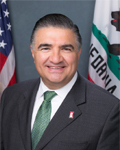
Photo of Dante Acosta
R California Assembly · District 38

Asm. Dante Acosta

Compare
Total votes
3,920
all sessions
Attendance
96%
136 missed
Near the chamber average
With party
95%
of cast votes
Lower than 85% of chamber peers
Bipartisan score
3%
crosses aisle rarely
Higher than 84% of chamber peers
Sponsored
424
bills & resolutions
Near the chamber average
Committees
0
assignments
424 bills and resolutions

Sponsored bills

Total
424
Primary
39
Co-sponsor
385
This page
424
matching current filters
Co-sponsor ACR 109
Passed · California Assembly · Co-sponsor
Relative to Red Ribbon Week.

This measure would proclaim the period of October 23, 2017, to October 31, 2017, inclusive, as Red Ribbon Week and would encourage all Californians to help build drug-free communities and to participate in drug prevention activities.

Passed Jan 3, 2018 1 co-sponsor
Co-sponsor AB 1499
Signed into law · California Assembly · Co-sponsor
Horse racing: state-designated fairs: allocation of revenues: gross receipts for sales and use tax.

The Horse Racing Law provides that any unallocated balance from the total revenue received by the Department of Food and Agriculture pursuant to that law, except as specified, is hereby appropriated without regard to fiscal years for allocation by the Secretary of Food and Agriculture for capital outlay to California fairs, including state-designated fairs, for among other things, fair projects involving public health and safety, and projects that are required to protect fair property. That law also provides that a portion of these funds may be allocated to California fairs for general operational support. This bill would, beginning July 1, 2018, require a return filed with the California Department of Tax and Fee Administration (CDTFA) to report gross receipts for sales and use tax purposes to segregate the gross receipts of the seller and the sales price of the property on a line or a separate form as prescribed by the CDTFA when the place of sale in this state or for use in this state is on or within the real property of a state-designated fair, as defined, or any real property of a state-designated fair that is leased to another party. The bill would require the CDTFA to report the amount of the total gross receipts segregated on the returns filed pursuant to these provisions to the Department of Finance on or before November 1 of each year. The bill would require the CDTFA to estimate the total gross receipts segregated for the 2019–20 fiscal year by January 31, 2019, based on the 3rd quarter of 2018, and would require that an amount equal to 34 of 1% of this estimated amount be included in the Governor's revised budget in May 2019 for allocation to fairs pursuant to the provisions described above. The bill would require the CDTFA to reconcile this first-year estimate with actual return data from the full 2018–19 fiscal year, and to then adjust this figure as appropriate as the amount to be reported to the Department of Finance on November 1, 2019. The bill would require that an amount equal to 34 of 1% of the total amount of gross receipts reported to the Department of Finance be included in the next annual Governor's Budget for the Department of Food and Agriculture for allocation to fairs pursuant to the provisions described above. The bill would require, upon the enactment of the annual Budget Act, that this amount be transferred by the Controller to the Fair and Exposition Fund, which is continuously appropriated, and would allocate these moneys to state-designated fairs for specified fair projects and subject to certain conditions. The bill would require the CDTFA to be paid the actual cost for administering those provisions, as specified. By creating a new source of revenue to be deposited into a continuously appropriated fund, the bill would make an appropriation.

Signed into law Oct 14, 2017 1 co-sponsor
Co-sponsor SB 145
Signed into law · California Senate · Co-sponsor
Autonomous vehicles: testing on public roads.

Existing law authorizes the operation of an autonomous vehicle on public roads for testing purposes by a driver who possesses the proper class of license for the type of vehicle operated if specified requirements are satisfied. Existing law prohibits the operation of an autonomous vehicle on public roads until the manufacturer submits an application to the Department of Motor Vehicles, as specified, and that application is approved. Existing law requires the department to notify the Legislature if it receives an application from a manufacturer seeking approval to operate an autonomous vehicle capable of operating without the presence of a driver inside the vehicle. Existing law prohibits such an application from becoming effective any sooner than 180 days after that application is submitted. Existing law requires the department to adopt regulations no later than January 1, 2015, setting forth requirements for submitting evidence of insurance, surety bond, or self-insurance, and for submitting and approving an application to operate an autonomous vehicle. Existing law requires the department to approve an application submitted by a manufacturer if it finds, among other information, that the applicant has completing testing necessary to satisfy the department that the autonomous vehicles are safe to operate on the public roads. Existing law prohibits the limitation or expansion of existing authority to operate autonomous vehicles on public roads, until 120 days after the department adopts those regulations. This bill would repeal the requirement that the department notify the Legislature of receipt of an application seeking approval to operate an autonomous vehicle capable of operating without the presence of a driver inside the vehicle. The bill would also repeal the requirement that the approval of such an application not be effective any sooner that 180 days after the date the application is submitted. The bill would require the department to provide public notice when it adopts the autonomous vehicle regulations, would repeal the 120 day prohibition against limiting or expanding the authority to operate autonomous vehicles, and instead would prohibit the department from approving an application submitted pursuant to the regulations until 30 days after public notice of the adopted regulations is provided. This bill would declare that it is to take effect immediately as an urgency statute.

Signed into law Oct 12, 2017 1 co-sponsor
Co-sponsor SB 61
Signed into law · California Senate · Co-sponsor
Personal income taxes: voluntary contributions: Emergency Food for Families Voluntary Tax Contribution Fund.

Existing law authorizes individuals to contribute amounts in excess of their personal income tax liability for the support of specified funds, including the Emergency Food Assistance Program Fund. Existing law also has general administrative provisions applicable to voluntary contributions. Existing law provides for any new or extended voluntary contribution fund, to include the words "voluntary tax contribution" in the name of the fund, require the administering agency to include specified information about the fund on its Internet Web site, continuously appropriate from the fund the contributions made to the administering agency, and set a minimum contribution amount for the continuation of any voluntary tax contribution on the tax return form and include a generally applicable repeal date for a voluntary tax contribution. Existing law requires that the Emergency Food Assistance Program Fund equal or exceed a minimum contribution amount, which initially was $250,000 and which was required to be and has been adjusted for inflation. This bill would change the name of the Emergency Food Assistance Program Fund to the Emergency Food for Families Voluntary Tax Contribution Fund, would provide that the required calendar year minimum contribution amount for the fund to continue appearing on the return is an unadjusted $250,000, and would extend the provisions that apply to that voluntary contribution fund to January 1, 2026. The bill would make a continuous appropriation from the Emergency Food for Families Voluntary Tax Contribution Fund to the Franchise Tax Board and the Controller for reimbursement of all costs incurred in the administration of these provisions and to the State Department of Social Services for allocation to the Emergency Food Assistance Program. The bill would also make additional changes to conform to the provisions described above.

Signed into law Oct 12, 2017 1 co-sponsor
Co-sponsor AB 41
Signed into law · California Assembly · Co-sponsor
DNA evidence.

Existing law establishes the Sexual Assault Victims' DNA Bill of Rights, which, among other things, encourages a law enforcement agency assigned to investigate specified sexual assault offenses to perform DNA testing of rape kit evidence or other crime scene evidence in a timely manner to ensure the longest possible statute of limitations. Existing law also requires a law enforcement agency to inform victims of certain unsolved sexual assault offenses if the law enforcement agency elects not to analyze DNA evidence within certain time limits. This bill would require law enforcement agencies to report information regarding rape kit evidence, within 120 days of the collection of the kit, to the Department of Justice through a database established by the department. The bill would require that information to include, among other things, whether biological evidence samples were submitted to a DNA laboratory for analysis and if a probative DNA profile was generated. The bill would additionally require a public DNA laboratory, or a law enforcement agency contracting with a private laboratory, to provide a reason for not testing a sample every 120 days the sample is untested, except as specified. The bill would only impose these requirements for a kit collected on or after January 1, 2018. By imposing additional duties on local law enforcement, the bill would create a state-mandated local program. The bill would require that money received by the Office of Emergency Services from the federal Office on Violence Against Women be used before appropriating money from the General Fund for purposes of reimbursing any costs determined by the Commission on State Mandates to be mandated by the state to a local law enforcement agency by the bill. This bill would require the department to file a report to the Legislature on an annual basis summarizing the information in its database. The bill would prohibit law enforcement agencies or laboratories from being compelled to provide any contents of the database in a civil or criminal case, except as required by a law enforcement agency's duty to produce exculpatory evidence to a defendant in a criminal case. Existing constitutional provisions require that a statute that limits the right of access to the meetings of public bodies or the writings of public officials and agencies be adopted with findings demonstrating the interest protected by the limitation and the need for protecting that interest. This bill would make legislative findings to that effect. The California Constitution requires the state to reimburse local agencies and school districts for certain costs mandated by the state. Statutory provisions establish procedures for making that reimbursement. This bill would provide that, if the Commission on State Mandates determines that the bill contains costs mandated by the state, reimbursement for those costs shall be made pursuant to these statutory provisions.

Signed into law Oct 12, 2017 1 co-sponsor
Co-sponsor AB 228
Signed into law · California Assembly · Co-sponsor
Collectibles: sale of autographed memorabilia.

Existing law regulates the sale or offer to sell by a dealer to a consumer of a collectible in or from this state, as specified. Existing law defines the term "collectible" to mean any autographed item, as specified, sold or offered for sale in or from this state by a dealer, to a consumer for $5 or more. Existing law defines the term "autographed" to mean bearing the actual signature of a personality signed by that individual's own hand. Existing law defines a "dealer," among other things, as a person who is principally in the business of selling or offering for sale collectibles in or from this state or a person who by his or her occupation holds himself or herself out as having knowledge or skill peculiar to collectibles. Existing law includes a person engaged in a cable television business for the sale of collectibles in the definition of dealer. Existing law excludes, among other persons, the personality who signs the memorabilia from the definition of dealer. Existing law also excludes from the definition of dealer a provider or operator of an online marketplace, provided that the marketplace provider or operator is not principally in the business of selling, or offering for sale, collectibles, in or from the state, exclusively or nonexclusively, or does not hold itself out as having knowledge or skill peculiar to collectibles. This bill would instead define "autographed collectible" to mean an autographed sports or entertainment media item, as specified, sold or offered for sale by a dealer to a consumer for $50 or more, bearing the signature of a particular person that increases the sale value of the item over that of a comparable item without the actual signature. The bill would exclude, among other items, works of fine art, signed books, furniture, and decorative objects, from the definition of an autographed collectible. The bill would amend the definition of a dealer to be, among other things, a person who is in the business of selling autographed collectibles and who sells 3 or more autographed collectibles in a period of 12 months. The bill would include a person engaged in any television business for the sale of autographed collectibles and an auctioneer or auction company in the definition of dealer. The bill would delete the exclusion of a provider or operator of an online marketplace from the definition of dealer. Existing law requires a dealer to provide a certificate of authenticity, as specified, for each collectible to, among other things, indicate to a buyer whether a collectible item was purchased from a 3rd party and if so, the name and address of the 3rd party. This bill instead would require a dealer to provide an express warranty, as specified. The bill also would require a dealer, for items obtained on and after January 1, 2018, separate from the express warranty, to maintain a record stating whether the autographed collectible was purchased by the dealer from a 3rd party and the name and address of the 3rd party. The bill would permit discovery of this information in a civil dispute, as specified. The bill would require the dealer to keep the 3rd-party information on file for 7 years. Existing law requires a dealer displaying or offering for sale a collectible in this state to have at the location and in close proximity to the collectible merchandise a conspicuous sign that informs consumers of the written certificate of authenticity requirement, as specified. Existing law exempts auctioneers selling collectibles from this requirement. Existing law also requires a dealer engaged in a mail-order, telephone-order, or online business for the sale of collectibles in or from this state to, among other things, include in each television or online advertisement a similar disclosure in an onscreen message, as specified. This bill would require an auctioneer, auction company, and a vendor at a trade show to display specified signage regarding the express warranty requirements for autographed collectibles. Existing law grants certain individuals the right to cancel or to rescind certain contracts within a specified number of business days. Existing law requires a retail seller that sells goods to the public in this state that has a policy as to any of those goods of not giving full refunds, or of not allowing equal exchanges, or any combination thereof, for at least 7 days following purchase of the goods, as specified, to conspicuously display that policy, as specified. The bill would grant a consumer the right to cancel the contract for the purchase of an autographed collectible represented by a dealer as authentic until at least midnight of the 3rd day after the day on which the consumer purchased the autographed collectible, except when the autographed collectible is purchased at a public auction or trade show, or as part of a trade or barter, as specified. The bill would specify procedures and conditions of the cancellation. The bill would require the 3-day right of return, except as specified, to be included in the sign and the onscreen message a dealer is required to display. Existing law prohibits a dealer from displaying or offering for sale a collectible in this state at any trade show or similar event primarily featuring sales of collectibles or other memorabilia that offers onsite admission ticket sales, except as provided. Existing law requires a promoter who arranges or organizes a trade show featuring collectibles and autograph signings to provide a specified notification to any dealer who agrees to purchase or rent space in the trade show. This bill would repeal those provisions. Existing law provides that a consumer who is injured by a failure of the dealer to provide a certificate of authenticity is entitled to recover from that dealer, among other things, 10 times his or her actual damages. Existing law also authorizes the court to award additional damages based on the egregiousness of the dealer's conduct. This bill instead would provide for specified civil penalties in a civil action against the dealer for failure to comply with the provisions regarding express warranties. The bill would provide for separate specified civil penalties for providing a false warranty, providing a false warranty as the result of gross negligence, and knowingly providing a false warranty, as well as attorney's fees and other costs to be paid to the consumer. The bill would authorize the court to award punitive damages based on the egregiousness of the dealer's conduct. This bill would declare that it is to take effect immediately as an urgency statute.


Signed into law Oct 12, 2017 1 co-sponsor
Co-sponsor AB 1294
Signed into law · California Assembly · Co-sponsor
Solid waste: plastic products.

Existing law prohibits the sale of a plastic product, as defined, labeled as "compostable," "home compostable," or "marine degradable" unless it meets specified ASTM International standard specifications, the OK Compost HOME certification, as specified, or a standard adopted by the department, or unless the plastic product is labeled with a qualified claim for which the department has adopted an existing standard, and the plastic product meets that standard. Existing law prohibits the sale of a plastic product that is labeled as "biodegradable," "degradable," "decomposable," or as otherwise specified. Existing law, until January 1, 2018, requires a manufacturer or supplier of plastic products making an environmental marketing claim relating to the recycled content of a plastic food container product to maintain specified information and documentation in written form in its records in support of that claim. Existing law provides for the imposition of a civil penalty by a city, county, or the state for a violation of those provisions. This bill would extend indefinitely the provision concerning recycled content marketing claims.

Signed into law Oct 11, 2017 1 co-sponsor
Co-sponsor AB 153
Signed into law · California Assembly · Co-sponsor
Military fraud.

Existing law requires certain elected officers to forfeit their office upon the conviction of a crime pursuant to the federal Stolen Valor Act of 2005 that involves a false claim of receipt of any military decoration or medal, as specified, or the California Stolen Valor Act that involves a false claim, made with the intent to defraud, that the person is a veteran or a member of the Armed Forces of the United States. Existing law, the federal Stolen Valor Act of 2013, prohibits a person, with the intent to obtain money, property, or other tangible property, from fraudulently holding oneself out to be a recipient of a military decoration or medal, as specified. This bill would instead require these elected officers to forfeit their office upon the conviction of a crime pursuant to the federal Stolen Valor Act of 2013 or the California Stolen Valor Act that involves a fraudulent claim, made with the intent to obtain money, property, or other tangible benefit, as defined, that the person is a veteran or a member of the Armed Forces of the United States, as prescribed in those acts. Existing law makes it a misdemeanor for a person to falsely represent himself or herself as a veteran or member of the Armed Forces of the United States in connection with specified acts. Existing law provides that any person who, orally, in writing, or by wearing any military decoration, falsely represents himself or herself to have been awarded any military decoration, with the intent to defraud, is guilty of a misdemeanor. This bill would conform those provisions to the federal Stolen Valor Act of 2013, and impose a misdemeanor only if the prescribed actions described above are made fraudulently with the intent to obtain money, property, or other tangible benefit, as defined. The bill would expand the above-described crime related to misrepresentation to include a person who fraudulently represents himself or herself as a veteran or member of other specified armed forces with the intent to obtain money, property, or other tangible benefit. The bill would additionally make it a misdemeanor for a person to misrepresent himself or herself as a member or veteran of specified armed forces in connection with certain acts, such as, among other things, the forgery or use of falsified military documentation, or for purposes of employment or promoting a business, charity, or other endeavor, as prescribed. By creating new crimes, this bill would impose a state-mandated local program. The California Constitution requires the state to reimburse local agencies and school districts for certain costs mandated by the state. Statutory provisions establish procedures for making that reimbursement. This bill would provide that no reimbursement is required by this act for a specified reason.

Signed into law Oct 8, 2017 1 co-sponsor
Showing 261 to 270 of 424 bills
Previous 1 … 26 27 28 … 43 Next