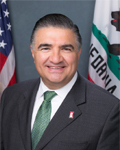
Photo of Dante Acosta
R California Assembly · District 38

Asm. Dante Acosta

Compare
Total votes
3,920
all sessions
Attendance
96%
136 missed
Near the chamber average
With party
95%
of cast votes
Lower than 85% of chamber peers
Bipartisan score
3%
crosses aisle rarely
Higher than 84% of chamber peers
Sponsored
424
bills & resolutions
Near the chamber average
Committees
0
assignments
424 bills and resolutions

Sponsored bills

Total
424
Primary
39
Co-sponsor
385
This page
424
matching current filters
Co-sponsor SCR 137
Signed into law · California Senate · Co-sponsor
Relative to Foster Care Month.

This measure would recognize the month of May 2018 as Foster Care Month as an opportunity to raise awareness about the challenges that children, and particularly lesbian, gay, bisexual, transgender, queer, and questioning (LGBTQ) youth, face in the foster care system, as specified.

Signed into law May 29, 2018 1 co-sponsor
Co-sponsor AB 1874
In committee · California Assembly · Co-sponsor
Fuel taxes: Off-Highway Vehicle Trust Fund.

Existing law imposes an excise tax on motor vehicle fuel (gasoline) and requires these taxes to be deposited in the Motor Vehicle Fuel Account. Existing law requires the moneys attributable to the excise tax on gasoline related to specified off-highway motor vehicles and off-highway vehicle activities to be transferred monthly from the Motor Vehicle Fuel Account to the Off-Highway Vehicle Trust Fund. With respect to the portion of those moneys attributable to an increase in the excise tax as a result of the elimination of the sales tax on gasoline effective July 1, 2010, existing law instead requires those moneys to be transferred to the General Fund. With respect to the portion of those moneys from a $0.12 per gallon increase in the excise tax commencing November 1, 2017, and future inflation adjustments from that increase, existing law instead requires those funds to be transferred to the State Parks and Recreation Fund, to be used for state parks, off-highway vehicle programs, or boating programs. Existing law also requires the Controller to withhold $833,000 from the monthly transfer to the Off Highway Vehicle Trust Fund, and transfer that amount to the General Fund. This bill would, on June 30, 2019, eliminate the requirement that the Controller withhold $833,000 from the monthly transfer to the Off-Highway Vehicle Trust Fund and transfer that amount to the General Fund. The bill would thereby transfer this amount monthly to the Off-Highway Vehicle Trust Fund.

In committee May 25, 2018 1 co-sponsor
Co-sponsor AB 2214
In committee · California Assembly · Co-sponsor
Recovery residences.

Existing law provides for the licensure and regulation of community care facilities by the State Department of Social Services. Existing law also provides for the licensure and regulation by the State Department of Health Care Services of adult alcoholism and drug abuse recovery and treatment facilities for adults. This bill would, among other things, define a "recovery residence" as a residential property that is operated as a cooperative living arrangement to provide an alcohol and drug free environment for persons recovering from alcoholism or drug abuse, or both, who seek a living environment that supports personal recovery. The bill would authorize a recovery residence to demonstrate its commitment to providing a supportive recovery environment by applying and becoming certified by a certifying organization that is approved by the State Department of Health Care Services. The bill would require an approved certifying organization to, among other things, maintain an affiliation with a national organization recognized by the department, establish and use procedures to administer the application, certification, renewal, and disciplinary processes for a recovery residence, and investigate and enforce violations by a residence of the organization's code of conduct, as provided. The bill would specify the information and documentation that an operator who seeks to have a residence certified is required to submit to an approved certifying organization. This bill would require an approved certifying organization to maintain and post on its Internet Web site a registry containing specified information of a residence that has been certified pursuant to these provisions, and would require the department to maintain and post on its Internet Web site a registry that contains specified information regarding each residence and operator that has had its certification revoked. This bill would require, on and after January 1, 2020, specified entities, including a state agency, state-contracted vendor, county agency, or county-contracted vendor, certified alcohol drug counselor, and person or entity licensed in the healing arts that directs substance use treatment, or a judge or parole board that sets terms and conditions for the release, parole, or discharge of a person from custody, if it requires that person to reside in a sober living environment, to first refer that person to a residence listed as a certified recovery residence on a registry posted by an approved certifying organization, if available. The bill would authorize those entities to refer persons to noncertified recovery residences, if they determine it is in the best interests of those persons, and would authorize those entities to notify the department of their decision. The bill would require the department to report to the Legislature on or before January 1, 2021, regarding the efficacy of its regulation of certifying organizations' impact on complaint resolution, as specified. By imposing additional duties on local governments, this bill would create a state-mandated local program. The bill would provide for the repeal of all of these provisions on January 1, 2026. The California Constitution requires the state to reimburse local agencies and school districts for certain costs mandated by the state. Statutory provisions establish procedures for making that reimbursement. This bill would provide that, if the Commission on State Mandates determines that the bill contains costs mandated by the state, reimbursement for those costs shall be made pursuant to the statutory provisions noted above.


In committee May 25, 2018 1 co-sponsor
Primary AB 2101
In committee · California Assembly · Lead sponsor
Caregiver resource centers: volunteer workforce.

Existing law requires the Director of Health Care Services to, among other things, maintain or enter into contracts directly with nonprofit caregiver resource centers (CRCs) to provide direct services to caregivers of cognitively impaired adults, as defined, throughout the state. This bill would establish, until January 1, 2024, a pilot program, administered by the director, pursuant to which the CRCs would select, train, and place volunteers to provide care to persons who are at least 65 years of age or who have a cognitive impairment and meet specified criteria. The bill would establish selection criteria for prospective volunteers and specified training requirements. The bill would require the CRCs to provide a stipend and an educational award, as specified, to volunteers. The bill would require the director to appoint an advisory council and would require the director and the advisory council to evaluate the program, as specified.

In committee May 25, 2018 0 co-sponsors
Co-sponsor AB 2478
In committee · California Assembly · Co-sponsor
Personal income taxes: gross income: exclusion: student loan assistance.

The Personal Income Tax Law excludes from the gross income of an employee amounts paid or incurred by an employer for educational assistance to the employee, as specified, up to $5,250 during a calendar year. This bill would exclude from the gross income of an employee amounts, not exceeding an aggregate amount of $5,250 per year, that are paid or incurred by an employer on and after January 1, 2018, and before January 1, 2023, for the payment of principal or interest on a qualified education loan, as defined, incurred by the employee. This bill would take effect immediately as a tax levy.

In committee May 25, 2018 1 co-sponsor
Co-sponsor AB 1898
Failed · California Assembly · Co-sponsor
State highways: property leases.

Existing law provides that the Department of Transportation has full possession and control of the state highway system, including associated property. Existing law authorizes the department to lease certain property, including the area above or below a state highway, and certain property held for future highway purposes, to public agencies under specified terms and conditions, including specific provisions governing leases of airspace and other property in the City and County of San Francisco for purposes of an emergency shelter or feeding program, and at a lease cost of $1 per month and payment of an administrative fee not to exceed $500 per year. Existing law also requires that a lease be offered on a right of first refusal by the department to the city and county or a political subdivision of the city and county and authorizes leases of property for park, recreational, or open-space purposes, subject to certain additional terms and conditions, including a requirement for the department to lease property located within a priority development area to the city and county for up to 10 parcels, at a specified below market value lease amount, and a requirement, applicable to all leases, for the lessee to be responsible for all associated maintenance costs. Existing law also requires that a lease authorize the lessee to subsidize its maintenance costs through a limited revenue generation model, with any revenues generated above the maintenance costs to be shared with the state and requires the City and County of San Francisco or a political subdivision of the city and county, in consultation with the department, to follow all applicable health, environmental, safety, design, and engineering standards. This bill would similarly authorize the department to offer a lease on a right of first refusal basis of any airspace under a freeway, or real property acquired for highway purposes, located in a disadvantaged community, that is not excess property to the city or county in which the disadvantaged community is located for purposes of an emergency shelter or feeding program, or for park, recreational, or open-space purposes for a rental amount of $1 per month, subject to certain conditions. The bill would also authorize the department to lease up to 10 parcels in any city, or in the unincorporated area of any county, in which the disadvantaged community is located for park, recreational, or open-space purposes at an amount equal to 30% of the fair market lease value of the applicable parcel.

Failed May 25, 2018 1 co-sponsor
Co-sponsor AB 2183
In committee · California Assembly · Co-sponsor
Foster care: resource family.

Existing law requires each county to provide cash assistance and other social services to needy families through the California Work Opportunity and Responsibility to Kids (CalWORKs) program using federal Temporary Assistance to Needy Families (TANF) block grant program, state, and county funds. Existing law establishes the Aid to Families with Dependent Children-Foster Care (AFDC-FC) program, under which counties provide payments to foster care providers on behalf of qualified children in foster care. Under existing law, a child who is placed in the approved home of a relative is eligible for AFDC-FC if he or she is eligible for federal financial participation in the AFDC-FC payment, as specified. Existing law establishes the Approved Relative Caregiver Funding Program (ARC) for the purpose of making the amount paid to relative caregivers for the in-home care of children placed with them who are ineligible for AFDC-FC payments equal to the amount paid on behalf of children who are eligible for AFDC-FC payments. Existing law provides for the temporary or emergency placement of dependent children of the juvenile court and nonminor dependents with relative caregivers or nonrelative extended family members under specified circumstances. Existing law requires counties, until June 30, 2018, to provide an emergency assistance payment or ARC payment to an emergency caregiver who meets specified requirements, and is caring for a child or nonminor dependent placed in the caregiver's home under specified circumstances, if the child or nonminor dependent resides in California, and is not otherwise eligible for AFDC-FC or ARC. Existing law requires the payments to be made either through ARC or through the TANF block grant emergency assistance program for child welfare services, as specified. This bill would extend indefinitely the requirement that counties provide an emergency assistance payment or ARC payment to an emergency caregiver, but would remove the requirement that the child or nonminor dependent reside in California and not otherwise be eligible for AFDC-FC or ARC. Existing law provides for the implementation of the resource family approval process, which replaces the multiple processes for licensing foster family homes, certifying foster homes by foster family agencies, approving relatives and nonrelative extended family members as foster care providers, and approving guardians and adoptive families. Existing law defines a resource family as an individual or family that has successfully met both home environment assessment standards and permanency assessment criteria, as specified, necessary for providing care for a child placed by a public or private child placement agency by court order, or voluntarily placed by a parent or legal guardian. This bill would authorize a county to waive the permanency assessment criteria and approve an individual or family as a resource family upon completion of a home environment assessment if exceptional circumstances exist, as specified. The bill would require the county to document the reason for the waiver and indicate its applicability to a specific child. The bill would require the permanency assessment to be completed as soon as possible and no later than the annual update of the resource family approval. This bill would require a county welfare department, immediately following the placement of a child in the home of a relative or nonrelative extended family member who has not been approved as a resource family, to initiate funding through an emergency assistance payment or ARC payment, as specified. By expanding the duties of counties relating to foster care, the bill would impose a state-mandated local program. The California Constitution requires the state to reimburse local agencies and school districts for certain costs mandated by the state. Statutory provisions establish procedures for making that reimbursement. This bill would provide that no reimbursement is required by this act for a specified reason. This bill would declare that it is to take effect immediately as an urgency statute.

In committee May 25, 2018 1 co-sponsor
Showing 121 to 130 of 424 bills
Previous 1 … 12 13 14 … 43 Next