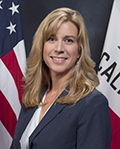
Photo of Christy Smith
D California House · District 38

Rep. Christy Smith

Compare
Total votes
3,287
all sessions
Attendance
94%
170 missed
Near the chamber average
With party
98%
of cast votes
Near the chamber average
Bipartisan score
1%
crosses aisle rarely
Near the chamber average
Sponsored
225
bills & resolutions
Near the chamber average
Committees
0
assignments
225 bills and resolutions

Sponsored bills

Total
225
Primary
28
Co-sponsor
197
This page
225
matching current filters
Co-sponsor ACR 182
Passed · California House · Co-sponsor
California Down Syndrome Awareness Week and Day.

This measure would proclaim March 15, 2020, to March 22, 2020, as California Down Syndrome Awareness Week and March 21, 2020, as California Down Syndrome Day, and would encourage all Californians to support and participate in related activities.

Passed May 26, 2020 1 co-sponsor
Primary AB 2614
In committee · California House · Lead sponsor
Emergency services: counties: large animals.

Existing law establishes the Office of Emergency Services within the office of the Governor. The office is under the supervision of the Director of Emergency Services and is responsible for the state's emergency and disaster response services for natural, technological, or human-made disasters and emergencies. Existing law prescribes various requirements with regard to accessibility to emergency information and services and, in this regard, imposes certain requirements on counties when updating their emergency plans. This bill would require a county and its office of emergency services, in consultation with relevant county departments, offices, and commissions, including those responsible for food and agriculture, to make available to the public emergency preparedness informational materials for livestock, horses, and other large animals. The bill would require these materials to include, among other things, addresses and contact information for designated shelters and facilities, best practices for stocking emergency animal husbandry supplies, transport of animals, and identification of animals. This bill would require a county, in the next update of its emergency plan, to consider and integrate large animal evacuation, sheltering, and care into its emergency plan by addressing certain minimum specified elements. In developing the update to its emergency plan, the bill would require the county to consult with certain stakeholders. By increasing the duties of local officials, this bill would impose a state-mandated local program. The California Constitution requires the state to reimburse local agencies and school districts for certain costs mandated by the state. Statutory provisions establish procedures for making that reimbursement. This bill would provide that, if the Commission on State Mandates determines that the bill contains costs mandated by the state, reimbursement for those costs shall be made pursuant to the statutory provisions noted above.

In committee May 5, 2020 0 co-sponsors
Co-sponsor AB 2356
In committee · California House · Co-sponsor
Electrical corporations: failure to comply with safety standards or requirements: enforcement.

Under existing law, the Public Utilities Commission has regulatory authority over public utilities, including electrical corporations. Existing law authorizes the commission to establish rules for all public utilities, subject to control by the Legislature. Existing law authorizes the commission, after a hearing, to require every public utility to construct, maintain, and operate its line, plant, system, equipment, apparatus, tracks, and premises in a manner so as to promote and safeguard the health and safety of its employees, passengers, customers, and the public. The Public Utilities Act provides that any public utility that violates any provision of the California Constitution or the act, or that fails or neglects to comply with any order, decision, decree, rule, direction, demand, or requirement of the commission, where a penalty has not otherwise been provided, is subject to a penalty of not less than $500 and not more than $100,000 for each offense. This bill would authorize the Attorney General or the district attorney of a proper county or city and county, as specified, to bring an action in the name of the people, pursuant to the above-described civil penalty provision, against an electrical corporation involving a failure to comply with safety standards or requirements. The bill would provide that when the conduct that constitutes the violation or failure to comply is of a continuing nature, each day of that violation or failure to comply is subject to a separate and distinct civil penalty. The bill would require that an action seeking these civil penalties be commenced within 4 years after the cause of action accrues. The Public Utilities Act provides that every public utility and every officer, agent, or employee of a public utility, who violates or fails to comply with, or who procures, aids, or abets any violation by any public utility of any provision of the California Constitution or of the act, or who fails to comply with any part of any order, decision, rule, direction, demand, or requirement of the commission, or who procures, aids, or abets any public utility in a violation or noncompliance, in a case in which a penalty has not otherwise been provided, is guilty of a misdemeanor and is punishable by a fine not exceeding $5,000, or by imprisonment in a county jail not exceeding one year, or by both fine and imprisonment. This bill would authorize the Attorney General or the district attorney of a proper county or city and county, as specified, to bring an action in the name of the people, pursuant to the above-described criminal provision, against an electrical corporation involving a failure to comply with safety standards or requirements. The bill would provide that when the conduct that constitutes the violation or failure to comply is of a continuing nature, each day of that violation or failure to comply is a separate and distinct offense subject to a fine or imprisonment, or both a fine and imprisonment. The bill would require that an action seeking a fine or imprisonment pursuant to the above-described criminal provision be commenced within 4 years after the commission discovers the violation or failure to comply, or within 4 years after completion of the violation or failure to comply, whichever is later. The Public Utilities Act provides that all penalties accruing under the act are cumulative, and a suit for the recovery of one penalty does not bar or affect the recovery of any other penalty or forfeiture or serve as a bar to any criminal prosecution against any public utility, or any officer, director, agent, or employee of the public utility, or any other corporation or person. This bill would expressly provide that the above-described civil penalty and criminal sanction provisions are in addition to other fines or penalties imposed by other law. The Public Utilities Act requires the commission to ensure that where enforcement of provisions affecting public utilities is not specifically vested in some other officer or tribunal, that those provisions are enforced and obeyed and that violations are promptly prosecuted and penalties are recovered and collected. To accomplish this requirement, the commission is authorized to sue in the name of the people and to request the Attorney General or a district attorney to aid in any investigation, hearing, or trial and to institute and prosecute actions or proceedings. This bill would provide that the bill does not diminish the duty of the commission to be the primary entity responsible to ensure that the laws pertaining to public utilities are enforced and obeyed and does not diminish the authority of the commission to request the Attorney General or the district attorney of a proper county or city and county to aid in any investigation, hearing, or trial pursuant to the act.


In committee May 5, 2020 1 co-sponsor
Primary AB 2971
In committee · California House · Lead sponsor
Leases: renewals: County of Ventura.

Existing law requires a county to follow specified procedures when leasing real property. Under existing law, a county board of supervisors is authorized to prescribe, by ordinance, a procedure alternative to those procedures for the leasing or licensing of any real property belonging to, leased by, or licensed by the county and requires the alternative procedure to include bidding. Existing law provides that leases or licenses of a duration not exceeding 10 years and that have an estimated monthly rent not exceeding a dollar limit that may be established by ordinance of the board, or, if no ordinance is adopted, not exceeding $10,000, may be excluded from those bidding procedures. Under existing law, the lease or license is prohibited from exceeding a term of 10 years and is not renewable. This bill would permit a lease for real property owned by the County of Ventura and located in the City of Simi Valley to also be excluded from those bidding procedures if the lease has an estimated monthly rent not exceeding $10,000, the lessee is a specified nonprofit organization, and the real property subject to the lease is only used for providing medical care, counseling, dental, and legal assistance to individuals and families in need. The bill would require notice to be provided as specified. The bill would prohibit the lease term from exceeding 99 years and would allow the lease to be renewable. This bill would make legislative findings and declarations as to the necessity of a special statute for the County of Ventura.

In committee May 5, 2020 0 co-sponsors
Primary AB 2379
In committee · California House · Lead sponsor
Sales and use taxes: exemption: emergency preparation items.

Existing sales and use tax laws impose taxes on retailers measured by the gross receipts from the sale of tangible personal property sold at retail in this state or on the storage, use, or other consumption in this state of tangible personal property purchased from a retailer for storage, use, or other consumption in this state, and provides various exemptions from the taxes imposed by those laws. This bill, on and after January 1, 2021, until January 1, 2023, would exempt from those taxes the gross receipts from the sale of, and the storage, use, or other consumption of, emergency preparation items, as defined, sold or purchased during the 3-day period beginning at 12:01 a.m. on the Saturday before the last Monday in June and ending at midnight on the last Monday in June. Existing law requires a bill that would authorize a new tax expenditure under the Sales and Use Tax Law to identify specific goals, purposes, and objectives that the tax expenditure will achieve, and detailed performance indicators and data collection requirements for determining whether the tax expenditure achieves these goals, purposes, and objectives. This bill would state the intent of the Legislature to enact legislation to comply with those new tax expenditure requirements. The Bradley-Burns Uniform Local Sales and Use Tax Law authorizes counties and cities to impose local sales and use taxes in conformity with the Sales and Use Tax Law, and existing laws authorize districts, as specified, to impose transactions and use taxes in accordance with the Transactions and Use Tax Law, which generally conforms to the Sales and Use Tax Law. Amendments to the Sales and Use Tax Law are automatically incorporated into the local tax laws. Existing law requires the state to reimburse counties and cities for revenue losses caused by the enactment of sales and use tax exemptions. This bill would provide that, notwithstanding Section 2230 of the Revenue and Taxation Code, no appropriation is made and the state shall not reimburse any local agencies for sales and use tax revenues lost by them pursuant to this bill. This bill would take effect immediately as a tax levy.

In committee Mar 17, 2020 0 co-sponsors
Co-sponsor AB 1995
In committee · California House · Co-sponsor
Pupil nutrition: reduced-price meals.

Existing law requires a school district or county superintendent of schools maintaining a kindergarten or any of grades 1 to 12, inclusive, to provide a needy pupil with one nutritionally adequate free or reduced-price meal during each schoolday, and authorizes the school district or county superintendent of schools to use funds available from any federal or state program to comply with that requirement, as provided. Existing law generally requires a school district or a county superintendent of schools to provide breakfast and lunch free of charge to all pupils at a very high poverty school, as defined. This bill would require a school district or county superintendent of schools maintaining a kindergarten or any of grades 1 to 12, inclusive, to provide a pupil, eligible to receive a reduced-priced meal, that meal free of charge. By creating a new duty on a school district or a county superintendent of schools, the bill would create a state-mandated program. To comply with the above, the bill would authorize a school district or county office of education to use funds made available through any federal, to the extent allowed, or state program relating to the provision of meals to pupils, as provided. The California Constitution requires the state to reimburse local agencies and school districts for certain costs mandated by the state. Statutory provisions establish procedures for making that reimbursement. This bill would provide that, if the Commission on State Mandates determines that the bill contains costs mandated by the state, reimbursement for those costs shall be made pursuant to the statutory provisions noted above.

In committee Mar 16, 2020 1 co-sponsor
Co-sponsor AB 2963
In committee · California House · Co-sponsor
Education finance: allocation of lottery funds.

Existing law establishes a statewide system of public elementary and secondary education under which local educational agencies throughout the state provide instruction and other services to pupils in kindergarten and grades 1 to 12, inclusive. Existing law establishes the State Department of Education, under the administration of the Superintendent of Public Instruction, and assigns to that department numerous duties and responsibilities with respect to the funding and governance of this system. The California State Lottery Act of 1984, an initiative measure approved by the voters at the November 6, 1984, statewide general election, authorizes a California State Lottery and provides for its operation and administration by the California State Lottery Commission and the Director of the California State Lottery, with certain limitations. The act requires all revenues from the imposition of the lottery after accrual of all obligations for prizes and expenses to be deposited in the California State Lottery Education Fund. The act continuously appropriates the moneys in the fund for the benefit of public education, as specified. Following the end of each fiscal year, existing law requires the commission to calculate and report to the Controller and the Legislature the amount of total net revenues allocated to the benefit of public education from that fund. This bill would require the department, commencing on or before October 1, 2021, and on or before October 1 of each year thereafter, to submit a report of the total amount of lottery funds allocated to public elementary and secondary schools in the school year ending the preceding July 1. The bill would require the report to specify the amount received by each school and to describe how each school expended these funds. The bill would require the report to be submitted to the Governor and to the respective chairpersons of the Committees on Budget and Education of the Assembly and the Senate. This bill would amend the California State Lottery Act to specify that revenues of the California State Lottery are to be allocated so as to ensure that the relationship between increases in the net revenue of the California State Lottery and increases in funding allocated to public education is directly proportional. This bill would declare that its provisions further the purposes of the California State Lottery Act.

In committee Mar 16, 2020 1 co-sponsor
Co-sponsor AB 3198
In committee · California House · Co-sponsor
Emergency services: staffing grant program.

The California Emergency Services Act establishes the Office of Emergency Services and provides that the office is responsible for the state's emergency and disaster response services and serves as the State Disaster Council for the purposes of the California Disaster and Civil Defense Master Mutual Aid Agreement. The act authorizes state agencies to provide mutual aid, including personnel, equipment, and other available resources, to assist political subdivisions during a local emergency or in accordance with mutual aid agreements or at the direction of the Governor. This bill would direct the Office of Emergency Services to establish and administer a grant program entitled the California Staffing for Adequate Fire and Emergency Response (CA SAFER) , upon appropriation of sufficient funds by the Legislature, to augment California's firefighting mutual aid system.

In committee Mar 9, 2020 1 co-sponsor
Showing 31 to 40 of 225 bills
Previous 1 3 4 5 23 Next