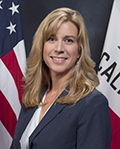
Photo of Christy Smith
D California Assembly · District 38

Asm. Christy Smith

Compare
Total votes
3,287
all sessions
Attendance
94%
170 missed
Near the chamber average
With party
98%
of cast votes
Near the chamber average
Bipartisan score
1%
crosses aisle rarely
Near the chamber average
Sponsored
225
bills & resolutions
Near the chamber average
Committees
0
assignments
225 bills and resolutions

Sponsored bills

Total
225
Primary
28
Co-sponsor
197
This page
225
matching current filters
Co-sponsor ACR 87
Passed · California Assembly · Co-sponsor
Upholding democracy through civic education in public schools.

This measure would endorse activities in public schools that instruct pupils in upholding and sustaining American democracy, encourage, in the strongest terms, California schools to pursue certain recognized designations that reflect specified ethos and values, and encourage publicly elected officials to conduct themselves in ways that strengthen civic engagement and participation in civil society.

Passed Sep 4, 2019 1 co-sponsor
Co-sponsor AJR 21
Passed · California Assembly · Co-sponsor
Relative to reparations for descendants of enslaved persons.

This measure would formally apologize for California's past complicity in enabling and furthering the practice of slavery and would urge the United States Congress and the President of the United States to enact House Resolution 40 to study the legacy of slavery and provide recommendations on redress for descendants of enslaved persons.

Passed Sep 4, 2019 1 co-sponsor
Co-sponsor AJR 22
Passed · California Assembly · Co-sponsor
Relative to the 76th anniversary of the repeal of the Chinese Exclusion Act.

This measure would mark December 17, 2019, as the 76th anniversary of the repeal of the Chinese Exclusion Act to honor the contributions of all immigrants and refugees in our communities. The measure would also declare the opposition of the Legislature to executive orders and a presidential proclamation signed by President Trump relating to immigration, call upon the President to revoke those orders and that proclamation, condemn the expansion of deportations being undertaken under the current presidential administration, stand in firm opposition to the President's proposal for construction of a wall along the southern border with Mexico, and reaffirm that the state is open and welcoming to immigrants and refugees who are integral to life in our state.

Passed Sep 4, 2019 1 co-sponsor
Co-sponsor AJR 7
Passed · California Assembly · Co-sponsor
Relative to the Green New Deal.

This measure would encourage the United States Congress to adopt climate policies, including those that might be adopted under the Green New Deal, that build upon California's programs that have reduced greenhouse gas emissions while improving air and water quality, create new green jobs, and improve disadvantaged communities and that just climate actions offer the nation an opportunity to achieve community-mindful policies that California has successfully adopted while growing its economy.

Passed Sep 4, 2019 1 co-sponsor
Co-sponsor AB 213
Passed · California Assembly · Co-sponsor
Local government finance: property tax revenue allocations: vehicle license fee adjustments.

Existing property tax law requires the county auditor, in each fiscal year, to allocate property tax revenue to local jurisdictions in accordance with specified formulas and procedures, and generally provides that each jurisdiction be allocated an amount equal to the total of the amount of revenue allocated to that jurisdiction in the prior fiscal year, subject to certain modifications, and that jurisdiction's portion of the annual tax increment, as defined. Existing property tax law also requires that, for purposes of determining property tax revenue allocations in each county for the 1992–93 and 1993–94 fiscal years, the amounts of property tax revenue deemed allocated in the prior fiscal year to the county, cities, and special districts be reduced in accordance with certain formulas. It requires that the revenues not allocated to the county, cities, and special districts as a result of these reductions be transferred to the Educational Revenue Augmentation Fund in that county for allocation to school districts, community college districts, and the county office of education. Beginning with the 2004–05 fiscal year and for each fiscal year thereafter, existing law requires that each city, county, and city and county receive additional property tax revenues in the form of a vehicle license fee adjustment amount, as defined, from a Vehicle License Fee Property Tax Compensation Fund that exists in each county treasury. Existing law requires that these additional allocations be funded from ad valorem property tax revenues otherwise required to be allocated to educational entities. Existing law, for the 2006–07 fiscal year, and for each fiscal year thereafter, requires the vehicle license fee adjustment amount to be the sum of the vehicle license fee adjustment amount for the prior fiscal year, if specified provisions did not apply, and the product of that sum and the percentage change from the prior fiscal year in the gross taxable valuation within the jurisdiction of the entity. Existing law establishes a separate vehicle license fee adjustment amount for a city that was incorporated after January 1, 2004, or on or before January 1, 2012. This bill, for the 2019–20 fiscal year, would instead require the vehicle license fee adjustment amount to be the sum of the vehicle license fee adjustment amount in the 2018–19 fiscal year, the product of that sum and the percentage change in gross taxable assessed valuation within the jurisdiction of that entity between the 2018–19 fiscal year to the 2018–19 fiscal year, and the product of the amount of specified motor vehicle license fee revenues that the Controller allocated to the applicable city in July 2010 and 1.17. This bill, for the 2020–21 fiscal year, and for each fiscal year thereafter, would require the vehicle license fee adjustment amount to be the sum of the vehicle license fee adjustment amount for the prior fiscal year and the product of the amount as so described and the percentage change from the prior fiscal year in gross taxable assessed valuation within the jurisdiction of the entity. By imposing additional duties upon local tax officials with respect to the allocation of ad valorem property tax revenues, this bill would impose a state-mandated local program. The California Constitution requires the state to reimburse local agencies and school districts for certain costs mandated by the state. Statutory provisions establish procedures for making that reimbursement. This bill would provide that, if the Commission on State Mandates determines that the bill contains costs mandated by the state, reimbursement for those costs shall be made pursuant to the statutory provisions noted above.

Passed Aug 30, 2019 1 co-sponsor
Primary AB 769
Passed · California Assembly · Lead sponsor
Federally qualified health centers and rural health clinics: licensed professional clinical counselor.

Existing law provides for the Medi-Cal program, which is administered by the State Department of Health Care Services, under which qualified low-income individuals receive healthcare services. The Medi-Cal program is, in part, governed and funded by federal Medicaid program provisions. Existing law provides that federally qualified health center (FQHC) services and rural health clinic (RHC) services, as defined, are covered benefits under the Medi-Cal program, to be reimbursed, to the extent that federal financial participation is obtained, to providers on a per-visit basis. "Visit" is defined as a face-to-face encounter between a patient of an FQHC or RHC and specified health care professionals. Existing law allows an FQHC or RHC to apply for an adjustment to its per-visit rate based on a change in the scope of service it provides. This bill would additionally include a licensed professional clinical counselor within those health care professionals covered under that definition. The bill would require an FQHC or RHC that currently includes the cost of the services of a licensed professional clinical counselor for the purposes of establishing its FQHC or RHC rate to apply to the department for an adjustment to its per-visit rate, and, after the rate adjustment has been approved by the department, would require the FQHC or RHC to bill for these services as a separate visit, as specified. The bill would require an FQHC or RHC that does not provide the services of a licensed professional clinical counselor, and later elects to add this service and bill these services as a separate visit, to process the addition of these services as a change in scope of service.

Passed Aug 30, 2019 0 co-sponsors
Co-sponsor AB 1442
Passed · California Assembly · Co-sponsor
Income taxes: credits: Share Our Values Tax Credit.

The Personal Income Tax Law and the Corporation Tax Law allow a motion picture credit for taxable years beginning on or after January 1, 2020, to be allocated by the California Film Commission on or after July 1, 2020, and before July 1, 2025. Existing law allows a credit in an amount equal to 20% or 25% of qualified expenditures up to $100,000,000 for the production of a qualified motion picture in this state, with additional specified credit amounts allowed. Existing law limits the aggregate amount of these new credits to be allocated in each fiscal year to $330,000,000 plus, among other amounts, the amount of any unused credit amounts for the preceding fiscal year. This bill, for taxable years beginning on or after January 1, 2020, would allow an additional tax credit, for qualified motion pictures in the same manner as described above, with modifications including revising the definition of "qualified motion picture" to mean a qualified motion picture that either relocated to California from, or chose not to pay or incur qualified expenditures for a qualified motion picture in, a state that has pending legislation or existing law that prohibits access to, criminalizes the provision of, or otherwise restricts a woman's access to abortion services after 8 weeks from the beginning of the pregnancy or earlier and would limit on the aggregate amount of these new credits to be allocated in each fiscal year to $50,000,000 plus additional specified amounts. This bill would take effect immediately as a tax levy.

Passed Aug 30, 2019 1 co-sponsor
Co-sponsor AB 720
Passed · California Assembly · Co-sponsor
Community colleges: funding: instructional service agreements with public safety agencies.

Existing law establishes the California Community Colleges, under the administration of the Board of Governors of the California Community Colleges, as one of the segments of public postsecondary education in this state. Existing law establishes community college districts throughout the state, and authorizes these districts to provide instruction at the community college campuses they operate and maintain. Existing law provides for a formula for the calculation of general purpose apportionments of state funds to community colleges. Existing law provides a separate formula for the allocation of apportionments of state funds to community colleges, which uses the numbers of full-time equivalent students as its basis, for use for apportionments for noncredit instruction and instruction in career development and college preparation. This bill would provide that instruction by community college districts under instructional service agreements with public safety agencies, as defined, would be funded under the apportionment formula used for instruction in career development and college preparation. The bill would also make various nonsubstantive changes.

Passed Aug 30, 2019 1 co-sponsor
Co-sponsor SB 14
Passed · California Senate · Co-sponsor
Education finance: Higher Education Facilities Bond Act of 2020.

(1) Under the Higher Education Facilities Bond Act of 1986, the Higher Education Facilities Bond Act of 1988, and the Higher Education Facilities Bond Act of June 1992, the issuance, pursuant to the State General Obligation Bond Law, of bonds in an amount not to exceed $400,000,000, $600,000,000, and $900,000,000, respectively, and the expenditure of the revenues therefrom, were authorized for the purpose of aid to the University of California and the California State University for, among other things, the construction and equipping of educational facilities, as specified. Existing law establishes the Higher Education Facilities Finance Committee to administer those acts, and to authorize the issuance and sale of bonds to the extent necessary to fund the education facilities construction apportionments expressly authorized by the Legislature in the annual Budget Act. More recently, the Class Size Reduction Kindergarten-University Public Education Facilities Bond Act of 1998, the Kindergarten-University Public Education Facilities Bond Act of 2002, the Kindergarten-University Public Education Facilities Bond Act of 2004, and the Kindergarten-University Public Education Facilities Bond Act of 2006 authorized the issuance of bonds and the expenditure of revenues therefrom for the University of California and the California State University, as well as for the California Community Colleges and public elementary and secondary schools. This bill would enact the Higher Education Facilities Bond Act of 2020, which, upon approval by the state electorate, would authorize the issuance of state general obligation bonds in an amount not to exceed $8,000,000,000, with one-half of the amount designated for the University of California and the Hastings College of the Law and the other half designated for the California State University, for purposes similar to those specified in the Higher Education Facilities Bond Act of 1986, the Higher Education Facilities Bond Act of 1988, and the Higher Education Facilities Bond Act of June 1992, to be issued and sold in a manner similar to that provided under those acts. The bill would require that any request for funds from the bonds issued pursuant to the bond act enacted by this bill be accompanied by the 5-year capital outlay plan of the particular university or college and include a schedule that prioritizes the seismic retrofitting needed to significantly reduce seismic hazards in buildings identified as high priority by the university or college, as specified. (2) This bill would provide for the submission of the Higher Education Facilities Bond Act of 2020 to the voters at the March 3, 2020, statewide primary election, as specified.


Passed Aug 30, 2019 1 co-sponsor
Co-sponsor SB 333
Passed · California Senate · Co-sponsor
Homeless Coordinating and Financing Council.

Existing law establishes various programs, including, among others, the Emergency Housing and Assistance Program, to provide assistance to homeless persons. Existing law requires a state agency or department that funds, implements, or administers a state program that provides housing or housing-related services to people experiencing homelessness or at risk of homelessness, except as specified, to revise or adopt guidelines and regulations to include enumerated Housing First policies. Existing law establishes the Homeless Coordinating and Financing Council to oversee the implementation of the Housing First guidelines and regulations and, among other things, to identify resources, benefits, and services that can be accessed to prevent and end homelessness in California. This bill would require the Homeless Coordinating and Financing Council, by July 1, 2021, to develop and implement a statewide strategic plan for addressing homelessness in the state, as specified. The bill would require the council, by January 1, 2021, to implement strategic plans to assist federal Housing and Urban Development Continuum of Care lead agencies in better implementing Housing and Urban Development recommended activities and meeting Housing and Urban Development requirements.

Passed Aug 30, 2019 1 co-sponsor
Showing 101 to 110 of 225 bills
Previous 1 … 10 11 12 … 23 Next