

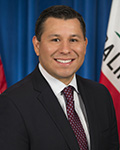
Photo of Eduardo Garcia
D California Assembly · District 36 · Former member

Asm. Eduardo Garcia

Contact Email
Compare
Total votes
27,298
all sessions
Attendance
92%
1,511 missed
Near the chamber average
With party
99%
of cast votes
Higher than 90% of chamber peers
Bipartisan score
0%
crosses aisle rarely
Lower than 93% of chamber peers
Sponsored
2,006
bills & resolutions
Near the chamber average
Committees
0
assignments
2,006 bills and resolutions

Sponsored bills

Total
2,006
Primary
262
Co-sponsor
1,744
This page
2,006
matching current filters
Co-sponsor SB 604
In committee · California Senate · Co-sponsor
Natural resources: the Nature and Parks Career Pathway and Community Resiliency and Equity Act of 2021.

Existing law establishes various environmental and economic policies and programs. This bill, upon appropriation by the Legislature, as provided, would establish the Nature and Parks Career Pathway and Community Resiliency and Equity Act of 2021, which would require state conservancies and the Wildlife Conservation Board to establish grant programs to fund climate mitigation, adaptation, or resilience, natural disaster, and other climate emergency projects, as specified.

In committee Feb 1, 2022 1 co-sponsor
Co-sponsor SB 809
In committee · California Senate · Co-sponsor
Multijurisdictional regional agreements: housing element.

The Planning and Zoning Law requires each county and city to adopt a comprehensive, long-term general plan for its physical development, and the development of certain lands outside its boundaries, that includes, among other mandatory elements, a housing element. Existing law requires that the housing element include, among other things, an inventory of land suitable and available for residential development that identifies sites that can be developed for housing within the planning period and that are sufficient to provide for the jurisdiction's share of the regional housing need for all income levels, as specified. This bill would authorize a city or county to satisfy part of its requirement to identify zones suitable for residential development by adopting and implementing a multijurisdictional regional agreement. The bill would require the multijurisdictional regional agreement to clearly establish the jurisdiction that is contributing suitable land for residential development and the jurisdiction or jurisdictions that are contributing funding for that development. The bill would require that a multijurisdictional regional agreement be between 2 or more cities or counties that are located within the same county or within adjacent counties. This bill would require a jurisdiction that is a party to a multijurisdictional regional agreement under these provisions to provide specified information in its housing element, including how the multijurisdictional regional agreement will satisfy the jurisdiction's housing need for a designated income level. The bill would prohibit the jurisdictions that are a party to a multijurisdictional regional agreement from claiming an aggregate capacity in an amount greater than the actual capacity created by the housing development subject to the agreement. The bill would repeal these provisions on January 1, 2030. The bill would include findings that changes proposed by this bill address a matter of statewide concern rather than a municipal affair and, therefore, apply to all cities, including charter cities.

In committee Feb 1, 2022 1 co-sponsor
Primary AB 589
died · California Assembly · Lead sponsor
Public Social Services.

Existing law establishes various public assistance programs to provide protection, care, and assistance to the people of the state who are in need of those services. Existing law defines "public assistance" and "public assistance programs" to refer to specified public social services programs, including, among others, the California Work Opportunity and Responsibility to Kids (CalWORKs) program, adult day health care programs, programs for the aged, blind, and disabled, and in-home supportive services. This bill would make technical, nonsubstantive changes to that definition.

died Feb 1, 2022 0 co-sponsors
Primary AB 588
Failed · California Assembly · Lead sponsor
California Safe Drinking Water Act: compliance.

(1) Existing law, the California Safe Drinking Water Act, requires the State Water Resources Control Board to adopt primary drinking water standards for contaminants in drinking water. Existing law requires the state board to consider specified criteria when it adopts a primary drinking water standard, including the technological and economic feasibility of compliance. This bill would require the state board to identify actions necessary to assist specified water systems to achieve compliance within any compliance period established. The bill would require the state board to identify a compliance period or periods, when it adopts a primary drinking water standard, of not less than 30 days and not more than 3 years, and to consider specified criteria when identifying the compliance period. The bill would authorize the state board to grant additional time for compliance beyond the identified compliance period on a case-by-case basis. The bill would require a public water system to provide written notice regarding its progress in achieving a compliance plan to the persons served by the public water system at least 2 times per year. (2) The act authorizes the state board, if the state board determines that a public water system is subject to potential contamination, to, by order, require the public water system to conduct a periodic water analysis in accordance with conditions specified by the state board. This bill would require the above-described order to identify the analytical test methods to be used by laboratories and provide for electronic submission of the monitoring results to the state board. The bill would authorize the above-described order to apply to an individual public water system, specific groups of public water systems, or to all public water systems. The bill would exempt an order issued to a specific group of public water systems or to all public water systems from specified administrative regulation and rulemaking requirements.

Failed Feb 1, 2022 0 co-sponsors
Co-sponsor AB 508
Failed · California Assembly · Co-sponsor
Pupil nutrition: reduced-price meals.

Existing law requires a school district or county superintendent of schools maintaining a kindergarten or any of grades 1 to 12, inclusive, to provide a needy pupil with one nutritionally adequate free or reduced-price meal during each schoolday, and authorizes the school district or county superintendent of schools to use funds available from any federal or state program to comply with that requirement, as provided. Existing law generally requires a school district or a county superintendent of schools to provide breakfast and lunch free of charge to all pupils at a very high poverty school, as defined. This bill would require a school district or county superintendent of schools maintaining a kindergarten or any of grades 1 to 12, inclusive, to provide a pupil, eligible to receive a reduced-priced meal, that meal free of charge. By creating a new duty on a school district or a county superintendent of schools, the bill would create a state-mandated program. The bill would require the state to provide sufficient funding to school districts and county offices of education to cover the cost of providing meals free of charge to pupils from households that would otherwise be required to provide a copayment for these meals. To comply with the above, the bill would authorize a school district or county office of education to use funds made available through any federal, to the extent allowed, or state program relating to the provision of meals to pupils, as provided. The California Constitution requires the state to reimburse local agencies and school districts for certain costs mandated by the state. Statutory provisions establish procedures for making that reimbursement. This bill would provide that, if the Commission on State Mandates determines that the bill contains costs mandated by the state, reimbursement for those costs shall be made pursuant to the statutory provisions noted above.

Failed Feb 1, 2022 1 co-sponsor
Co-sponsor AB 940
Failed · California Assembly · Co-sponsor
College Mental Health Services Program.

Existing law, the Mental Health Services Act, an initiative statute enacted by the voters as Proposition 63 at the November 2, 2004, statewide general election, funds a system of county mental health plans for the provision of mental health services, as specified. Existing law establishes the continuously appropriated Mental Health Services Fund. Existing law requires the Controller, prior to distributing the balance of the funds to the counties, as specified, to reserve up to 5% of the total annual revenues of the fund for the costs for the State Department of Health Care Services, the California Behavioral Health Planning Council, the Office of Statewide Health Planning and Development, the Mental Health Services Oversight and Accountability Commission, the State Department of Public Health, and any other state agency to implement all duties pursuant to the programs set forth in the act. This bill would amend Proposition 63 by appropriating $20,000,000 annually from the administrative account of the Mental Health Services Fund to the University of California, if the University of California chooses to accept the moneys, the California State University, and the California Community Colleges, as specified, to implement the College Mental Health Services Program. The bill would require those funds to be used for the purpose of funding programs to increase campus student mental health services and mental health-related education and training. The bill would require campuses that participate in the program to report on the use of those grant funds, as specified, and to post that information on their internet websites.

Failed Feb 1, 2022 1 co-sponsor
Co-sponsor AB 839
Failed · California Assembly · Co-sponsor
Career technical education: California Career Technical Education Incentive Grant Program.

Existing law establishes the California Career Technical Education Incentive Grant Program, administered by the State Department of Education, with the purpose of encouraging, maintaining, and strengthening the delivery of high-quality career technical education programs. Existing law appropriates specified amounts for the program from the General Fund for the 2015–16, 2016–17, and 2017–18 fiscal years. Existing law provides, for the 2018–19 fiscal year and every fiscal year thereafter, that $150,000,000 is made available for the program upon appropriation by the Legislature. Existing law specifies minimum eligibility requirements for grant applicants. Existing law also requires the department, on or before January 31, 2024, and on or before January 31 every 5 years thereafter, to submit to the Department of Finance, the Governor, and the appropriate policy and fiscal committees of the Legislature a report evaluating the progress that local educational agencies have made with respect to specified issues related to the program. This bill would provide that, for the 2021–22 fiscal year and each fiscal year thereafter, $300,000,000 would be made available to the department, upon appropriation by the Legislature in the Budget Act or another statute, for the program. The bill would also make slight adjustments to program provisions relating to eligibility requirements for grant applicants and to the reporting requirements referenced above.

Failed Feb 1, 2022 1 co-sponsor
Primary AB 922
Failed · California Assembly · Lead sponsor
Redevelopment: housing successor: Low and Moderate Income Housing Asset Fund.

Existing law dissolved redevelopment agencies and community development agencies as of February 1, 2012, and provides for the designation of successor agencies to wind down the affairs of the dissolved redevelopment agencies and to, among other things, make payments due for enforceable obligations and to perform duties required by any enforceable obligation. Existing law authorizes the city, county, or city and county that created a former redevelopment agency to elect to retain the housing assets and functions previously performed by the former redevelopment agency. Existing law requires the housing successor to maintain any funds transferred to it, together with any funds generated from housing assets in a separate Low and Moderate Income Housing Asset Fund to be used in accordance with applicable housing-related provisions of the Community Redevelopment Law, except as specified. Existing law requires the housing successor to expend funds received from the successor agency to meet its enforceable obligations, and for specified administrative and monitoring costs relating to ensuring the long-term affordability of units subject to affordability restrictions. The housing successor may then expend a specified amount per fiscal year for homeless prevention and rapid rehousing services, including specified types of services described in that provision, and must use all funds remaining thereafter for the development of affordable housing, as specified. If a housing successor has an excess surplus, the housing successor is required to encumber those funds, within 3 fiscal years, for the development of affordable housing, or to enter into an agreement to transfer the funds for transit priority projects, as specified. Existing law defines the term "excess surplus" for these purposes to mean an unencumbered amount in the housing successor's Low and Moderate Income Housing Asset Fund that exceeds the greater of $1,000,000 or the aggregate amount deposited into the fund during the housing successor's preceding 4 fiscal years, whichever is greater. This bill would expand the definition of "excess surplus" to also include, for an entity operating as a housing successor that owns and operates affordable housing that was transferred to the housing successor as a housing asset of the former redevelopment agency, an unencumbered amount in the housing successor's Low and Moderate Income Housing Asset Fund that exceeds the greater of $1,000,000 or the aggregate amount deposited into the account during the housing successor's preceding 8 fiscal years, whichever is greater.

Failed Feb 1, 2022 0 co-sponsors
Primary AB 765
Failed · California Assembly · Lead sponsor
Public lands: school lands: California Desert Conservation Area.

Existing law requires the State Lands Commission to enter into a memorandum of agreement by April 1, 2012, with the United States Secretary of the Interior to facilitate land exchanges that consolidate school land parcels into contiguous holdings that are suitable for large-scale renewable energy-related projects. Existing law requires, after the memorandum of agreement is entered into, the commission to make best efforts to consolidate all school land parcels in the California desert into contiguous holdings for large-scale renewable energy-related projects. Existing law requires the commission to report to the Legislature by January 1 of each year on the status of the memorandum of agreement and school land consolidation efforts in the California desert. Existing law provides that these requirements are contingent on the cooperation of the United States Secretary of the Interior. Existing law defines "California desert" for these purposes to mean the California Desert Conservation Area as described pursuant to specified federal law. This bill would also include as part of the definition of "California desert" any other additional areas included in a specified United States Bureau of Land Management amendment, as provided.

Failed Feb 1, 2022 0 co-sponsors
Co-sponsor AB 125
Failed · California Assembly · Co-sponsor
Equitable Economic Recovery, Healthy Food Access, Climate Resilient Farms, and Worker Protection Bond Act of 2022.

Existing law requires the Department of Food and Agriculture to promote and protect the agricultural industry of the state. Existing law under Article XVI of the California Constitution requires measures authorizing general obligation bonds to specify the single object or work to be funded by the bonds and further requires a bond act to be approved by a 23 vote of each house of the Legislature and a majority of the voters. This bill would enact the Equitable Economic Recovery, Healthy Food Access, Climate Resilient Farms, and Worker Protection Bond Act of 2022, which, if approved by the voters, would authorize the issuance of bonds in the amount of $3,302,000,000 pursuant to the State General Obligation Bond Law, to finance programs related to, among other things, agricultural lands, food and fiber infrastructure, climate resilience, agricultural professionals, including farmers, ranchers, and farmworkers, workforce development and training, air quality, tribes, disadvantaged communities, nutrition, food aid, meat processing facilities, fishing facilities, and fairgrounds. The bill would provide for the submission of the bond act to the voters at the November 8, 2022, statewide general election.

Failed Feb 1, 2022 1 co-sponsor
Showing 751 to 760 of 2,006 bills
Previous 1 … 75 76 77 … 201 Next