

Passed Aug 12, 2019
1 co-sponsor
Total votes
27,298
all sessions
Attendance
92%
1,511 missed
Near the chamber average
With party
99%
of cast votes
Higher than 90% of chamber peers
Bipartisan score
0%
crosses aisle rarely
Lower than 93% of chamber peers
Sponsored
2,006
bills & resolutions
Near the chamber average
Committees
0
assignments
2,006 bills and resolutions
Sponsored bills
Total
2,006
Primary
262
Co-sponsor
1,744
This page
2,006
matching current filters
Desert Healthcare District.
Existing law, the Local Health Care District Law, authorizes the organization and incorporation of local health care districts and specifies the powers of those districts, including, among other things, the power to establish, maintain, and operate, or provide assistance in the operation of, one or more health facilities or health services. Existing law authorizes the expansion of the Desert Healthcare District, as specified, and requires the board of directors of the district, following expansion, to adopt a resolution to increase the number of members of the district's board of directors from 5 to 7, and to appoint 2 members who are residents of the territory annexed by the district to fill the vacant positions. Existing law requires the board to designate 1 of those appointees to leave office when their successor takes office at noon on the first Friday in December next following the general district election and the other appointee to leave office 2 years thereafter. This bill would instead require the board to designate 1 appointee to have an initial term of office from the date of appointment until the date in December described above that occurs in 2020 and the other appointee to have an initial term of office from the date of appointment until the date in December described above that occurs in 2022.
Signed into law Jul 30, 2019
0 co-sponsors
Drinking water.
(1) Existing law, the California Safe Drinking Water Act, requires the State Water Resources Control Board to administer provisions relating to the regulation of drinking water to protect public health. Existing law declares it to be the established policy of the state that every human being has the right to safe, clean, affordable, and accessible water adequate for human consumption, cooking, and sanitary purposes. This bill would establish the Safe and Affordable Drinking Water Fund in the State Treasury to help water systems provide an adequate and affordable supply of safe drinking water in both the near and long terms. The bill would authorize the state board to provide for the deposit into the fund of certain moneys and would continuously appropriate the moneys in the fund to the state board for grants, loans, contracts, or services to assist eligible recipients. The bill would require the state board, in consultation with the Department of Finance, to adopt a fund expenditure plan with specified contents and would require, on and after July 1, 2020, expenditures of the fund to be consistent with the plan. The bill would require, by January 1, 2021, the state board, in consultation with local health officers and other relevant stakeholders, to make publicly available, as specified, a map of aquifers that are used or likely to be used as a source of drinking water that are at high risk of containing contaminants that exceed safe drinking water standards. For purposes of the map, the bill would require local health officers and other relevant local agencies to provide all results of, and data associated with, water quality testing performed by certified laboratories to the state board, as specified. By imposing additional duties on local health officers and local agencies, the bill would impose a state-mandated local program. The act provides for the operation of public water systems and authorizes the state board to contract with, or provide a grant to, an administrator to provide administrative, technical, operational, or managerial services, or any combination of those services, to a designated water system to assist with the provision of an adequate supply of affordable, safe drinking water. The act defines an administrator as a person whom the state board has determined is competent to perform the administrative, technical, operational, or managerial services required, as specified, and authorizes a privately owned public utility to serve as an administrator. This bill would, among other things, authorize an administrator to additionally provide legal services pursuant to those provisions and to act, where the administrator is authorized to act on behalf of a designated public water system, on behalf of a voluntary participant, as defined. The bill would recast the authorization for a local agency or a privately owned public utility to serve as an administrator for these purposes. The act prohibits a person from operating a public water system unless the person first submits an application to the state board and receives a permit to operate the system, as specified. The act authorizes the state board, if the state board determines that it is feasible for the service area of the public water system addressed by the application to be served by one or more currently permitted public water systems, to deny the permit of a proposed new public water system if it determines that it is reasonably foreseeable that the proposed new public water system will be unable to provide affordable, safe drinking water in the reasonably foreseeable future, as prescribed. This bill would eliminate the requirement that the state board determine that it is reasonably foreseeable that the proposed new public water system will be unable to provide affordable, safe drinking water in the reasonably foreseeable future in order to deny the permit of a proposed new public water system. The act defines a disadvantaged community for its purposes as an area, as specified, in which the median household income is less than 80% of the statewide average. This bill would revise that definition to apply to specified areas with a median household income of less than 80% of the statewide annual median household income level. The act requires a public water system to submit a technical report to the state board as a part of the permit application or when otherwise required by the state board, as specified. This bill would require a public water system to submit the report in the form and format and at intervals specified by the state board. (2) Existing law requires a laboratory that performs analyses for regulatory purposes of drinking water, wastewater, hazardous waste, and contaminated soils or sediments to obtain certification or accreditation, as specified. Existing law requires, when a person or entity submits material to the laboratory for testing, the laboratory to report the results of all detected contaminants and pollutants to that person or entity. This bill would require a laboratory accredited by the State Water Resources Control Board to also report the results of each drinking water analysis to the state board in the form or format and at intervals specified by the state board. (3) The California Global Warming Solutions Act of 2006 designates the State Air Resources Board as the state agency charged with monitoring and regulating sources of emissions of greenhouse gases. The act authorizes the state board to include the use of market-based compliance mechanisms. Existing law requires all moneys, except for fines and penalties, collected by the state board as part of a market-based compliance mechanism to be deposited in the Greenhouse Gas Reduction Fund and to be available upon appropriation. Existing law continuously appropriates 35% of the annual proceeds of the fund for transit, affordable housing, and sustainable communities programs and 25% of the annual proceeds of the fund for certain components of a specified high-speed rail project. This bill, beginning in the 2020–21 fiscal year, would require 5% of the annual proceeds of the Greenhouse Gas Reduction Fund, up to the sum of $130,000,000, to be deposited into the Safe and Affordable Drinking Water Fund for the purposes of the Safe and Affordable Drinking Water Fund, subject to specified restrictions. The bill would require the Director of Finance, beginning in the 2023–24 fiscal year and until June 30, 2030, to calculate the sum to be transferred by the Controller from the General Fund to the Safe and Affordable Drinking Water Fund if the annual transfer from the annual proceeds of the Greenhouse Gas Reduction Fund is less than $130,000,000 to equal a total transfer into the Safe and Affordable Drinking Water Fund of $130,000,000, as specified. (4) The Budget Act of 2019 appropriates $100,000,000 from the Greenhouse Gas Reduction Fund and $30,000,000 from the General Fund to the State Water Resources Control Board for support or local assistance to fund grants, loans, contracts, or services to help water systems provide safe and affordable drinking water. This bill would require these moneys to be available for the purposes of the Safe and Affordable Drinking Water Fund, subject to specified restrictions. (5) This bill would provide that its provisions are severable. (6) The California Constitution requires the state to reimburse local agencies and school districts for certain costs mandated by the state. Statutory provisions establish procedures for making that reimbursement. This bill would provide that, if the Commission on State Mandates determines that the bill contains costs mandated by the state, reimbursement for those costs shall be made pursuant to the statutory provisions noted above. (7) This bill would declare that it is to take effect immediately as an urgency statute.
Signed into law Jul 24, 2019
1 co-sponsor
Relative to the American Legion.
This measure would commemorate the American Legion for 100 years of service to the United States.
Signed into law Jul 23, 2019
1 co-sponsor
Relative to Latex Allergy Awareness Week.
This measure would proclaim October 6, 2019, through October 12, 2019, as Latex Allergy Awareness Week in California.
Signed into law Jul 23, 2019
1 co-sponsor
Relative to the Marine Corporal Erik H. Silva Memorial Bridge.
This measure would designate the Alamo River Bridge on the Evan Hewes Highway (State Route 115) at the entry to the City of Holtville, California, as the Marine Corporal Erik H. Silva Memorial Bridge. The measure would request the Department of Transportation to determine the cost for appropriate signs showing this special designation and, upon receiving donations from nonstate sources covering that cost, to erect those signs.
Signed into law Jul 23, 2019
0 co-sponsors
Relative to Foster Care Month.
This measure would declare the month of May 2019 as Foster Care Month.
Signed into law Jul 23, 2019
1 co-sponsor
Relative to Juneteenth.
This measure would recognize June 19, 2019, as Juneteenth and would urge the people of California to join in celebrating Juneteenth as a day to honor and reflect on the significant role that African Americans have played in the history of the United States and how they have enriched society through their steadfast commitment to promoting unity and equality.
Signed into law Jul 23, 2019
1 co-sponsor
Relative to Secure Your Load Day.
This measure would declare June 6, 2019, as Secure Your Load Day in California.
Signed into law Jul 18, 2019
1 co-sponsor
Invasive species: federal Nutria Eradication and Control Act of 2003.
The federal Nutria Eradication and Control Act of 2003 authorizes the Secretary of the Interior, subject to the availability of appropriations, to provide financial assistance to the State of Maryland and the State of Louisiana for a program to implement measures to eradicate or control nutria and restore marshland damaged by nutria. Under the federal act, the federal share of the costs of the program is prohibited from exceeding 75% of the total costs of the program. This measure would urge the United States Congress to reauthorize and specifically add California to the Nutria Eradication and Control Act of 2003 and to authorize an appropriation of $4,000,000 to help the state implement a nutria eradication program.
Signed into law Jul 18, 2019
1 co-sponsor
Ask Maddy
·
AI policy assistant
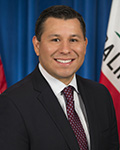
Ask Maddy about Eduardo Garcia
Scope: CA
Hi! I can help you understand Eduardo Garcia's legislative record. What would you like to know?
Try one of these
i
Maddy answers using official bill text and legislative records. Always verify before sharing.
Sources cited inline