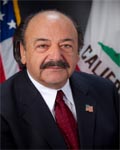
Photo of Katcho Achadjian
R California Assembly · District 35

Asm. Katcho Achadjian

Compare
Total votes
12,699
all sessions
Attendance
97%
310 missed
Near the chamber average
With party
92%
of cast votes
Lower than 90% of chamber peers
Bipartisan score
4%
crosses aisle rarely
Higher than 86% of chamber peers
Sponsored
807
bills & resolutions
Lower than 91% of chamber peers
Committees
0
assignments
807 bills and resolutions

Sponsored bills

Total
807
Primary
92
Co-sponsor
715
This page
807
matching current filters
Co-sponsor SCR 88
Signed into law · California Senate · Co-sponsor
Relative to Human Trafficking Awareness Month.

This measure would proclaim the month of January 2016 as Human Trafficking Awareness Month, encourage all Californians to become educated about human trafficking and work to eradicate these criminal practices within and beyond our borders, and encourage Members of the Legislature, as well as organizations, businesses, and individuals, to host or sponsor and attend community events in order to bring visibility and support to efforts made by nongovernmental organizations to recognize and combat human trafficking.

Signed into law Feb 1, 2016 1 co-sponsor
Co-sponsor AB 334
Failed · California Assembly · Co-sponsor
Peace officers: training: profiling of motorcycle riders.

Existing law establishes the Commission on Peace Officer Standards and Training in the Department of Justice and requires the commission to adopt rules establishing minimum standards regarding the recruitment of peace officers. Existing law requires the commission to develop guidelines and implement courses of instruction regarding racial profiling, handling domestic violence, hate crimes, and human trafficking, among others. This bill would require the Commission on Peace Officer Standards and Training to ensure that the profiling of motorcycle riders is addressed in the course of basic law enforcement training and offered to law enforcement officers in conjunction with existing training regarding profiling. The bill would require all local law enforcement agencies to adopt a written policy designed to condemn and prevent the profiling of motorcycle riders and to review and audit any existing policies to ensure that those policies do not enable or foster the practice of profiling motorcycle riders. Because this bill would impose additional duties on local law enforcement agencies, this bill would impose a state-mandated local program. The California Constitution requires the state to reimburse local agencies and school districts for certain costs mandated by the state. Statutory provisions establish procedures for making that reimbursement. This bill would provide that, if the Commission on State Mandates determines that the bill contains costs mandated by the state, reimbursement for those costs shall be made pursuant to these statutory provisions.

Failed Feb 1, 2016 1 co-sponsor
Co-sponsor AB 239
Failed · California Assembly · Co-sponsor
Greenhouse gases: regulations.

The California Global Warming Solutions Act of 2006 authorizes the State Air Resources Board to adopt greenhouse gas emissions limits and emission reduction measures by regulation to achieve the maximum technologically feasible and cost-effective reduction in greenhouse gas emissions in furtherance of achieving the statewide greenhouse gas emissions limit. The act authorizes the board, in the regulations adopted, to include the use of market-based compliance mechanisms. This bill would prohibit the board, on and after January 1, 2016, from adopting or amending regulations pursuant to the act. The bill would authorize the board to submit to the Legislature recommendations on how to achieve the goals of the act.

Failed Feb 1, 2016 1 co-sponsor
Co-sponsor AB 388
Signed into law · California Assembly · Co-sponsor
Housing: veterans: supportive and transitional housing: reports.

Existing law requires the Department of Housing and Community Development to submit an annual report to the Governor and both houses of the Legislature on the operations and accomplishments during the previous fiscal year of the housing programs administered by the department. Existing law requires the report to include, among other things, an evaluation, in collaboration with the Department of Veterans Affairs, of any program established by the department pursuant to the Veterans Housing and Homeless Prevention Act of 2014. This bill would additionally require the evaluation to include information relating to the effectiveness of assisted projects in helping veterans occupying any supportive housing or transitional housing development that was issued funds pursuant to that act, as specified. This bill would incorporate changes to Section 50408 of the Health and Safety Code proposed by both this bill and AB 90, which would become operative only if both bills are enacted and become effective on or before January 1, 2016, and this bill is chaptered last.

Signed into law Oct 9, 2015 1 co-sponsor
Co-sponsor AB 1295
Signed into law · California Assembly · Co-sponsor
Craft distillers: licenses.

The Alcoholic Beverage Control Act contains various provisions regulating the application for, the issuance of, the suspension of, and the conditions imposed upon, alcoholic beverage licenses by the Department of Alcoholic Beverage Control. Existing law provides for various annual fees for the issuance of alcoholic beverage licenses, depending upon the type of license issued. This bill, the Craft Distillers Act of 2015, would authorize the department to issue a craft distiller's license to manufacture distilled spirits, subject to specified conditions, including that the licensee manufacture no more than 100,000 gallons of distilled spirits per fiscal year, excluding brandy the craft distiller manufactures or has manufactured for them. The bill would allow the craft distiller's licensee to sell distilled spirits to specified consumers, to own interests in on-sale retail licenses, and to sell beer, wines, brandies, and distilled spirits to consumers for consumption on the premises of a bona fide eating place, as provided. The bill would impose an original fee and an annual renewal fee for the license, which would be deposited in the Alcohol Beverage Control Fund. The Alcoholic Beverage Control Act authorizes a licensed distilled spirits manufacturer to conduct tastings of distilled spirits produced or bottled by, or produced or bottled for, the licensee, on the licensed premises, under specified conditions, including that tasting not be given in the form of a cocktail or mixed drink. This bill would extend that authorization to a licensed craft distiller and would revise the tasting conditions by allowing a tasting to be given in the form of a cocktail or mixed drink. Existing law prohibits a distilled spirits manufacturer's or distilled spirits manufacturer's agent's license from being held by a person that holds any ownership or interest in any distilled spirits wholesaler's, rectifier's, or retailer's license, as specified. This bill would additionally prohibit a distilled spirits manufacturer's or distilled spirits manufacturer's agent's license from being held by a person that holds any ownership or interest in a craft distiller's license.

Signed into law Oct 8, 2015 1 co-sponsor
Primary AB 1178
Signed into law · California Assembly · Lead sponsor
Vehicles: manufacturers and distributors.

Existing law establishes the New Motor Vehicle Board in the Department of Motor Vehicles, and requires the board to hear and decide certain protests presented by a motor vehicle franchisee in regard to a dispute with the vehicle manufacturer. This bill would, until January 1, 2019, authorize the board to hear protests by an association challenging the legality of an export or sale-for-resale prohibition policy of a manufacturer, manufacturer branch, distributor, or distributor branch, and would establish procedures for hearing those protests, as specified. Existing law generally requires a manufacturer, distributor, transporter, or dealer of vehicles to be licensed by the Department of Motor Vehicles. Under existing law, it is unlawful for a manufacturer, manufacturer branch, distributor, or distributor branch to engage in specified practices, including taking or threatening to take any adverse action against a dealer pursuant to an export or sale-for-resale prohibition because the dealer sold or leased a vehicle to a customer who either exported the vehicle to a foreign country or resold the vehicle in violation of the prohibition, unless the export or sale-for-resale prohibition policy was provided to the dealer in writing prior to the sale or lease, and the dealer knew or reasonably should have known of the customer's intent to export or resell the vehicle in violation of the prohibition at the time of sale or lease. Existing law further provides that if the dealer causes the vehicle to be registered in this or any other state, and collects or causes to be collected any applicable sales or use tax due to this state, a rebuttable presumption is established that the dealer did not have reason to know of the customer's intent to export or resell the vehicle. A violation of these provisions is a crime. This bill would recast the provisions relating to export and sale-for-resale prohibitions described above to provide that it would be unlawful to take or threaten to take any adverse action against a dealer pursuant to an export or sale-for-resale prohibition because the dealer sold or leased a vehicle to a customer who either exported the vehicle to a foreign country or resold the vehicle in violation of the prohibition unless the export or sale-for-resale prohibition policy was provided to the dealer in writing at least 48 hours before the sale or lease of the vehicle and the dealer knew or reasonably should have known of the customer's intent to export or resell the vehicle in violation of the prohibition. The bill would provide that a rebuttable presumption is established that the dealer did not have reason to know of the customer's intent to export or resell the vehicle if the dealer causes the vehicle to be registered in this or any other state, and collects or causes to be collected any applicable sales or use tax due to this state. By expanding the scope of an existing crime, this bill would impose a state-mandated local program. The bill would, in any proceeding in which a challenge to an adverse action is at issue, require the burden of proof to be on the manufacturer, manufacturer branch, distributor, or distributor branch. This bill would make additional technical, nonsubstantive changes to those provisions and make related findings and declarations. This bill would incorporate additional changes to Sections 3050.7 and 11713.3 of the Vehicle Code made by this bill and AB 759 to take effect if both bills are chaptered and this bill is chaptered last. The California Constitution requires the state to reimburse local agencies and school districts for certain costs mandated by the state. Statutory provisions establish procedures for making that reimbursement. This bill would provide that no reimbursement is required by this act for a specified reason.

Signed into law Oct 6, 2015 0 co-sponsors
Co-sponsor AB 494
Signed into law · California Assembly · Co-sponsor
Restraining orders: protection of animals.

Existing law authorizes the court to issue a restraining order or a protective order to enjoin a party from specified behavior, such as, among other things, enjoining a person from molesting, attacking, striking, threatening, sexually assaulting, battering, harassing, telephoning, destroying the personal property of, or contacting another person, upon the showing of good cause. Existing law authorizes the court to issue an ex parte order under specified circumstances related to the protection of a ward of the court. This bill would additionally authorize the court, on a showing of good cause, to include in restraining orders or protective orders an order granting the petitioner or applicant exclusive care, possession, or control of an animal that is held by the petitioner or a person protected by a restraining order or that resides in the same residence or household that is held by the petitioner or a person protected by a restraining order or that resides in the same residence or household and an order for the respondent or restrained person to stay away from, and refrain from taking or harming, that animal, as specified. The bill would make conforming changes to related provisions, including the provision relating to the protection of a ward of the court. This bill would incorporate additional changes to Section 527.6 of the Code of Civil Procedure and Section 213.5 of the Welfare and Institutions Code, proposed by AB 1081, that would become operative only if AB 1081 and this bill are both chaptered and become effective on or before January 1, 2016, and this bill is chaptered last. This bill would incorporate additional changes to Section 15657.03 of the Welfare and Institutions Code, proposed by AB 1081 and SB 196, that would become operative only if this bill and either or both of those bills are chaptered and become effective on or before January 1, 2016, and this bill is chaptered last.

Signed into law Oct 1, 2015 1 co-sponsor
Primary AB 361
Signed into law · California Assembly · Lead sponsor
Nuclear powerplants.

Existing law, the California Emergency Services Act, authorizes local government entities to create disaster councils by ordinance and in turn develop disaster plans specific to their jurisdictions. Existing law, the Radiation Protection Act of 1999, requires local governments to develop and maintain radiological emergency preparedness and response plans to safeguard the public in the emergency planning zone around a nuclear powerplant, and generally makes the Office of Emergency Services responsible for the coordination and integration of all emergency planning programs and response plans created pursuant to the Radiation Protection Act of 1999. The California Emergency Services Act, until July 1, 2019, prescribes a method for funding state and local costs for carrying out these activities that are not reimbursed by federal funds, with the costs borne by utilities operating nuclear powerplants with a generating capacity of 50 megawatts or more. This bill, operative July 1, 2019, would extend, until August 26, 2025, the method for funding state and local costs for emergency service activities associated with a nuclear powerplant, as described above, with respect to a utility operating a nuclear powerplant with a generating capacity of 50 megawatts or more, thereby extending an amount, as specified, available for disbursement for local costs for the Diablo Canyon site. Under existing law, the Public Utilities Commission has regulatory authority over public utilities, including electrical corporations. Existing law authorizes the commission to fix the rates and charges for every public utility, and requires that those rates and charges be just and reasonable. Existing law requires the commission, for purposes of establishing rates for any electrical corporation, to disallow expenses reflecting the direct or indirect costs resulting from any unreasonable error or omission relating to the planning, construction, or operation of any portion of the corporation's plant which cost, or is estimated to have cost, more than $50,000,000, including any expenses resulting from delays caused by any unreasonable error or omission. For these purposes, "planning" includes activities related to the initial and subsequent assessments of the need for a plant construction project and includes investigation and interpretation of environmental factors such as seismic conditions. This bill would require the commission to convene, or continue, until August 26, 2025, an independent peer review panel to conduct an independent review of enhanced seismic studies and surveys of the Diablo Canyon Units 1 and 2 powerplant, including the surrounding areas of the facility and areas of nuclear waste storage. This bill would declare that it is to take effect immediately as an urgency statute.


Signed into law Oct 1, 2015 0 co-sponsors
Co-sponsor ACR 15
Signed into law · California Assembly · Co-sponsor
Relative to California Holocaust Memorial Week.

This measure would proclaim April 12 through April 19, 2015, as California Holocaust Memorial Week and would urge Californians to observe these days of remembrance for the victims of the Holocaust in an appropriate manner.

Signed into law Sep 25, 2015 1 co-sponsor
Showing 181 to 190 of 807 bills
Previous 1 … 18 19 20 … 81 Next