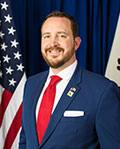
Photo of Devon Mathis
R California House · District 33

Rep. Devon Mathis

Contact Email
Compare
Total votes
23,116
all sessions
Attendance
85%
2,834 missed
Near the chamber average
With party
97%
of cast votes
Near the chamber average
Bipartisan score
2%
crosses aisle rarely
Near the chamber average
Sponsored
2,082
bills & resolutions
Higher than 76% of chamber peers
Committees
0
assignments
2,082 bills and resolutions

Sponsored bills

Total
2,082
Primary
225
Co-sponsor
1,857
This page
2,082
matching current filters
Co-sponsor HR 59
Passed · California House · Co-sponsor
Relative to Sickle Cell Disease Awareness Month.

Maddy summaryThis bill designates September 2024 as Sickle Cell Disease Awareness Month in California to highlight the disease's impact, particularly on African American communities. It encourages the state to allocate funds for outreach, education, research, and treatment while also calling for the development of chronic kidney disease screening programs with genetic testing referrals. The resolution aims to raise public knowledge about the condition and support better care outcomes for those affected.

Passed Aug 22, 2024 1 co-sponsor
Co-sponsor HR 121
Passed · California House · Co-sponsor
Relative to boat people awareness.

Maddy summaryThis bill designates specific periods in 2024 as Boat People Awareness Week and Month to honor Vietnamese refugees who fled their country by sea after the Vietnam War. The resolution highlights the historical hardships these individuals faced, including dangerous voyages and high mortality rates, while acknowledging their significant contributions to communities across California. It does not create new laws or funding but serves as a commemorative measure to recognize the resilience and spirit of the Vietnamese refugee community. The text is intended to be shared with the bill's author for public distribution to raise awareness about this historical event.

Passed Aug 19, 2024 1 co-sponsor
Co-sponsor SB 1214
Passed · California Senate · Co-sponsor
California Commission on the United States Semiquincentennial.

Existing law establishes various commissions within state government. This bill would, until January 1, 2028, establish the California Commission on the United States Semiquincentennial in state government to celebrate the 250th anniversary of the signing of the Declaration of Independence and the founding of the United States of America. The bill would require the commission to plan and coordinate commemorations and observances of the 250th anniversary of the Declaration of Independence and the American Revolution. The bill would require the commission to be solely supported by private or federal funds made available for the purpose of supporting the commission. The bill would require that these funds be deposited in the Semiquincentennial Fund, and would create that fund in the State Treasury. The bill would require funds in the Semiquincentennial Fund to be available, upon appropriation by the Legislature, as specified. The bill would require the records, files, and other memoranda of the commission, other than any private possessions, to be deposited and filed with the State Archives before January 1, 2028, and would require the State Archives to receive those materials. These provisions would become operative only if the Treasurer determines that sufficient private or federal funds have been made available.

Passed Aug 15, 2024 1 co-sponsor
Co-sponsor SB 73
Passed · California Senate · Co-sponsor
Employment policy: voluntary veterans' preference.

Under existing law, the California Fair Employment and Housing Act (FEHA) , it is an unlawful employment practice for an employer, unless based upon a bona fide occupational qualification or applicable security regulations established by the United States or the State of California, to refuse to hire or employ a person or to refuse to select a person for a training program leading to employment, or to bar or discharge a person from employment or a training program leading to employment, or to discriminate against a person in compensation or in terms, conditions, or privileges of employment because of the race, religious creed, color, national origin, ancestry, physical disability, mental disability, medical condition, genetic information, marital status, sex, gender, gender identity, gender expression, age, sexual orientation, or military and veteran status of that person. FEHA provides that nothing in that act relating to discrimination on account of sex affects the right of an employer to use veteran status as a factor in employee selection or to give special consideration to Vietnam-era veterans. FEHA is enforced by the Civil Rights Department, which is in the Business, Consumer Services, and Housing Agency, and is under the direction of an executive officer known as the Director of Civil Rights. This bill would enact the Voluntary Veterans' Preference Employment Policy Act to authorize a private employer to establish and maintain a written veterans' preference employment policy, to be applied uniformly to hiring decisions, to give a voluntary preference for hiring a veteran over another qualified applicant. The bill would require a private employer with a veterans' preference employment policy to annually report to the Civil Rights Department the number of veterans hired under the preference policy and any demographic information about those veterans that the employer obtained in response to the department's reporting requirements. Under the bill, failure to submit that report would render any preference granted by the employer ineligible for the protections provided by this bill. The bill would require the department to report that information, in addition to the number of discrimination claims received based on an employer's veterans' preference employment policy, to specified legislative policy committees by July 1, 2026, and July 1, 2028. This bill would provide that the granting of a veterans' preference pursuant to the bill, in and of itself, shall be deemed not to violate any local or state equal employment opportunity law or regulation, including, but not limited to, the antidiscrimination provisions of FEHA. The bill would require the Department of Veterans Affairs to assist any private employer in determining if an applicant is a veteran, to the extent permitted by law. The bill would prohibit a veterans' preference employment policy from being established or applied for the purpose or with the effect of unlawfully discriminating against an employment applicant on the basis of a protected classification, as specified. The bill would repeal these provisions on January 1, 2029.


Passed Aug 15, 2024 1 co-sponsor
Co-sponsor AB 46
Passed · California House · Co-sponsor
Personal income taxes: exclusion: Military Services Retirement and Surviving Spouse Benefit Payment Act.

The Personal Income Tax Law imposes a tax on individual taxpayers measured by the taxpayer's taxable income for the taxable year, but excludes certain items of income from the computation of tax, including an exclusion for combat-related special compensation. This bill, for taxable years beginning on or after January 1, 2024, and before January 1, 2034, would exclude from gross income retirement pay received by a taxpayer from the federal government for service performed in the uniformed services, as defined, during the taxable year. The bill, for taxable years beginning on or after January 1, 2024, and before January 1, 2034, would also exclude from gross income annuity payments received by a qualified taxpayer, as defined, pursuant to a United States Department of Defense Survivor Benefit Plan during the taxable year. The bill would make related findings and declarations. Existing law requires any bill authorizing a new tax expenditure to contain, among other things, specific goals, purposes, and objectives that the tax expenditure will achieve, detailed performance indicators, and data collection requirements. This bill also would include additional information required for any bill authorizing a new tax expenditure. The bill would require the Franchise Tax Board and the Department of Veterans Affairs to provide any data requested by the Legislative Analyst to write the report, as provided, and would make taxpayer information received by the Legislative Analyst subject to limitation on the collection and use of that information. By expanding the scope of a crime, this bill would impose a state-mandated local program. The California Constitution requires the state to reimburse local agencies and school districts for certain costs mandated by the state. Statutory provisions establish procedures for making that reimbursement. This bill would provide that no reimbursement is required by this act for a specified reason. This bill would take effect immediately as a tax levy.

Passed Aug 15, 2024 1 co-sponsor
Co-sponsor SB 980
Passed · California Senate · Co-sponsor
The Smile Act.

Existing law establishes the Medi-Cal program, which is administered by the State Department of Health Care Services and under which qualified low-income individuals receive health care services, including certain dental services. The Medi-Cal program is, in part, governed and funded by federal Medicaid program provisions. Under existing law, early and periodic screening, diagnostic, and treatment (EPSDT) services are covered under Medi-Cal for an individual under 21 years of age in accordance with certain federal provisions. Under existing law, for persons 21 years of age or older, laboratory-processed crowns on posterior teeth are a covered benefit when medically necessary to restore a posterior tooth back to normal function based on the criteria specified in the Medi-Cal Dental Manual of Criteria. This bill, The Smile Act, for purposes of the above-described Medi-Cal coverage for laboratory-processed crowns, would remove the condition that the tooth be posterior and would apply the coverage to persons 13 years of age or older. The bill would also add, as a covered Medi-Cal benefit for persons of any age, subject to prior authorization, a dental implant if tooth extraction or removal is medically necessary or if the corresponding tooth is missing. The bill would condition this coverage on there being no other covered functional alternatives for prosthetic replacement to correct the person's dental condition, as specified, on the person being without medical conditions for which dental implant surgery would be contraindicated, on receipt of any necessary federal approvals, and on the availability of federal financial participation. Under the bill, the above-described provisions would not be construed to exclude Medi-Cal coverage for laboratory-processed crowns on teeth or dental implants if otherwise required under EPSDT services.

Passed Aug 15, 2024 1 co-sponsor
Co-sponsor AB 3238
Passed · California House · Co-sponsor
California Environmental Quality Act: electrical infrastructure projects.

The California Environmental Quality Act (CEQA) requires a lead agency, as defined, to prepare, or cause to be prepared, and certify the completion of an environmental impact report on a project that it proposes to carry out or approve that may have a significant effect on the environment or to adopt a negative declaration if it finds that the project will not have that effect. The CEQA also requires a lead agency to prepare a mitigated negative declaration for a project that may have a significant effect on the environment if revisions in the project would avoid or mitigate that effect and there is no substantial evidence that the project, as revised, would have a significant effect on the environment. The CEQA exempts certain projects from its requirements, including actions necessary to prevent or mitigate an emergency. Existing law prohibits an electrical corporation from beginning the construction of a line, plant, or system, or extensions of those facilities without first having to obtain from the Public Utilities Commission a certificate that the present or future convenience and necessity require or will require the construction. Existing law specifies that the certificate is not required for the extension, expansion, upgrade, or other modification of existing electrical transmission facilities. This bill would, for electrical infrastructure projects, as defined, designate the commission as the lead agency for purposes of the CEQA, would require the commission to prescribe procedures for the preparation of the appropriate environmental review document for those projects, and would specify the manner in which the environmental review for those projects is to be conducted. The bill would repeal these provisions on January 1, 2035.

Passed Aug 15, 2024 1 co-sponsor
Primary AB 2818
Passed · California House · Lead sponsor
County jail: available social services.

Existing law creates a program authorizing the sheriff or county officer responsible for operative jails of certain counties to assist indigent inmates with the reentry process within 30 days after the inmate's release from the county jail or other adult detention facility, as specified. Existing law specifies that the assistance provided may include work placement, counseling, obtaining proper identification, education, and housing. This bill would require, beginning January 1, 2026, each county jail to provide each incarcerated person with the contact information for certain entities, including, among other things, the local social services agency, upon release from custody, as specified. The bill would authorize the information to be provided electronically if the incarcerated person provides the necessary contact information. By imposing duties on local jails, this bill would create a state-mandated local program. The California Constitution requires the state to reimburse local agencies and school districts for certain costs mandated by the state. Statutory provisions establish procedures for making that reimbursement. This bill would provide that, if the Commission on State Mandates determines that the bill contains costs mandated by the state, reimbursement for those costs shall be made pursuant to the statutory provisions noted above.

Passed Aug 15, 2024 0 co-sponsors
Co-sponsor HR 116
Passed · California House · Co-sponsor
Relative to the assassination attempt on former President Donald J. Trump.

Maddy summaryThis California House Resolution condemns the July 13, 2024, assassination attempt on former President Donald J. Trump and calls for an end to political violence. The measure highlights the event where Trump was wounded while speaking at a rally in Butler, Pennsylvania, and notes that one attendee died and others were injured while trying to protect him. It urges the state to foster a political environment based on respectful discourse and nonviolence. The resolution is a formal statement of the Assembly's stance and does not create new laws or change existing policies.

Passed Aug 15, 2024 1 co-sponsor
Co-sponsor SCR 132
Signed into law · California Senate · Co-sponsor
Relative to Hire a Veteran Day.

Maddy summaryThis bill designates Thursday, July 25, 2024, as Hire a Veteran Day in California to honor veterans and encourage their employment. The measure is a commemorative resolution that does not create new laws, regulations, or funding but serves as an official state recognition of the date. By acknowledging this day, the Legislature aims to highlight the skills veterans bring to the workforce and support efforts to reduce veteran unemployment. The resolution requires no action from businesses or individuals other than observing the designated date.

Signed into law Aug 13, 2024 1 co-sponsor
Showing 41 to 50 of 2,082 bills
Previous 1 4 5 6 209 Next