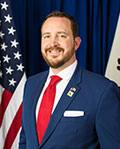
Photo of Devon Mathis
R California House · District 33

Rep. Devon Mathis

Contact Email
Compare
Total votes
23,116
all sessions
Attendance
85%
2,834 missed
Near the chamber average
With party
97%
of cast votes
Near the chamber average
Bipartisan score
2%
crosses aisle rarely
Near the chamber average
Sponsored
2,082
bills & resolutions
Higher than 76% of chamber peers
Committees
0
assignments
2,082 bills and resolutions

Sponsored bills

Total
2,082
Primary
225
Co-sponsor
1,857
This page
2,082
matching current filters
Primary AB 77
died · California House · Lead sponsor
Milk and Milk Products Act of 1947.

The Milk and Milk Products Act of 1947 regulates the preparation, production, manufacture, distribution, and sale of milk and specified milk products. The act defines certain terms, including, among others, milk product and dairy product. This bill would make technical, nonsubstantive changes to these provisions.

died Feb 1, 2016 0 co-sponsors
Co-sponsor AB 23
Failed · California House · Co-sponsor
California Global Warming Solutions Act of 2006: market-based compliance mechanisms: exemption.

The California Global Warming Solutions Act of 2006 designates the State Air Resources Board as the state agency charged with monitoring and regulating sources of emissions of greenhouse gases. The state board is required to adopt a statewide greenhouse gas emissions limit equivalent to the statewide greenhouse gas emissions level in 1990 to be achieved by 2020, and to adopt rules and regulations in an open public process to achieve the maximum, technologically feasible, and cost-effective greenhouse gas emissions reductions. The act authorizes the state board to include the use of market-based compliance mechanisms. Existing state board regulations require specified entities to comply with a market-based compliance mechanism beginning January 1, 2013, and require additional specified entities to comply with that market-based compliance mechanism beginning January 1, 2015. This bill would instead exempt those categories of persons or entities that did not have a compliance obligation, as defined, under a market-based compliance mechanism beginning January 1, 2013, from being subject to that market-based compliance mechanism through December 31, 2020. This bill would declare that it is to take effect immediately as an urgency statute.

Failed Feb 1, 2016 1 co-sponsor
Primary AB 79
died · California House · Lead sponsor
State highway routes: route numbers.

Existing law gives the Department of Transportation full possession and control of all state highways. Existing law describes the authorized routes in the state highway system by route numbers and provides that the route numbers are those given to the routes by the California Transportation Commission. This bill would make technical, nonsubstantive changes to these provisions.

died Feb 1, 2016 0 co-sponsors
Co-sponsor AB 42
Failed · California House · Co-sponsor
Public postsecondary education: funding and mandatory fees.

(1) Existing law establishes the California State University, under the administration of the Trustees of the California State University, the University of California, under the administration of the Regents of the University of California, and the California Community Colleges, under the administration of the Board of Governors of the California Community Colleges, as the 3 segments of public postsecondary education in this state. Existing law appropriates funding, in the annual Budget Act and in other statutes, from the state General Fund for the support of these segments. Existing law also authorizes these segments to require their students to pay mandatory systemwide fees and tuition, among other costs, for matriculation at these institutions. Proposition 30, known as the Schools and Local Public Safety Protection Act of 2012, was approved by the voters at the November 6, 2012, statewide general election and, among other things, increases personal income tax and sales and use tax rates and provides revenue for public elementary and secondary schools and community colleges. This bill would express a finding and declaration of the Legislature, and express the intent of the Legislature, relating to the enactment of Proposition 30 by the voters and to the provision of funding to the California State University, the University of California, and the California Community Colleges. The bill, from the 2015–16 fiscal year to the 2018–19 fiscal year, inclusive, would prohibit mandatory systemwide fees or tuition charged to students of the California State University from exceeding the level of the mandatory systemwide fees or tuition charged to students of the California State University for the 2014–15 fiscal year. The bill, from the 2015–16 fiscal year to the 2018–19 fiscal year, inclusive, would prohibit the mandatory systemwide fees charged to students of the California Community Colleges from increasing beyond the level of the mandatory systemwide fees charged to students of the California Community Colleges for the 2014–15 fiscal year. The bill, from the 2015–16 fiscal year to the 2018–19 fiscal year, inclusive, would prohibit the mandatory systemwide fees or tuition charged to students of the University of California from exceeding the level of the mandatory systemwide fees or tuition charged to students of the University of California for the 2014–15 fiscal year. (2) Existing law prohibits a campus of the California State University, or the Chancellor of the California State University, or both, from approving a student success fee before January 1, 2016. Existing law requires, during the 2014–15 fiscal year, the chancellor to conduct a review of the California State University Student Fee Policy relating to student success fees and to recommend to the Trustees of the California State University changes to the fee policy. This bill, commencing with the 2015–16 fiscal year, would prohibit the imposition of a student success fee at a campus of a segment of public postsecondary education unless the student success fee is approved by a favorable vote of 2 3 "?> a majority of those students voting at an election of the student body held at that campus within the preceding 48 months. (3) This bill would declare that it is to take effect immediately as an urgency statute.


Failed Feb 1, 2016 1 co-sponsor
Primary AB 175
died · California House · Lead sponsor
Electricity.

The Warren-Alquist State Energy Resources Conservation and Development Act establishes the State Energy Resources Conservation and Development Commission and requires it to certify sufficient sites and related facilities that are required to provide a supply of electricity sufficient to accommodate projected demand for electricity in that commission's most recent forecast of statewide and service area electricity demand. This bill would make nonsubstantive revisions to the State Energy Resources Conservation and Development Commission's certification requirements. Existing law requires the Public Utilities Commission, in cooperation with the State Energy Resources Conservation and Development Commission, the State Air Resources Board, air quality management districts and air pollution control districts, electrical and gas corporations, and the motor vehicle industry, to evaluate and implement policies to promote the development of equipment and infrastructure needed to facilitate the use of electricity and natural gas to fuel low-emission vehicles. This bill would make nonsubstantive revisions to these requirements of the Public Utilities Commission.

died Feb 1, 2016 0 co-sponsors
Primary AB 307
died · California House · Lead sponsor
Graywater: groundwater recharge.

Existing law requires the Department of Water Resources, in consultation with the State Department of Public Health and the Center for Irrigation Technology at California State University, Fresno, to adopt standards for the installation of graywater systems. Existing law requires the California Building Standards Commission, as a part of the next triennial edition of the California Building Standards Code adopted after January 1, 2011, to adopt building standards for the construction, installation, and alteration of graywater systems for indoor and outdoor uses in nonresidential occupancies, in accordance with prescribed requirements. Existing law terminates the authority of the Department of Water Resources to adopt standards for graywater systems upon the approval or adoption of certain standards by the commission. This bill would state the intent of the Legislature to enact legislation to explicitly permit the usage of residential, commercial, and industrial graywater for the recharge of a groundwater basin or aquifer.

died Feb 1, 2016 0 co-sponsors
Primary AB 1053
Failed · California House · Lead sponsor
Certificates of death: veterans.

Existing law establishes the State Department of Public Health under the direction of the State Public Health Officer. Existing law sets forth the powers and duties of the State Public Health Officer, including, but not limited to, designation as the State Registrar of Vital Statistics, having supervisory powers over local registrars and responsibility for the uniform and thorough enforcement of provisions relating to the registration of certain vital statistics. Existing law requires that each death be registered with the local registrar of births and deaths in the district in which the death was officially pronounced or the body was found. Existing law sets forth the persons responsible for completing the certificate of death and the required contents of the certificate, including, but not limited to, the decedent's name, sex, and birthplace. Certain violations of these requirements are a crime. This bill, commencing July 1, 2016, would require a person completing the certificate of death to record whether the decedent was ever in the Armed Forces of the United States and to include in the items relating to health data information, information on whether the cause of death is any manner of suicide. The bill would also require the local registrar to make information on veteran suicide available to the Department of Veterans Affairs and United States Department of Veterans Affairs. By changing the definition of existing crimes, and by increasing the responsibility of local officials, this bill would impose a state-mandated local program. The California Constitution requires the state to reimburse local agencies and school districts for certain costs mandated by the state. Statutory provisions establish procedures for making that reimbursement. This bill would provide that with regard to certain mandates no reimbursement is required by this act for a specified reason. With regard to any other mandates, this bill would provide that, if the Commission on State Mandates determines that the bill contains costs so mandated by the state, reimbursement for those costs shall be made pursuant to the statutory provisions noted above.

Failed Feb 1, 2016 0 co-sponsors
Primary AB 955
Failed · California House · Lead sponsor
Disaster assistance: droughts: temporary assistance.

Existing law, the California Disaster Assistance Act, authorizes the Office of Emergency Services to establish a model process that would be made available to assist a community in recovering from an emergency proclaimed by the Governor and would provide that the process may consider, among other things, the role of the office to facilitate the use of temporary services, including, but not limited to, the provision of potable water. This bill would additionally authorize the office to, either independently, or working through local agencies, nonprofit organizations, or other state entities, address the effects of a drought by providing temporary water supplies for drinking and sanitation to property owners. The bill would authorize the office, either independently, or working through local agencies, nonprofit organizations, or other state entities to, among other things, provide temporary water supplies for drinking and sanitation to property owners, and to allow temporary assistance to be provided to property owners whose income exceeds a specified threshold.

Failed Feb 1, 2016 0 co-sponsors
Co-sponsor AB 184
Failed · California House · Co-sponsor
Small Business Technical Assistance Act of 2015.

The Economic Revitalization Act establishes the Governor's Office of Business and Economic Development, also known as "GO-Biz," to serve the Governor as the lead entity for economic strategy and the marketing of California on issues relating to business development, private sector investment, and economic growth. The Bergeson-Peace Infrastructure and Economic Development Bank Act establishes the Infrastructure and Economic Development Bank within GO-Biz to, among other things, assist in the promotion of economic development throughout the state. This bill would enact the Small Business Technical Assistance Act of 2015, within the bank under the direction of GO-Biz to, among other things, serve as the lead state entity for overseeing the state's participation with the federal California Small Business Development Center Program, the Women's Business Center program, the Veteran Business Outreach Center program, the Service Corps of Retired Executives (SCORE) , and the Procurement Technical Assistance Cooperative Agreement program. The bill would also recognize those federal programs, and would authorize GO-Biz or any other state entity to contract with a federal small business technical assistance center. The bill would require the State Chair of the California Small Business Development Center Leadership Council, or the contract lead for any of the other federal small business technical assistance centers, to report specific information to GO-Biz relating to any year that state funds are appropriated to support the California Small Business Development Center Program or any of the other federal small business technical assistance center programs, and would, in turn, require the director of GO-Biz or the contract lead for any of the other small business technical assistance centers to provide that report to the Legislature and post the report on the GO-Biz's Internet Web site. The bill would also require the state chair, as a condition of accepting state funds, to allow access to other information about those federal programs under certain conditions. The bill would make legislative findings and declarations in this regard.

Failed Feb 1, 2016 1 co-sponsor
Co-sponsor AB 255
Failed · California House · Co-sponsor
Veterans: Internal Audits for Veterans Affairs.

Existing law establishes the Department of Veterans Affairs and designates the Secretary of Veterans Affairs as the chief administrative officer of the department. Existing law also establishes the California Veterans Board, and requires the board to advise the department and secretary on policies for operations of the department. Existing law provides for veterans programs, including the veterans farm and home purchase programs, and provides for veterans homes. This bill would create the office of Internal Audits for Veterans Affairs, the chief auditor of which would be subject to the direction of the secretary within the department. The bill would require the chief auditor to be appointed by the Governor, subject to Senate confirmation. The chief auditor would be responsible for reviewing and investigating, at the request of the secretary or other members of senior management of the department, the operations and financial condition of each California veterans home, each veterans farm and home purchase program, and other department programs and functions. Beginning January 1, 2017, and each year thereafter, the bill would require the chief auditor to submit a summary report to the board and the appropriate committees of the Legislature providing information about the office's activities and recommendations that lead to departmental efficiencies and improvements. The bill would authorize the chief auditor to receive communications from any individual who believes he or she may have information that warrants a review or investigation of a veterans program. The bill would require the chief auditor to establish a toll-free telephone number to report alleged wrongdoing regarding veterans programs. The bill would repeal the provisions described above on January 1, 2020. Existing constitutional provisions require that a statute that limits the right of access to the meetings of public bodies or the writings of public officials and agencies be adopted with findings demonstrating the interest protected by the limitation and the need for protecting that interest. This bill would make legislative findings to that effect.

Failed Feb 1, 2016 1 co-sponsor
Showing 1,941 to 1,950 of 2,082 bills