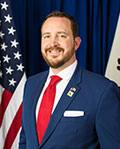
Photo of Devon Mathis
R California Assembly · District 33

Asm. Devon Mathis

Contact Email
Compare
Total votes
23,116
all sessions
Attendance
85%
2,834 missed
Near the chamber average
With party
97%
of cast votes
Near the chamber average
Bipartisan score
2%
crosses aisle rarely
Near the chamber average
Sponsored
2,082
bills & resolutions
Higher than 76% of chamber peers
Committees
0
assignments
2,082 bills and resolutions

Sponsored bills

Total
2,082
Primary
225
Co-sponsor
1,857
This page
2,082
matching current filters
Co-sponsor SCR 103
Signed into law · California Senate · Co-sponsor
Teen Dating Violence Awareness and Prevention Month.

This measure would proclaim the month of February 2016 as Teen Dating Violence Awareness and Prevention Month, and would encourage all Californians to observe Teen Dating Violence Awareness and Prevention Month with programs and activities that raise awareness about teen dating violence.

Signed into law Jun 1, 2016 1 co-sponsor
Co-sponsor AB 2775
Failed · California Assembly · Co-sponsor
Abortion services facilities: pregnancy center notice.

Existing law requires a licensed covered facility, as defined, to disseminate to clients a notice, as specified, stating that California has public programs that provide immediate free or low-cost access to comprehensive family planning services, prenatal care, and abortion for eligible women. Existing law requires an unlicensed covered facility, as defined, to disseminate to clients a notice, as specified, stating that the facility is not licensed as a medical facility by the State of California and has no licensed medical provider. Existing law authorizes the Attorney General, city attorney, or county counsel to bring an action to impose a specified civil penalty against covered facilities that fail to comply with these requirements. This bill would require a facility that offers abortion services to disseminate a notice to clients, as specified, providing the telephone number for a specified organization and stating that pregnancy centers can provide women with services at no cost that include consultation, pregnancy tests, sexually transmitted disease or sexually transmitted infection (STD/STI) testing, ultrasound services, support groups, parenting programs, and material assistance.

Failed Jun 1, 2016 1 co-sponsor
Co-sponsor AB 1913
In committee · California Assembly · Co-sponsor
Veterans: Employment Development Department.

Existing law authorizes the Employment Development Department, within the Labor and Workforce Development Agency, to perform various functions and duties with respect to job creation and retention activities. Existing law requires the department to research the needs of veterans throughout the state and develop a profile of veterans' employment and training needs. Existing law requires the department to develop a statewide plan for the equitable distribution of employment funds for veterans' employment services. Existing law authorizes the board of supervisors of each county to appoint a county veterans service officer to provide veteran-related services. This bill would require the Employment Development Department, upon request of the local county veterans service officer, to provide training to the county veterans service officer and his or her staff in providing assistance to veterans applying for unemployment insurance benefits. The bill would require the Employment Development Department to coordinate with county veterans service officers for purposes of becoming familiar with the services provided by county veterans service officers. The bill would further require the Employment Development Department to establish a system to refer veterans to county veterans service officers for purposes of determining eligibility for benefits.

In committee May 27, 2016 1 co-sponsor
Co-sponsor SB 1183
In committee · California Senate · Co-sponsor
Property taxation: exemptions: disabled veterans.

Existing property tax law provides, pursuant to the authorization of the California Constitution, a disabled veterans' property tax exemption for the principal place of residence of a veteran or a veteran's spouse, including an unmarried surviving spouse, if the veteran, because of injury incurred in military service, is blind in both eyes, has lost the use of 2 or more limbs, or is totally disabled, as those terms are defined, or if the veteran has, as a result of a service-connected injury or disease, died while on active duty in military service. Existing law exempts that part of the full value of the residence that does not exceed $100,000, or $150,000, if the veteran's household income does not exceed $40,000, adjusted for inflation, as specified. This bill, for property tax lien dates for the 2017–18 fiscal year and for each fiscal year thereafter, would instead exempt that portion of the full value of the principal place of residence of a veteran or veteran's spouse that does not exceed $1,000,000, adjusted annually for inflation, as specified. The bill would also define the term "blind in both eyes" to mean that the veteran is a blind person, as defined in a specific statute. The bill would also specify that a "totally disabled" veteran includes a veteran so severely disabled as to be unable to move without the aid of an assistive device. The bill would make other technical and conforming changes to the disabled veterans' property tax exemption. By changing the manner in which local tax officials administer the disabled veterans' property tax exemption, this bill would impose a state-mandated local program. Section 2229 of the Revenue and Taxation Code requires the Legislature to reimburse local agencies annually for certain property tax revenues lost as a result of any exemption or classification of property for purposes of ad valorem property taxation. This bill would provide that, notwithstanding Section 2229 of the Revenue and Taxation Code, no appropriation is made and the state shall not reimburse local agencies for property tax revenues lost by them pursuant to the bill. The California Constitution requires the state to reimburse local agencies and school districts for certain costs mandated by the state. Statutory provisions establish procedures for making that reimbursement. This bill would provide that, if the Commission on State Mandates determines that the bill contains costs mandated by the state, reimbursement for those costs shall be made pursuant to these statutory provisions. This bill would take effect immediately as a tax levy.

In committee May 27, 2016 1 co-sponsor
Co-sponsor AB 2253
Failed · California Assembly · Co-sponsor
Specialized license plates.

Existing law authorizes a state agency to apply to the Department of Motor Vehicles (DMV) to sponsor a specialized license plate program and requires the DMV to issue those license plates if the sponsoring state agency meets certain requirements. Existing law requires the DMV to charge specified fees related to the issuance of those plates and to deposit the fees, less the DMV's costs, in the Specialized License Plate Fund. Existing law requires that moneys in the fund be allocated, upon appropriation by the Legislature, to the sponsoring agency in proportion to the amount that is attributable to the agency's specialized license plate program. Existing law authorizes the sponsoring agency to use these moneys to fund projects and programs that promote the state agency's official policy, mission, or work. This bill would require the Department of Veterans Affairs, in consultation with the State Treasurer, to apply to the DMV to sponsor specified historic state and federal motto license plate programs and would require the DMV to issue those specialized license plates for those programs if the Department of Veterans Affairs satisfies certain requirements. Notwithstanding the above-described provisions regarding fees for specialized license plates, the bill would require the additional fees for the issuance, renewal, or transfer of these specialized license plates to be deposited, after the DMV deducts its administrative costs, in a newly created fund, to be available upon appropriation by the Legislature for the purpose of funding specified veterans programs and services.

Failed May 27, 2016 1 co-sponsor
Co-sponsor AB 1595
In committee · California Assembly · Co-sponsor
Employment: human trafficking training: mass transportation employers.

Existing law establishes the Division of Labor Standards Enforcement in the Department of Industrial Relations for the enforcement of labor laws, and establishes certain obligations on an employer, including, requiring an employer to post specified wage and hour information in a location where it can be viewed by employees. Under existing law, any person who deprives or violates the personal liberty of another with the intent to obtain forced labor or services is guilty of the crime of human trafficking. This bill would require a private or public employer that provides mass transportation services, as specified, in the state to train its employees, who are likely to interact or come into contact with victims of human trafficking, in recognizing the signs of human trafficking and how to report those signs to the appropriate law enforcement agency. The bill would require the Department of justice to develop guidelines for the training, including, but not limited to, guidance on how to report human trafficking. The bill would require that, by January 1, 2018, the training be incorporated into the initial training process for all new employees and that all existing employees receive the training.

In committee May 27, 2016 1 co-sponsor
Co-sponsor AB 2058
In committee · California Assembly · Co-sponsor
CalWORKs: education incentives.

Existing law requires each county to provide cash assistance and other social services to needy families through the California Work Opportunity and Responsibility to Kids (CalWORKs) program using federal, state, and county funds. Under existing law, a recipient of CalWORKs is required to participate in welfare-to-work activities for a specified number of hours each week as a condition of eligibility for aid. Existing law authorizes certain welfare-to-work participants to engage in adult basic education in satisfaction of these work requirements. Existing law establishes the Cal-Learn Program, under which a recipient of CalWORKs aid who is under 19 years of age and who does not have a high school diploma or its equivalent is required to participate in the program as a student attending school on a full-time basis. Existing law provides for a supplement to, or a reduction in, a Cal-Learn participant's aid grant based on his or her performance in school. This bill would create the CalWORKs Educational Opportunity and Attainment Program to provide CalWORKs recipients with a monthly education incentive grant of $100 for attainment of a high school diploma or its equivalent, $200 for attainment of an associate's degree or career technical education program, or $300 for attainment of a bachelor's degree, if the educational program was completed while the recipient was receiving CalWORKs assistance. The bill would require the education incentive grant to be provided on an ongoing basis if the recipient meets certain eligibility criteria. The bill would require a recipient, when applying for an education bonus, to submit evidence of completion of the educational program to the county. The bill would require the county, upon verification of completion of the educational program, to certify that the recipient is eligible for an education incentive grant and ensure that the recipient's monthly cash grant is increased. By imposing additional administrative duties on counties, this bill would impose a state-mandated local program. Existing law establishes the CalWORKs Recipients Education Program in the California Community Colleges. Existing law requires, to the extent that funding is provided in the annual Budget Act, a community college district to receive funding for purposes of providing special services for CalWORKs recipients, including job placement and workstudy. This bill would appropriate $20,000,000 from the General Fund to the Board of Governors of the California Community Colleges to fund services provided under that program. The California Constitution requires the state to reimburse local agencies and school districts for certain costs mandated by the state. Statutory provisions establish procedures for making that reimbursement. This bill would provide that, if the Commission on State Mandates determines that the bill contains costs mandated by the state, reimbursement for those costs shall be made pursuant to these statutory provisions.

In committee May 27, 2016 1 co-sponsor
Co-sponsor SB 1081
In committee · California Senate · Co-sponsor
Hunting and sport fishing: free and reduced license fees: veterans.

(1) Under existing law, a hunting license grants the privilege to take birds and mammals. Existing law requires the Department of Fish and Wildlife to issue a hunting license for a term of one year, as provided, upon payment of a fee, to eligible residents and nonresidents. Existing law requires the department to issue a reduced fee hunting license for a term of one year, as provided, upon payment of a reduced fee, to a disabled veteran or recovering service member, as specified. Existing law requires these fees to be adjusted annually according to a specified index. Under existing law, the department issues tags, validations, and other entitlements upon payment of specified fees that are required in addition to a valid hunting license to take specified birds and mammals for purposes other than commercial purposes. This bill would instead require the department to issue a free hunting license, upon application to the department, to a disabled veteran or recovering service member and would require the department to issue a reduced fee hunting license, upon application and payment of a fee of $5, to a veteran of the Armed Forces of the United States who was honorably discharged. The bill would prohibit the reduced hunting license fee from being adjusted pursuant to the specified index. The bill would require the department to reduce the fee required for a tag, validation, or other entitlement by 50% for a person who receives a reduced fee hunting license for veterans and would prohibit the department from charging a person who receives a free hunting license for disabled veterans or recovering service members a fee for these entitlements. (2) Existing law requires every person 16 years of age or older who takes any fish, reptile, or amphibian for any purpose other than profit to first obtain a sport fishing license for that purpose and to have that license on his or her person or in his or her immediate possession when engaged in carrying out any activity authorized by the license. Existing law requires the department to issue a sport fishing license for the period of a calendar year, as provided, upon payment of a specified fee, to eligible residents and nonresidents. Existing law requires the department to issue a reduced fee sport fishing license for the period of a calendar year upon payment of a reduced fee to a disabled veteran or recovering service member, as specified. Existing law requires these fees to be adjusted annually according to a specified index. Under existing law, the department issues sport fishing report cards and validations upon payment of specified fees that authorize various activities relating to the taking and possession of amphibians, reptiles, and fish for purposes other than profit. This bill would instead require the department to issue a free sport fishing license, upon application to the department, to a disabled veteran or recovering service member and would require the department to issue a reduced fee sport fishing license, upon application and payment of a fee of $5, to a veteran of the Armed Forces of the United States who was honorably discharged. The bill would prohibit this reduced fishing license fee from being adjusted pursuant to the specified index. The bill would require the department to reduce the fee required to obtain a sport fishing report card, validation, or other entitlement by 50% for a person who receives a reduced fee sport fishing license for veterans and would prohibit the department from charging a person who receives a free sport fishing license for disabled veterans or recovering service members a fee for these entitlements.


In committee May 27, 2016 1 co-sponsor
Primary AB 1596
In committee · California Assembly · Lead sponsor
Veterans service organizations.

Existing law authorizes the Department of Veterans Affairs to assist a veteran and his or her dependents or survivors to make a claim against the United States arising out of military service and establishing a right to a privilege, preference, care, or compensation. Existing law authorizes the department to cooperate and, with approval of the Department of Finance, contract with any veterans service organization for the purpose of assisting veterans in their claims. Existing law defines veterans service organization for these purposes. This bill would appropriate $3,000,000 from the General Fund to the Department of Veterans Affairs for the purpose of grants to veterans service organizations. The bill would require the department to establish criteria, regulations, and reporting requirements for any organization it contracts with pursuant to these provisions. The bill would additionally require a veterans service organization that contracts with the department to have a presence in this state and be registered with both the Secretary of State and Attorney General.

In committee May 27, 2016 0 co-sponsors
Showing 1,851 to 1,860 of 2,082 bills