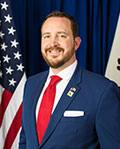
Photo of Devon Mathis
R California Assembly · District 33

Asm. Devon Mathis

Contact Email
Compare
Total votes
23,116
all sessions
Attendance
85%
2,834 missed
Near the chamber average
With party
97%
of cast votes
Near the chamber average
Bipartisan score
2%
crosses aisle rarely
Near the chamber average
Sponsored
2,082
bills & resolutions
Higher than 76% of chamber peers
Committees
0
assignments
2,082 bills and resolutions

Sponsored bills

Total
2,082
Primary
225
Co-sponsor
1,857
This page
2,082
matching current filters
Co-sponsor ACR 256
Signed into law · California Assembly · Co-sponsor
Relative to Rosie's Day.

This measure would declare July 27, 2018, as California Bullying Prevention Day, also to be known as Rosie's Day.

Signed into law Aug 27, 2018 1 co-sponsor
Co-sponsor SB 495
Signed into law · California Senate · Co-sponsor
Protected species: blunt-nosed leopard lizard: taking or possession.

Existing law prohibits the taking or possession of a fully protected reptile or amphibian, except as provided, and designates the blunt-nosed leopard lizard as a fully protected reptile. The California Endangered Species Act prohibits the taking of an endangered or threatened species, except as specified. Under that act, the Department of Fish and Wildlife is permitted to authorize, by permit, the take of listed species if the take is incidental to an otherwise lawful activity and the impacts are minimized and fully mitigated. This bill would permit the department to authorize, under the California Endangered Species Act, by permit, the take or possession of the blunt-nosed leopard lizard resulting from impacts attributable to or otherwise related to the Allensworth Community Services District's drilling and construction of a new water well, connection of the new water well to the existing distribution system, and construction of a new water storage tank, if specified conditions are met. The bill would also make a conforming change and delete obsolete cross-references. This bill would declare that it is to take effect immediately as an urgency statute.

Signed into law Aug 27, 2018 1 co-sponsor
Co-sponsor AB 1954
Signed into law · California Assembly · Co-sponsor
Timber harvest plans: exemption: reducing flammable materials.

The Z'berg-Nejedly Forest Practices Act of 1973 prohibits a person from conducting timber operations, as defined, unless a timber harvesting plan prepared by a registered professional forester has been submitted to the Department of Forestry and Fire Protection. The act authorizes the State Board of Forestry and Fire Protection to exempt from some or all of those provisions of the act a person engaging in specified forest management activities, including a person engaged in forest management whose activities are limited to the cutting or removal of trees on the person's property in compliance with existing laws relating to defensible space, as provided, and requires the board to adopt regulations to implement this exemption no later than January 1, 2016. Existing law requires the department evaluate the effects of this exemption and report its recommendations to the Legislature based on that evaluation, as provided. Existing law makes the exemption inoperative 3 years after the effective date of regulations adopted by the board or no later than January 1, 2019. This bill would extend the inoperative date to January 1, 2022, and would delete the reporting requirement.

Signed into law Aug 27, 2018 1 co-sponsor
Co-sponsor AB 2805
Passed · California Assembly · Co-sponsor
Wild pigs: validations.

(1) Existing law defines the term "wild pig" for purposes of managing, taking, or hunting that species and classifies the wild pig as a game mammal. Under existing law, a mammal occurring naturally in California that is not a game mammal, fully protected mammal, or fur-bearing mammal is a nongame mammal. Existing law requires the Department of Fish and Wildlife to prepare a plan for the management of wild pigs that may include specified information. Existing law requires a person to procure, as specified, either a hunting license and a wild pig tag or a depredation permit in order to take a wild pig. However, existing law provides that any wild pig that is encountered while in the act of inflicting injury to, or damaging or destroying, or threatening to immediately damage or destroy, land or other property may be taken immediately by the owner or the owner's employee or agent, as specified. Under existing law, a violation of the Fish and Game Code is a crime. This bill would revise and recast the provisions applicable to wild pigs by, among other things, specifying that the wild pig is not a game mammal or nongame mammal. The bill would expand the definition of "wild pig" to include any pig that has 2 or more specified phenotypical characteristics and that does not have a permanent mark or visible tag, as specified, and any free-roaming pig, feral pig, or European wild boar having no visible tags, markings, or characteristics indicating that the pig or boar is from a domestic herd. The bill would make this definition applicable to the entire Fish and Game Code. The bill would, however, also create the category of exotic game mammals to include wild pigs, including feral pigs and European wild boar that are within the definition of that term. The bill would make conforming changes to reflect the creation of this separate category of game mammal. This bill would replace the wild pig tag requirement with a wild pig validation that would authorize a person who procures the validation to take any number of wild pigs specified by the Fish and Game Commission during the license year of the validation. The bill would set the price of a wild pig validation at $25 for residents and $75 for nonresidents for the license year beginning on July 1, 2019, and would provide for increases for subsequent license years pursuant to a specified inflation index. This bill would eliminate the requirement to obtain a depredation permit and also eliminate the authority of a property owner, or the property owner's employee or agent, to immediately take a wild pig on the owner's property under the above-described circumstances. The bill would instead provide that any wild pig found to be injuring, molesting, pursuing, worrying, or killing livestock or damaging or destroying, or threatening to damage or destroy, land or other property, may be taken at any time or in any manner by the owner or tenant of the premises or employees and agents in immediate possession of written permission from the owner or tenant of the premises, as specified. Under the bill, an owner or tenant of the premises, or an employee or agent in immediate possession of written permission from the owner or tenant of the premises, who chooses to inform the department of a taking pursuant to these provisions, would be authorized to inform the department of the taking in a manner determined by the commission. The bill would require an owner or tenant of the premises, or an employee or agent in immediate possession of written permission from the owner or tenant of the premises, who plans to take a wild pig at night, to give adequate notification, as determined by the department, to the department at its nearest local office at least 24 hours before the taking of any wild pig. The bill would also prohibit the use of poison to take exotic game mammals. This bill would require the commission to adopt regulations governing the transportation of a wild pig carcass and the reporting of any take of a wild pig, as specified. The bill would repeal the provision requiring the department to prepare a plan for the management of wild pigs and would instead require the department, for each license year beginning with the 2018–19 license year to the 2022–23 license year, inclusive, to conduct a management assessment of wild pigs to measure the success or failure of department efforts to reduce wild pig populations and the damage to habitats caused by wild pigs, as provided. The bill would also require the department, on or before January 1, 2025, to submit to the Legislature a report that evaluates wild pig takings trends to determine whether wild pig takings have increased. This bill would make other nonsubstantive and conforming changes to these provisions. These provisions, except for the provision regarding procurement of wild pig validations and the provision requiring management assessments and an associated report, would become operative on July 1, 2019. Because a violation of these new provisions would be a crime, this bill would impose a state-mandated local program. (2) Existing law requires that funds deposited in the Big Game Management Account be available for expenditure upon appropriation by the Legislature to the Department of Fish and Wildlife to, among other things, implement programs to benefit wild pigs. This bill, beginning July 1, 2019, would instead require that these funds be expended for the use of hunting to manage wild pigs. (3) Existing law makes it unlawful for any person to import any swine into this state except for immediate slaughter unless the person procures a health certificate and an import permit from the Department of Food and Agriculture prior to the shipment or movement of the swine. Under existing law, a violation of the Food and Agricultural Code is a crime. This bill, beginning July 1, 2019, would require the Department of Food and Agriculture to adopt regulations to require a person who possesses a domestic swine that has 2 or more phenotypical characteristics, as described, of a wild pig, to identify the swine with a brand, tattoo, or other permanent mark or visible tag approved by the department. Because a violation of this provision would be a crime, this bill would impose a state-mandated local program. (4) Existing law creates the Shared Habitat Alliance for Recreational Enhancement (SHARE) program in the Department of Fish and Wildlife, which is designed to improve public access to private or landlocked public land and provides that participating landowners will be compensated with monetary payment and liability protection for providing access to or through their land for recreational use and enjoyment of wildlife. Existing law provides that the SHARE program is funded with SHARE access permit application fees through the department. This bill, beginning July 1, 2019, would require the department to work with landowners to mitigate depredation by sport hunting, including the application of the SHARE program, and would authorize the department to use the SHARE program and other means to work with landowners to promote and enhance public hunting opportunities for exotic game mammals on private lands. (5) Existing law provides that, if a person with a lifetime hunting license pays a premium, the person shall annually be issued a deer tag application and 5 wild pig tags. Beginning July 1, 2019, this bill would alternately provide for a person who pays the premium to be issued a deer tag application, a wild pig validation, and 8 Shared Habitat Alliance for Recreational Enhancement access permit applications. (6) The California Constitution requires the state to reimburse local agencies and school districts for certain costs mandated by the state. Statutory provisions establish procedures for making that reimbursement. This bill would provide that no reimbursement is required by this act for a specified reason.


Passed Aug 27, 2018 1 co-sponsor
Co-sponsor AB 2114
Signed into law · California Assembly · Co-sponsor
Livestock inspection.

(1) Existing law, the California Meat and Poultry Supplemental Inspection Act, requires each person to be licensed before operating a meat processing establishment or a custom livestock slaughterhouse and provides for the inspection of those establishments. Existing law exempts from these licensing and inspection requirements certain persons and activities, including owners of livestock who slaughter, on their own premises, livestock of their own raising, as specified, and a mobile slaughter operator who provides services to that owner, where the slaughter occurs on the owner's premises and the meat is thereafter transported for the owner to an establishment for further processing. Existing law requires all fees, charges, and collections collected pursuant to the act to be deposited in the Department of Food and Agriculture Fund to be used for the enforcement of the act. Existing law provides that a violation of these provisions is a misdemeanor. This bill would include a new exemption for a mobile slaughter operator where the livestock is not of the owner's own raising but the slaughter occurs on the premises of the person who raised the livestock, subject to specified conditions. The bill would provide that this exemption shall not apply to the slaughter of more than 5 head of cattle on a single premises in a calendar month. (2) Existing law requires any person who desires to use a brand in this state to record the brand with the Bureau of Livestock Identification. Existing law requires cattle to be inspected prior to being moved or transported under certain circumstances, including before cattle are moved out of the state. Existing law authorizes the Secretary of Food and Agriculture to impose a service charge not to exceed $12 for each site at which an inspection is performed. Existing law also establishes various inspection fees per head of cattle to supplement this site-based charge, as specified. Existing law requires all of these fees to be deposited in the Department of Food and Agriculture Fund. Existing law provides for amounts deposited in the fund pursuant to these provisions to be continuously appropriated. This bill would increase the authorized site-based service charge for brand inspections to $25 for an inspection of 29 head of cattle or less at each site or $15 for an inspection of 30 head of cattle or more at each site. By increasing the amount of an existing fee, the revenue of which is continuously appropriated, the bill would make an appropriation. (3) Existing law authorizes the Secretary of Food and Agriculture to issue various annual permits, and to charge a fee for those permits, to allow cattle to be transported out of the state without a brand inspection. Existing law provides for permit fees to be deposited in the Department of Food and Agriculture Fund. Existing law provides for amounts deposited in the fund pursuant to these provisions to be continuously appropriated to cover the cost of issuing or renewing the permits. Existing law provides that a violation of these provisions is a misdemeanor. This bill would authorize the secretary to issue an additional annual permit. Under the bill, this permit would allow cattle to be transported out of the state without a brand inspection if the cattle are only moved for exhibition purposes and other specified conditions are met. The bill would authorize the Department of Food and Agriculture to charge a fee for the exhibition permit not to exceed $10 per head of cattle. The bill would also require the department to accept the exhibition permits of other states and allow cattle to return to their state of origin under those permits without an inspection. By creating a new fee, the revenue of which is continuously appropriated, the bill would make an appropriation. Because the bill would create a new permit that is subject to specified conditions, the violation of which would be a crime, the bill would impose a state-mandated local program. (4) The California Constitution requires the state to reimburse local agencies and school districts for certain costs mandated by the state. Statutory provisions establish procedures for making that reimbursement. This bill would provide that no reimbursement is required by this act for a specified reason.
Signed into law Aug 27, 2018 1 co-sponsor
Showing 1,311 to 1,320 of 2,082 bills