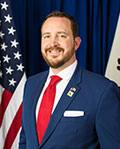
Photo of Devon Mathis
R California Assembly · District 33

Asm. Devon Mathis

Contact Email
Compare
Total votes
23,116
all sessions
Attendance
85%
2,834 missed
Near the chamber average
With party
97%
of cast votes
Near the chamber average
Bipartisan score
2%
crosses aisle rarely
Near the chamber average
Sponsored
2,082
bills & resolutions
Higher than 76% of chamber peers
Committees
0
assignments
2,082 bills and resolutions

Sponsored bills

Total
2,082
Primary
225
Co-sponsor
1,857
This page
2,082
matching current filters
Co-sponsor ACR 28
Passed · California Assembly · Co-sponsor
Sickle Cell Disease Awareness Month.

This measure would recognize September 2020 as Sickle Cell Disease Awareness Month and encourage the Legislature to appropriate funds for research, treatment, and monitoring of sickle cell disease, and for related education and outreach.

Passed Jan 15, 2020 1 co-sponsor
Co-sponsor ACR 148
In committee · California Assembly · Co-sponsor
Relative to Chinese American Day.

This measure would designate October 23, 2020, as Chinese American Day in California to highlight the important historical contributions of Chinese Americans to California and to the United States of America.

In committee Jan 13, 2020 1 co-sponsor
Co-sponsor SB 365
Vetoed · California Senate · Co-sponsor
CalWORKs: immediate childcare assistance.

Existing law provides for the California Work Opportunity and Responsibility to Kids (CalWORKs) program, under which each county provides cash assistance and other benefits to qualified low-income families and individuals. Existing law provides for an immediate assistance payment of $200 or the maximum amount for which an applicant is eligible, whichever is less, if a county determines at the time of application that the applicant is apparently eligible for CalWORKs aid, and the applicant needs immediate assistance because the family's total available liquid resources are less than $100 and there is an emergency situation, as specified. Existing law requires the State Department of Social Services to establish and continuously update a trustline registry of persons who provide childcare, supervision, or in-home educational or counseling services who are not required to be licensed and who have either not been convicted of a crime other than a minor traffic violation or who have been granted an exemption by the department. This bill would, commencing on July 1, 2020, or when the department notifies the Legislature that the Statewide Automated Welfare System can perform the necessary automation for this purpose, whichever date is later, additionally require a county to provide an applicant with immediate childcare assistance for their child, as specified, if the county determines at the time of application that the applicant is apparently eligible for CalWORKs aid, and (1) the applicant has verification of a job or a job offer and needs childcare assistance in order to maintain or obtain employment or (2) the applicant needs childcare assistance in order to attend an educational or training activity. If an applicant chooses childcare services that are exempt from licensure and require trustline registration, the bill would require the county to issue childcare payments only after the provider has become a registered trustline provider. By imposing additional duties on counties, this bill would impose a state-mandated local program. The bill would authorize the department to implement the bill's provisions through an all-county letter or similar instruction until final regulations are adopted. The bill would require the final regulations to be adopted no later than 24 months after the release of the all-county letter or similar instruction. The California Constitution requires the state to reimburse local agencies and school districts for certain costs mandated by the state. Statutory provisions establish procedures for making that reimbursement. This bill would provide that, if the Commission on State Mandates determines that the bill contains costs mandated by the state, reimbursement for those costs shall be made pursuant to the statutory provisions noted above.

Vetoed Jan 13, 2020 1 co-sponsor
Co-sponsor ACR 98
Passed · California Assembly · Co-sponsor
Relative to mental health and substance use treatment.

This measure would urge specified state departments and the Attorney General to use their authority to ensure that health care service plans and health insurers subject to their authority comply with the federal Paul Wellstone and Pete Domenici Mental Health Parity and Addiction Equity Act of 2008.

Passed Jan 9, 2020 1 co-sponsor
Co-sponsor SB 395
Signed into law · California Senate · Co-sponsor
Wild game mammals: accidental taking and possession of wildlife: collision with a vehicle: wildlife salvage permits.

(1) Existing law delegates to the Fish and Game Commission the power to regulate the taking or possession of birds, mammals, fish, amphibians, and reptiles, except as provided. Existing law provides that the accidental taking of a bird, mammal, reptile, or amphibian by collision with a motor vehicle while the vehicle is being operated on a road or highway is not a violation of law. Existing law authorizes the state or local agency having jurisdiction of a road or highway to remove an accidental take from the road or highway. A violation of the Fish and Game Code is a crime. This bill would, upon appropriation by the Legislature, authorize the commission to establish, in consultation with specified public agencies and stakeholders, a pilot program no later than January 1, 2022, for the issuance of wildlife salvage permits through a user-friendly and cell-phone-friendly web-based portal developed by the Department of Fish and Wildlife to persons desiring to recover, possess, use, or transport, for purposes of salvaging wild game meat for human consumption of, any deer, elk, pronghorn antelope, or wild pig that has been accidentally killed as a result of a vehicle collision on a roadway within California. The bill would require the commission to prescribe the requirements for applying for and receiving a wildlife salvage permit. The bill would authorize the commission to restrict the roadways where wildlife salvage may be conducted and the species subject to salvage, and to regulate any other aspect of the pilot program, as specified. The bill would, upon appropriation by the Legislature, require the department to implement the pilot program no later than 6 months after the commission establishes the pilot program. The bill would require the commission to require a person seeking to obtain a wildlife salvage permit to report certain information relating to the salvage through the department's web-based portal. The bill would require the department, beginning on the first March 1 after the department implements the pilot program, and each March 1 thereafter, to make available on its internet website data that includes the number of wildlife salvage permits issued, locations of impacts, and species of wildlife. The bill would repeal these provisions on January 1, 2029. The bill would define "roadway" and "vehicle" for these purposes and make conforming changes. By creating criteria for the accidental taking and possession of specified wild game animals, the violation of which would be a crime, the bill would impose a state-mandated local program. (2) Existing law vests the Department of Fish and Wildlife with jurisdiction over the conservation, protection, and management of fish, wildlife, native plants, and habitat necessary for biologically sustainable populations of those species. This bill would, upon appropriation by the Legislature, authorize the department to develop a pilot program to collect and compile information and data on wildlife-vehicle collisions to support certain wildlife conservation efforts. The bill would require the pilot program to be at a maximum of 3 geographically dispersed sites identified by the department to be areas of high wildlife-vehicle collisions. The bill would authorize the department, in developing the pilot program, to coordinate with other state agencies that remove dead wildlife from roadways to determine the scope of data collected on wildlife-vehicle collisions and would require the department, at the conclusion of the pilot program, to report to the Fish and Game Commission on the number of wildlife-vehicle collisions identified during the study period, barriers to additional data collection, and the feasibility of creating a statewide wildlife-vehicle collision reporting system. The bill would require the report to include an estimate of the costs of implementing the statewide wildlife-vehicle collision reporting system. (3) The California Constitution requires the state to reimburse local agencies and school districts for certain costs mandated by the state. Statutory provisions establish procedures for making that reimbursement. This bill would provide that no reimbursement is required by this act for a specified reason.

Signed into law Oct 13, 2019 1 co-sponsor
Co-sponsor SB 601
Signed into law · California Senate · Co-sponsor
State agencies: licenses: fee waiver.

Existing law requires various licenses to be obtained by a person before engaging in certain professions or vocations or business activities, including licensure as a healing arts professional by various boards within the Department of Consumer Affairs. This bill would authorize any state agency that issues any business license to establish a process for a person or business that has been displaced or is experiencing economic hardship as a result of an emergency, as defined, to submit an application for reduction or waiver of fees required by the agency to obtain a license, renew or activate a license, or replace a physical license for display.

Signed into law Oct 12, 2019 1 co-sponsor
Co-sponsor SB 289
Signed into law · California Senate · Co-sponsor
Medi-Cal: home- and community-based services: military.

Existing law establishes the Medi-Cal program, which is administered by the State Department of Health Care Services and under which qualified low-income persons receive health care services. The Medi-Cal program is, in part, governed and funded by federal Medicaid program provisions. Existing federal law provides for various home- and community-based services (HCBS) , as part of a waiver or a state plan amendment under the Medicaid program, to promote coverage and services that enable an individual who would otherwise be institutionalized to live at home or in the community. This bill would require the retention of placement on the waiting list for, or the reenrollment in, specified HCBS waiver programs for an individual who is a dependent child or spouse of an active duty military service member and who transfers out of state with the military service member on official military orders, if the individual subsequently reestablishes residence in this state and meets other specified procedural requirements. The bill would authorize an individual applying for one of those specified waiver programs who is a dependent child or spouse of an active duty military service member and is residing out of state to submit the individual's application to enroll in that waiver program as soon as the military service member receives official military orders to transfer to this state and before moving to this state, as specified. The bill would condition the implementation of these provisions on receipt of any necessary federal approvals and the availability of federal financial participation, and would authorize the department to seek amendments to the waiver programs, or take other action, as necessary to implement these provisions. The bill would authorize the department to implement these provisions by means of letters or other similar instructions, without taking regulatory action.

Signed into law Oct 12, 2019 1 co-sponsor
Co-sponsor SB 34
Signed into law · California Senate · Co-sponsor
Cannabis: donations.

(1) The Control, Regulate and Tax Adult Use of Marijuana Act (AUMA) , an initiative measure approved as Proposition 64 at the November 8, 2016, statewide general election, authorizes a person who obtains a state license under AUMA to engage in commercial adult-use cannabis activity pursuant to that license and applicable local ordinances. The Medicinal and Adult-Use Cannabis Regulation and Safety Act (MAUCRSA) , among other things, consolidates the licensure and regulation of commercial medicinal and adult-use cannabis activities. Existing administrative law prohibits a retailer licensee from providing free cannabis goods to any person or allowing individuals who are not employed by the retailer to provide free cannabis goods to any person on the licensed premises. Existing administrative law provides an exception to this prohibition for specified medicinal retailer and microbusiness licensees to provide access to medicinal cannabis patients who have difficulty accessing medicinal cannabis goods, as specified. This bill, the Dennis Peron and Brownie Mary Act, would similarly authorize, on and after a specified date, licensees that are authorized to make retail sales to provide free cannabis or cannabis products to a medicinal cannabis patient or the patient's primary caregiver if specified requirements are met, including that the cannabis or cannabis products otherwise meet specified requirements of MAUCRSA. The bill would authorize those licensees to contract with an individual or organization to coordinate the provision of free medicinal cannabis and medicinal cannabis products on the retailer's premises. (2) Existing law deems information contained in a physician's recommendation to use cannabis for medical purposes to be "medical information" within the meaning of the Confidentiality of Medical Information Act, and prohibits a licensee from disclosing this information except, among other exceptions, as necessary for the state or any city, county, or city and county to perform certain official duties. Existing law, the Medical Marijuana Program (MMP) , requires counties to administer an identification card program for qualified patients that possess or cultivate cannabis for personal medical purposes. Existing law deems identification cards issued to those qualified patients to be "medical information" within the meaning of the Confidentiality of Medical Information Act, and likewise prohibits a licensee from disclosing these identification cards, subject to the same exceptions. This bill would additionally except from these prohibitions against disclosure the disclosure of the medical information described above as necessary for the state or any city, county, or city and county to perform official duties pursuant to the Sales and Use Tax Law and pursuant to provisions relating to cannabis taxes. (3) Existing sales and use tax laws impose use taxes on the storage, use, or other consumption in this state of tangible personal property purchased from a retailer for storage, use, or other consumption in this state, presumes tangible personal property purchased outside the state that is stored, used, or consumed in this state is purchased for use in this state, and provides various exemptions from those taxes. This bill, on and after a specified operative date, and until 5 years after that operative date, would exempt from the use tax the storage, use, or other consumption in this state of medicinal cannabis or medicinal cannabis products that are donated, for no consideration, under specified circumstances. The bill would require the exemption to apply only if the cannabis retailer certifies in writing, as specified, that the medicinal cannabis or medicinal cannabis product will be used as specified. The bill would make a licensee that uses the donated medicinal cannabis or medicinal cannabis product in some other manner, or for some other purpose, liable for the payment of use tax and subject to having their license suspended. The Bradley-Burns Uniform Local Sales and Use Tax Law authorizes counties and cities to impose local sales and use taxes in conformity with the Sales and Use Tax Law, and existing laws authorize districts, as specified, to impose transactions and use taxes in accordance with the Transactions and Use Tax Law, which generally conforms to the Sales and Use Tax Law. Amendments to the Sales and Use Tax Law are automatically incorporated into the local tax laws. Existing law requires the state to reimburse counties and cities for revenue losses caused by the enactment of sales and use tax exemptions. This bill would provide that, notwithstanding Section 2230 of the Revenue and Taxation Code, no appropriation is made and the state shall not reimburse any local agencies for sales and use tax revenues lost by them pursuant to this bill. (4) AUMA imposes an excise tax on the purchase of cannabis and cannabis products, as defined, at the rate of 15% of the average market price of any retail sale by a cannabis retailer. The bill would require that these provisions not be construed to impose an excise tax upon medicinal cannabis, or medicinal cannabis products, donated for no consideration to a medicinal cannabis patient, as specified. (5) AUMA imposes a cultivation tax on all harvested cannabis that enters the commercial market upon all cultivators. Existing law defines entering the commercial market to mean cannabis or cannabis products, except for immature cannabis plants and seeds, that complete and comply with specified quality assurance review and testing. This bill, on and after a specified operative date, and until 5 years after that operative date, would prohibit the cultivation tax from being imposed on medicinal cannabis designated for donation by a cultivator in the track and trace system. The bill would require a licensee that certifies in writing that the medicinal cannabis or a medicinal cannabis product will be donated to a medicinal cannabis patient and sells or uses the medicinal cannabis or medicinal cannabis product in some manner or for some purpose other than donation be liable for the cultivation tax. By expanding the scope of the crime of perjury, the bill would impose a state-mandated local program. The bill would specify that the certification in writing relieves the cultivator that donates the medicinal cannabis from liability for the cultivation tax and the distributor from liability for collecting the cultivation only if the certification is taken in good faith. The bill would prohibit a distributor from collecting or remitting the cultivation tax for medicinal cannabis or medicinal cannabis products designated for donation by the cultivator. The bill would require a cultivator to keep records of any medicinal cannabis or medicinal cannabis products designated for donation. The bill would require that the cannabis tax provisions not be construed to impose a cultivation tax upon medicinal cannabis or medicinal cannabis products designated for donation by a cultivator. (6) The bill would require the Legislative Analyst's Office, in order to enable the Legislature to determine whether the use tax exemption and the cultivation tax exemption provided by the bill are meeting, failing to meet, or exceeding a specified goal and objective, to collect certain data regarding the tax exemptions from specified entities, and to submit a report containing the data to the Legislature and the Governor annually each year that the tax exemptions are in effect. (7) This bill would provide that the provisions of the act are severable. (8) This bill would incorporate additional changes to Section 26001 of the Business and Professions Code proposed by SB 185 to be operative only if this bill and SB 185 are enacted and this bill is enacted last. (9) The California Constitution requires the state to reimburse local agencies and school districts for certain costs mandated by the state. Statutory provisions establish procedures for making that reimbursement. This bill would provide that no reimbursement is required by this act for a specified reason. (10) The Control, Regulate and Tax Adult Use of Marijuana Act, an initiative measure, authorizes the Legislature to amend the act to further the purposes and intent of the act with a 23 vote of the membership of both houses of the Legislature, except as provided. This bill would declare that its provisions further specified purposes and intent of the Control, Regulate and Tax Adult Use of Marijuana Act.


Signed into law Oct 12, 2019 1 co-sponsor
Co-sponsor AB 169
Signed into law · California Assembly · Co-sponsor
Guide, signal, and service dogs: injury or death.

Under existing law, it is an infraction or a misdemeanor for a person to permit a dog that is owned, harbored, or controlled by the person to cause injury to, or the death of, a guide, signal, or service dog, as defined, while the guide, signal, or service dog is in discharge of its duties. Existing law makes a person who intentionally causes injury to, or the death of, a guide, signal, or service dog, while the dog is in discharge of its duties, guilty of a misdemeanor. This bill would delete, from both crimes, the requirement that the guide, signal, or service dog be in discharge of its duties when the injury or death occurs and would make these crimes applicable to the injury or death of dogs that are enrolled in a training school or program for guide, signal, or service dogs, as specified. Under existing law, if a defendant is convicted of either of the above crimes, the defendant is required to make restitution to the person with a disability who has custody or ownership of the dog for any veterinary bills and replacement costs of the dog if it is disabled or killed, or other reasonable costs deemed appropriate by the court. The bill would require the defendant, convicted of either crime, to also make restitution to the person for medical or medical-related expenses, or for loss of wages or income, as defined, incurred by the person with a disability. The bill would also include in the definition of "replacement costs" for this purpose the training costs for a new dog, if needed, the cost of keeping the now-disabled dog in a kennel while the handler travels to receive the new dog, and, if needed, the cost of the travel required for the handler to receive the new dog. Because this bill would expand the scope and penalties of existing crimes, it would impose a state-mandated local program. The California Constitution requires the state to reimburse local agencies and school districts for certain costs mandated by the state. Statutory provisions establish procedures for making that reimbursement. This bill would provide that no reimbursement is required by this act for a specified reason.

Signed into law Oct 8, 2019 1 co-sponsor
Co-sponsor AB 317
Signed into law · California Assembly · Co-sponsor
Department of Motor Vehicles: appointments: unlawful sale.

Existing law establishes the Department of Motor Vehicles in the Transportation Agency and sets forth the powers and duties of the department, including, but not limited to, vehicle registration and the issuance and renewal of driver's licenses. Existing law defines a "person," for the purposes of these and related provisions, as a natural person, firm, copartnership, association, limited liability company, or corporation. Under existing law, a violation of, or failure to comply with, any provision of the Vehicle Code is unlawful and constitutes an infraction, unless otherwise provided. This bill would make it unlawful for any person to sell, or offer for sale, an appointment with the department, as specified. Because a violation of this provision would be an infraction, the bill would create a state-mandated local program. The California Constitution requires the state to reimburse local agencies and school districts for certain costs mandated by the state. Statutory provisions establish procedures for making that reimbursement. This bill would provide that no reimbursement is required by this act for a specified reason.

Signed into law Oct 8, 2019 1 co-sponsor
Showing 1,101 to 1,110 of 2,082 bills