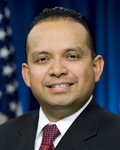
Photo of Luis Alejo
D California Assembly · District 30

Asm. Luis Alejo

Compare
Total votes
13,365
all sessions
Attendance
95%
552 missed
Near the chamber average
With party
99%
of cast votes
Near the chamber average
Bipartisan score
0%
crosses aisle rarely
Near the chamber average
Sponsored
940
bills & resolutions
Near the chamber average
Committees
0
assignments
940 bills and resolutions

Sponsored bills

Total
940
Primary
142
Co-sponsor
798
This page
940
matching current filters
Co-sponsor ACR 123
Signed into law · California Assembly · Co-sponsor
Relative to Sexual Assault Awareness Month and Denim Day California.

This measure would designate the month of April 2012 as Sexual Assault Awareness Month, would recognize April 25, 2012, as Denim Day California, and would encourage everyone to wear jeans on that day to help communicate the message that there is no excuse for, and never an invitation to commit, rape.

Signed into law May 31, 2012 1 co-sponsor
Co-sponsor ACR 112
Signed into law · California Assembly · Co-sponsor
Relative to the 24th Annual State Scientist Day.

This measure would declare May 23, 2012, as the 24th Annual State Scientist Day, as a tribute to the dedication and professionalism of the state scientists who work on behalf of all the residents of California.

Signed into law May 25, 2012 1 co-sponsor
Co-sponsor AB 1709
In committee · California Assembly · Co-sponsor
Juveniles: jury trial.

(1) Existing law provides that any person under 18 years of age who commits a crime is within the jurisdiction of the juvenile court, except as specified. The juvenile court must adjudicate a petition to declare a detained minor a ward of the court within 15 days after the petition is filed. Existing law, contained in 2 initiative statutes, commonly known as the Three Strikes law, requires increased penalties for certain recidivist offenders in addition to any other enhancement or penalty provisions that may apply. Existing law requires that if a defendant has 2 or more prior violent or serious felony convictions, the term for the current felony conviction shall be an indeterminate term of imprisonment in the state prison for life with a minimum term to be served, as specified. Under certain circumstances, a juvenile adjudication constitutes a violent or serious felony conviction under those provisions. This bill would require that a youth who is 16 years of age or older at the time of the commission of an offense that could be used as a future felony conviction under the Three Strikes law be entitled to a jury trial in the juvenile court. The bill also would require that the jury trial proceed in the same manner as a jury trial in criminal court. This bill would provide that the right to a jury trial does not affect the right of a detained minor to adjudication of the petition to declare him or her a ward of the court within 15 days of the filing of the petition. This bill would also make conforming changes. (2) Existing law authorizes a juvenile court to temporarily commit a ward of the court to a diagnostic and treatment center of the Department of Corrections and Rehabilitation, Division of Juvenile Facilities, for up to 90 days if the ward is otherwise eligible for commitment and the court concludes that the commitment would be in the ward's best interest, including in cases in which the minor has been adjudged a ward of the court due to habitual disobedience or truancy or due to the violation of any state or federal law or local ordinance defining crime, as specified. Existing law requires the Chief of the Department of Corrections and Rehabilitation, Division of Juvenile Facilities, to forward the minor's diagnosis and treatment recommendations to the court within that 90-day period. This bill would limit these provisions to minors who have been adjudicated as wards of the court for violating any state or federal law or local ordinance defining a crime, as specified.

In committee May 25, 2012 1 co-sponsor
Primary AB 2089
In committee · California Assembly · Lead sponsor
Juveniles: civil citation process.

Under existing law, a peace officer may take a minor into temporary custody without a warrant under specified circumstances, including when the officer has reasonable cause to believe that the minor has committed a crime and is within the jurisdiction of the juvenile court, and may release the minor, deliver the minor to a services agency, release the minor with a notice to appear before a probation officer, or promptly take the minor before a probation officer. Proceedings to declare a minor a ward of the court are commenced by the filing of a petition by a probation officer, district attorney, or prosecuting attorney. This bill would authorize a peace officer who takes a minor suspected of having committed a misdemeanor into temporary custody without a warrant to issue a civil citation to the minor if the minor consents and has not previously committed an offense. Under the bill, the officer would notify the county probation department, to which the minor would report within 7 days. The bill would require the probation department to assess the minor and to require the minor to serve no more than 50 hours of community service. The probation department would also be authorized to require the minor to participate in intervention programs. If the minor fails to report to the probation department or to fulfill the requirements of the civil citation program, this bill requires the probation department to present an affidavit with the facts constituting the original misdemeanor to the prosecuting attorney. By imposing new duties on county probation departments, and by increasing those departments' duties, this bill would impose a state-mandated local program. The California Constitution requires the state to reimburse local agencies and school districts for certain costs mandated by the state. Statutory provisions establish procedures for making that reimbursement. This bill would provide that, if the Commission on State Mandates determines that the bill contains costs mandated by the state, reimbursement for those costs shall be made pursuant to these statutory provisions.

In committee May 25, 2012 0 co-sponsors
Primary AB 1858
In committee · California Assembly · Lead sponsor
School finance: emergency loans: South Monterey County Joint Union High School District.

Existing law requires the Controller to transfer from Section A of the State School Fund the amount of funds necessary to pay certain warrants so that the effective cost of the lease financing provided to the Oakland Unified School District, the Vallejo Unified School District, and the West Contra Costa Unified School District is equal to the cost of the original General Fund emergency loan made to each school district. Existing law also specifies the original interest rate to be used in determining the cost of the original emergency loan made for these school districts. This bill would also require the Controller to make that transfer with respect to the lease financing provided to the South Monterey County Joint Union High School District. The bill would specify the original interest rate to be used in determining the cost of the original emergency loan for the South Monterey County Joint Union High School District. This bill would make legislative findings and declarations as to the necessity of a special statute for the South Monterey County Joint Union High School District.

In committee May 25, 2012 0 co-sponsors
Primary AB 1898
In committee · California Assembly · Lead sponsor
Education finance: emergency apportionments.

Existing law requires a school district that receives an emergency apportionment to enter into a lease financing with the California Infrastructure and Economic Development Bank for the purpose of financing the emergency apportionment. Existing law specifies various terms of the lease. This bill, commencing January 1, 2013, would provide that, for any lease financing with a total value of less than or equal to $25,000,000, adjusted annually as specified, entered into for the purpose of financing the emergency apportionment, the source of the financing would be the Pooled Money Investment Account, and the interest rate would be the rate earned by moneys in the Pooled Money Investment Account as of the date of the initial disbursement of emergency apportionment funds to the school district, unless the interest rate charged by the California Infrastructure and Economic Development Bank as of the date of the initial disbursement of emergency apportionment funds is lower than the Pooled Money Investment Account rate.

In committee May 25, 2012 0 co-sponsors
Primary AB 1516
In committee · California Assembly · Lead sponsor
Vehicles: driver's license requirements: farming exemption.

(1) Existing law provides that a person with a class C license may operate a motor vehicle or combination of motor vehicles of 26,000 pounds or less when it is operated by a farmer, an employee of a farmer, or an instructor credentialed in agriculture as part of a specified instructional program, it is used exclusively in the conduct of agricultural operations, and it is not used in the capacity of a for-hire carrier or for compensation. This bill would additionally authorize a class C licenseholder to operate, until January 1, 2018, a combination of vehicles with a specified gross combination weight rating and gross vehicle weight rating that meets specified operating conditions, including being operated by a farmer or an employee of a farmer and being operated within 150 miles of a farm. (2) Existing law excludes certain vehicles from the definition of a commercial motor vehicle for purposes of the Motor Carriers of Property Permit Act. This bill would exclude, from that act, until January 1, 2018, a pickup truck, as defined, or a vehicle that has a flatbed of less than 9 feet and meets certain conditions regarding its weight rating and operation. The bill would also exclude until January 1, 2018, a combination of vehicles with a specified weight rating that meets certain conditions regarding the weight rating and operation of those vehicles. (3) The bill would require the Department of the California Highway Patrol to submit a report, by January 1, 2017, to the Legislature, that evaluates the exemptions provided by the bill and recommends as to whether those exemptions should be continued. The bill would repeal the report requirement on January 1, 2021.


In committee May 25, 2012 0 co-sponsors
Co-sponsor AB 2241
In committee · California Assembly · Co-sponsor
Pupils: Transitioning Youth for Success Program.

Existing law provides for the administration and operation of public schools in juvenile halls, juvenile homes, day centers, juvenile ranches, juvenile camps, regional youth educational facilities, and certain group homes. The public schools or classes offered in these facilities are known as juvenile court schools. Existing law states that the Legislature encourages each county superintendent of schools or governing board of a school district, as specified, and the county chief probation officer to enter into a memorandum of understanding or equivalent mutual agreement to support a collaborative process for meeting the needs of wards of the court who are receiving their education in juvenile court schools with the purpose of developing a collaborative model that will foster an educational and residential environment that nurtures the whole child and consistently supports services that will meet the educational needs of the pupils. This bill would establish the Transitioning Youth for Success Program for the purpose of prioritizing the use of specified federal funds for neglected, delinquent, or at-risk pupils. The bill would require a county office of education or a school district to submit an application to the State Department of Education to receive funding under this program. Participating school districts and county offices of education would provide programs and services that focus on the special needs of youth who are or have been confined to a facility where a juvenile court school or classes are authorized to be offered. The purpose of the programs and services would be to ensure that these youth make a successful transition from the juvenile facility to further schooling or employment and are provided a support system to ensure their continued education. The bill would require a comprehensive transition plan to be developed and implemented for pupils served by the program. The bill would require the Superintendent of Public Instruction, in consultation with the Board of Corrections and county offices of education, by December 1, 2013, to develop consistent measures by which to evaluate the success of programs and services funded under this program. The bill would require the State Board of Education to amend California's consolidated state application for the federal No Child Left Behind Act of 2001, as necessary, so that the application adequately reflects the requirements and provisions of the program.

In committee May 25, 2012 1 co-sponsor
Primary AB 1439
In committee · California Assembly · Lead sponsor
Minimum wage: annual adjustment.

Existing law requires that, on and after January 1, 2008, the minimum wage for all industries be not less than $8.00 per hour. This bill would provide for an adjustment to the hourly minimum wage on January 1, 2013, and annually thereafter, to maintain employee purchasing power. The automatically adjusted minimum wage would be calculated using the California Consumer Price Index, as specified. The bill would prohibit the Industrial Welfare Commission from adjusting the minimum wage downward and from adjusting the minimum wage upward if the average percentage of inflation for the previous year, as defined, was negative. The bill would require the Industrial Welfare Commission to publicize the automatically adjusted minimum wage. This bill would provide that the commission may increase the minimum wage in an amount greater than the formula would provide.

In committee May 25, 2012 0 co-sponsors
Co-sponsor AB 2093
In committee · California Assembly · Co-sponsor
Foster Youth Higher Education Preparation and Support Act of 2012.

Existing law establishes the segments of the public postsecondary education system in the state, including the University of California administered by the Regents of the University of California, the California State University administered by the Trustees of the California State University, and the California Community Colleges administered by the Board of Governors of the California Community Colleges. Existing law establishes the Higher Education Outreach and Assistance Act for Emancipated Foster Youth, which requires the Trustees of the California State University and the Board of Governors of the California Community Colleges to perform specified services to assist emancipated foster youth. This bill would enact the Foster Youth Higher Education Preparation and Support Act of 2012, which would additionally require the California State University, and request the California Community Colleges and the University of California, to establish foster youth campus support programs, which are separate from the Higher Education Outreach and Assistance Act for Emancipated Foster Youth, to provide comprehensive support and outreach services, as specified, to current and former foster youth in an effort to retain foster youth in higher education. The bill would require the California State University, and request the California Community Colleges and the University of California, to designate a foster youth campus support program coordinator using new or existing resources. The bill would require the State Department of Social Services to annually notify foster youth 13 years of age or older, and those foster youths' caregivers, of the postsecondary educational support provided to them pursuant to this bill.

In committee May 25, 2012 1 co-sponsor
Showing 791 to 800 of 940 bills
Previous 1 … 79 80 81 … 94 Next