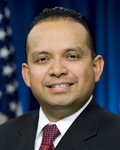
Photo of Luis Alejo
D California House · District 30

Rep. Luis Alejo

Compare
Total votes
13,365
all sessions
Attendance
95%
552 missed
Near the chamber average
With party
99%
of cast votes
Near the chamber average
Bipartisan score
0%
crosses aisle rarely
Near the chamber average
Sponsored
940
bills & resolutions
Near the chamber average
Committees
0
assignments
940 bills and resolutions

Sponsored bills

Total
940
Primary
142
Co-sponsor
798
This page
940
matching current filters
Co-sponsor ACR 176
Signed into law · California House · Co-sponsor
Relative to the Girl Scouts of America Gold Award.

This measure would commend Girl Scouts of America upon the occasion of the 100th anniversary of the Girl Scout Gold Award, applaud the vital role the organization has played in the lives of countless girls and young women, and extend best wishes for its continued success in the future.

Signed into law Aug 16, 2016 1 co-sponsor
Co-sponsor ACR 186
Signed into law · California House · Co-sponsor
Relative to California Fairground Appreciation Month.

This measure would designate June 2016 as California Fairground Appreciation Month and commend the directors, volunteers, staff, local agencies, nonprofits, and Californians who support and attend fairground events.

Signed into law Aug 16, 2016 1 co-sponsor
Co-sponsor SB 1170
Passed · California Senate · Co-sponsor
Public contracts: water pollution prevention plans: delegation.

Existing law prohibits a local public entity, charter city, or charter county from requiring a bidder on a public works contract to assume responsibility for the completeness and accuracy of architectural or engineering plans and specifications on public works projects, except as specified. Existing law requires the State Water Resources Control Board and the 9 California regional water quality control boards to prescribe waste discharge requirements in accordance with the National Pollutant Discharge Elimination System (NPDES) permit program established by the federal Clean Water Act and the Porter-Cologne Water Quality Control Act. Existing law regulates the discharge of pollutants in stormwater associated with construction activity to waters of the United States from construction sites that disturbs one or more acres of land surface, or that is part of a common plan of development or sale that disturbs more than one acre of land surface. This bill, except as specified, would prohibit a public entity, charter city, or charter county from delegating to a contractor the development of a plan, as defined, used to prevent or reduce water pollution or runoff on a public works contract. The bill would also prohibit a public entity, charter city, or charter county from requiring a contractor on a public works contract that includes compliance with a plan to assume responsibility for the completeness and accuracy of a plan developed by that entity. The bill would provide that these prohibitions do not apply to contracts that use specified procurement methods if the contractor or construction manager at risk is required by the bid or procurement documents to retain a plan developer for the project owners. The bill would also declare that this is a matter of statewide concern. The bill would state that its provisions are declaratory of existing law, as specified. The California Constitution requires the state to reimburse local agencies and school districts for certain costs mandated by the state. Statutory provisions establish procedures for making that reimbursement. This bill would provide that the Legislature finds there is no mandate contained in the bill that will result in costs incurred by a local agency or school district for a new program or higher level of service which require reimbursement pursuant to these constitutional and statutory provisions.

Passed Aug 11, 2016 1 co-sponsor
Co-sponsor AB 2715
Passed · California House · Co-sponsor
Agricultural Working Poor Energy Efficient Housing Program.

Existing law establishes the Department of Community Services and Development and requires the department to administer, among other things, the federal Low-Income Home Energy Assistance Program. Existing law requires the department to develop and administer the Energy Efficiency Low-Income Weatherization Program and to expend moneys appropriated by the Legislature for the purposes of the program. This bill would require the department to develop and administer the Agricultural Working Poor Energy Efficient Housing Program and to expend moneys appropriated by the Legislature for the purposes of the program to improve energy efficiency in farmworker-owned housing. The bill would require the department to report to the Legislature on the program with respect to balances and expenditures, households reached, demographics of the households reached, measures funded, and energy savings. Existing law requires the Public Utilities Commission (PUC) to supervise certain low-income targeted energy efficiency programs administered by electrical corporations, gas corporations, or 3rd-party administrators, and requires the State Energy Resources Conservation and Development Commission (Energy Commission) to undertake various activities and administer various programs to promote energy efficiency. This bill would require the department, in developing the Agricultural Working Poor Energy Efficient Housing Program, to consult with the PUC and the Energy Commission in order to ensure compatibility with the state's energy policies and goals and to avoid duplication of the energy efficiency programs supervised by those commissions.

Passed Aug 11, 2016 1 co-sponsor
Co-sponsor AB 2140
Passed · California House · Co-sponsor
Income taxes: insurance tax: credits: low-income housing: farmworker housing assistance.

Existing law establishes a low-income housing tax credit program pursuant to which the California Tax Credit Allocation Committee provides procedures and requirements for the allocation of state insurance, personal income, and corporation tax credit amounts among qualified low-income housing projects in modified conformity to federal law that have been allocated, or qualify for, a federal low-income housing tax credit, and for farmworker housing. Existing law limits the total annual amount of the state low-income housing credit for which a federal low-income housing credit is required to the sum of $70,000,000, as increased by any percentage increase in the Consumer Price Index for the preceding calendar year, any unused credit for the preceding calendar years, and the amount of housing credit ceiling returned in the calendar year. Existing law additionally allows a state credit, which is not dependent on receiving a federal low-income housing credit, of $500,000 per calendar year for projects to provide farmworker housing. Existing law defines "farmworker housing" to mean housing for agricultural workers that is available to, and occupied by, only farmworkers and their households. This bill, under the insurance taxation law, the Personal Income Tax Law, and the Corporation Tax Law, would modify the definition of applicable percentage relating to qualified low-income buildings that are farmworker housing projects, as provided. The bill would authorize the California Tax Credit Allocation Committee to allocate the farmworker housing credit even if the taxpayer receives federal credits for buildings located in designated difficult development areas or qualified census tracts. The bill would also redefine farmworker housing to mean housing in which at least 50% of the units are available to, and occupied by, farmworkers and their households. This bill would include a change in state statute that would result in a taxpayer paying a higher tax within the meaning of Section 3 of Article XIIIA of the California Constitution, and thus would require for passage the approval of 23 of the membership of each house of the Legislature. This bill would take effect immediately as a tax levy.


Passed Aug 11, 2016 1 co-sponsor
Co-sponsor AB 2494
Passed · California House · Co-sponsor
Veteran Resource Centers Grant Program.

Existing law establishes the California Community Colleges under the administration of the Board of Governors of the California Community Colleges. Existing law requires the board of governors to appoint a chief executive officer, to be known as the Chancellor of the California Community Colleges. This bill would establish the Veteran Resource Centers Grant Program, which would authorize the governing board of a community college district and a community college campus at which a veterans resource center has been or is intended to be established to jointly apply to the chancellor for a grant for purposes of providing resources to veterans and active duty members of the Armed Forces of the United States enrolled at the campus. The bill would establish the Veteran Resource Centers Grant Fund in the State Treasury. The bill would allocate moneys in the fund, upon appropriation by the Legislature in the annual Budget Act, to the chancellor for, among other things, administration of the program and distribution of awards to recipient community college districts and campuses. The bill would repeal the program on January 1, 2023.

Passed Aug 11, 2016 1 co-sponsor
Primary AB 2090
Passed · California House · Lead sponsor
Low Carbon Transit Operations Program.

The California Global Warming Solutions Act of 2006 designates the State Air Resources Board as the state agency charged with monitoring and regulating sources of emissions of greenhouse gases. The act authorizes the state board to include the use of market-based compliance mechanisms. Existing law requires all moneys collected by the state board as part of a market-based compliance mechanism to be deposited in the Greenhouse Gas Reduction Fund and to be available upon appropriation. Existing law continuously appropriates specified portions of the annual proceeds in the fund to various programs, including 5% for the Low Carbon Transit Operations Program, which provides operating and capital assistance for transit agencies to reduce greenhouse gas emissions and improve mobility, with a priority on serving disadvantaged communities. This bill would additionally authorize moneys appropriated to the program to be expended to support the operation of existing bus or rail service if the governing board of the requesting transit agency declares a fiscal emergency and other criteria are met, thereby expanding the scope of an existing continuous appropriation.

Passed Aug 11, 2016 0 co-sponsors
Showing 51 to 60 of 940 bills
Previous 1 5 6 7 94 Next