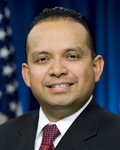
Photo of Luis Alejo
D California Assembly · District 30

Asm. Luis Alejo

Compare
Total votes
13,365
all sessions
Attendance
95%
552 missed
Near the chamber average
With party
99%
of cast votes
Near the chamber average
Bipartisan score
0%
crosses aisle rarely
Near the chamber average
Sponsored
940
bills & resolutions
Near the chamber average
Committees
0
assignments
940 bills and resolutions

Sponsored bills

Total
940
Primary
142
Co-sponsor
798
This page
940
matching current filters
Co-sponsor SJR 31
Failed · California Senate · Co-sponsor
Immigration: unaccompanied minors.

This measure would urge the President and Congress of the United States to take specified action and adopt specified policies designed to protect unaccompanied minors immigrating to the United States.

Failed Nov 30, 2014 1 co-sponsor
Primary AB 280
Failed · California Assembly · Lead sponsor
Voting rights: preclearance.

Existing law, the federal Voting Rights Act of 1965, provides that a change in voting procedures may not take effect in a state or political subdivision that is covered by the preclearance requirements of the federal act until the change is approved by a specified federal authority. A state or political subdivision is covered by the preclearance requirements of the federal act if it maintained a specified test or device as a prerequisite to voting, and had low voter registration or turnout, in the 1960s and early 1970s. The federal act allows a state or political subdivision covered by the act to obtain an exemption from the preclearance requirements if it satisfies specified criteria. The United States Supreme Court has held that the coverage formula of the federal act is unconstitutional and may not be used as a basis for requiring a jurisdiction to subject a proposed change in voting procedures to federal preclearance. Prior to that holding, the Counties of Kings, Monterey, and Yuba were covered jurisdictions subject to the federal preclearance requirements. This bill would establish a state preclearance system. Under this system, if a political subdivision enacts or seeks to administer a voting-related law, regulation, or policy, as specified, that is different from that in force or effect on the date this act is enacted, the governing body of the political subdivision would be required to submit the law, regulation, or policy to the Secretary of State for approval. The bill would require the Secretary of State to approve the law, regulation, or policy only if specified conditions are met. The bill would provide that the law, regulation, or policy shall not take effect or be administered in the political subdivision until the law, regulation, or policy is approved by the Secretary of State. The bill would allow the governing body of the political subdivision to seek review of the Secretary of State's decision by means of an action filed in the Superior Court of Sacramento. By requiring local governments to seek approval of the Secretary of State for changes to voting procedures, this bill would impose a state-mandated local program. The California Constitution requires the state to reimburse local agencies and school districts for certain costs mandated by the state. Statutory provisions establish procedures for making that reimbursement. This bill would provide that, if the Commission on State Mandates determines that the bill contains costs mandated by the state, reimbursement for those costs shall be made pursuant to these statutory provisions.

Failed Nov 30, 2014 0 co-sponsors
Co-sponsor AB 2715
Failed · California Assembly · Co-sponsor
District-based municipal elections.

Existing law provides for political subdivisions that encompass areas of representation within the state. With respect to these areas, public officials are generally elected by all of the voters of the political subdivision (at-large) or from districts formed within the political subdivision (district-based) . Existing law, the California Voting Rights Act of 2001, prohibits an at-large method of election to be imposed or applied in a manner that impairs the ability of a protected class to elect candidates of its choice or its ability to influence the outcome of an election, as a result of the dilution or the abridgment of the rights of voters who are members of a protected class, as defined. Existing law authorizes the legislative body of a city to submit to voters at any municipal or special election an ordinance providing for the election of members of the legislative body by districts, from districts, by districts with an elective mayor, or from districts with an elective mayor. Under existing law, "by district" means election of members of the legislative body by voters of the district alone and "from district" means election of members of the legislative body who are residents of the district from which they are elected by the voters of the entire city. Existing law prescribes the procedures for the electors to change from the election of these members by district to election from districts or vice versa. This bill would permit the legislative body of a city to provide by ordinance, without submitting the ordinance to the voters of the city for approval, for the election of members of the legislative body by district if the voters of the city previously rejected such an ordinance, as specified. This provision would be repealed on December 31, 2016. The bill would, commencing January 1, 2017, require the legislative body of a city with a population of 100,000 or more, as determined by the most recent federal decennial census, to provide by ordinance, without submitting the ordinance to the voters of the city for approval, for the election of members of the legislative body by district. The bill would, commencing January 1, 2017, permit the legislative body of any other city to provide by ordinance, without submitting the ordinance to the voters of the city for approval, for the election of members of the legislative body by district. The bill would require that the boundary lines of each district be adjusted in accordance with specified provisions of law. By requiring cities to conduct elections for members of their legislative bodies in a specified manner, this bill would impose a state-mandated local program. The California Constitution requires the state to reimburse local agencies and school districts for certain costs mandated by the state. Statutory provisions establish procedures for making that reimbursement. This bill would provide that, if the Commission on State Mandates determines that the bill contains costs mandated by the state, reimbursement for those costs shall be made pursuant to these statutory provisions. This bill would specify that its provisions become operative on July 1, 2015.


Failed Nov 30, 2014 1 co-sponsor
Co-sponsor AB 1799
Failed · California Assembly · Co-sponsor
Land use: mitigation lands.

The Planning and Zoning Law authorizes a state or local agency, where that agency requires a project proponent to transfer property to mitigate adverse project impacts upon natural resources, to in turn authorize a government entity, special district, or any of certain types of parties to hold title to, and manage, the transferred property. Existing law also allows a state or local agency that has required such a transfer of property for mitigation purposes to identify the funding needs for the long-term stewardship of the property, and establishes various requirements with respect to the amount and management of any endowment conveyed or secured for purposes of funding the protection of the property. This bill would where a governmental entity or specified district is the transferee of the property, specify that an endowment or other financial mechanism is not required if the governmental entity or special district provides evidence to the local or state agency that it possesses an investment-grade, as defined, credit rating by a nationally recognized statistical rating organization or other equivalent evidence of financial reliability, and enters into a contractual agreement, containing certain elements, with the local or state agency enforcing the mitigation requirements. This bill would require a participating governmental entity or special district to submit an annual report to the Department of Fish and Wildlife of the governmental entity's or special district's accounts receivables and discharged accounts, as specified.

Failed Nov 30, 2014 1 co-sponsor
Co-sponsor AB 1637
Failed · California Assembly · Co-sponsor
Driver's licenses: veteran designation.

(1) Under existing law, when the Department of Motor Vehicles determines that an applicant is lawfully entitled to a driver's license, the department is required to issue that license to the applicant. Existing law specifies the contents of a driver's license and requires the application for a driver's license or identification card to contain a space for an applicant to indicate whether he or she has served in the Armed Forces of the United States and to give his or her consent to be contacted regarding eligibility to receive state or federal veterans' benefits. This bill would, commencing November 11, 2015, allow an applicant for a driver's license or identification card to allow a person to request the driver's license or identification card be printed with the word "VETERAN." The applicant would be required to present to the Department of Motor Vehicles, on a form developed jointly by the Department of Veterans Affairs and the Department of Motor Vehicles, proof of veteran status. The bill would require county veterans service offices to verify an applicant's veteran status for these purposes, as specified. The department would be required to print the word "VETERAN" on the face of a driver's license or identification card issued to a person who makes that request and presents that verification to the department. (2) Existing law establishes certain fee amounts for the applications for, and renewal of, driver's licenses and identification cards. This bill would authorize the department to charge an additional fee in an unspecified amount to a person who requests that the person's driver's license or identification card be designated as provided above.

Failed Nov 30, 2014 1 co-sponsor
Co-sponsor AB 2332
Failed · California Assembly · Co-sponsor
Courts: personal services contracts.

The Trial Court Employment Protection and Governance Act establishes a trial court employee personnel system that provides authority to hire trial court personnel, regulates the classification and compensation of trial court employees, labor relations, and personnel files, and requires each trial court to establish a system of employment selection and advancement and an employment protection system. Existing law authorizes state agencies to use personal services contracts to achieve cost savings if specified standards are satisfied, including, among other things, the contract does not cause the displacement of civil service employees and the contract is awarded through a publicized, competitive bidding process. The State Personnel Board is required to review a proposed contract upon the request of an employee organization for compliance with those standards. This bill would establish specified standards if a trial court intends to enter into a contract for any services that are currently or customarily performed by that trial court's employees. Among other things, the bill would require the trial court to clearly demonstrate that the contract will result in actual overall cost savings to the trial court for the duration of the entire contract as compared with the trial court's actual costs of providing the same services. This bill would provide that these standards apply to any contract entered into on or after January 1, 2015. The bill would provide that its provisions do not apply to a contract under specified circumstances, including when services are incidental to a contract for the purchase or lease of real or personal property. This bill would require each trial court to provide a report by February 1, 2015, to the Chairperson of the Joint Legislative Budget Committee and the chairpersons of the Senate Judiciary Committee and the Assembly Judiciary Committee if the trial court entered into a contract between July 1, 2014, and December 31, 2014, inclusive, for services that were provided or are customarily provided by its trial court employees if the contract has a term extending beyond March 31, 2015. This report would be required to include specified information relating to these contracts, including an analysis of whether the contract resulted in the displacement of trial court employees. The bill would provide that its provisions are severable.

Failed Nov 30, 2014 1 co-sponsor
Co-sponsor ACR 27
died · California Assembly · Co-sponsor
Relative to César Chávez.

This measure would call upon all Californians to observe César Chávez's birthday, March 31, as a day of public service, to recognize the hard work and self-sacrifice that farmworkers go through to feed all the families in our state, and to learn from César Chávez's life and his mission of nonviolence, social justice, and selfless service to others.

died Nov 30, 2014 1 co-sponsor
Primary AB 2014
Failed · California Assembly · Lead sponsor
Undocumented workers: Taxation: undocumented immigrants.

Existing law establishes the Franchise Tax Board and prescribes its various powers and duties regarding, among other things, the administration of state personal income taxes and requires that an income tax return be filed by every individual who has income in excess of specified amounts. Existing law allows an income tax return to be filed with the Franchise Tax Board using an individual taxpayer identification number. This bill would require the Franchise Tax Board to, among other things, advertise the availability of filing an income tax return using an individual taxpayer identification number, to provide a receipt or proof of filing to those persons filing an income tax return using an individual taxpayer identification number, and to annually prepare a report to the Legislature and Governor including information regarding those persons. This bill would also provide that it is unlawful for any employee of the Franchise Tax Board, or other specified government employees, to reveal the identity of any person who has filed an income tax return using an individual taxpayer identification number absent a court order or statutory authorization. The California Constitution provides that the powers of state government are legislative, executive, and judicial. Existing law requires that the Governor see that the law is faithfully executed. Existing law provides that the Governor is the sole official organ of communication between the state and the government of any other state or of the United States. Existing federal law regulates immigration. This bill would require the Governor to request that the President of the United States direct the Department of Homeland Security, the United States Immigration and Customs Enforcement, and other relevant federal agencies to not expend resources within the interior of California to apprehend, detain, or remove any person who has filed a California state income tax return using an individual taxpayer identification number, as provided.

Failed Nov 30, 2014 0 co-sponsors
Co-sponsor SCR 35
Failed · California Senate · Co-sponsor
Relative to the Pinnacles National Park Highway.

This bill would designate a specified portion of State Route 25 as the Pinnacles National Park Highway. The measure would request the Department of Transportation to determine the cost of appropriate signs showing this special designation and, upon receiving donations from nonstate sources covering that cost, to erect those signs.

Failed Nov 30, 2014 1 co-sponsor
Primary AB 1080
Failed · California Assembly · Lead sponsor
Community Revitalization and Investment Authorities.

The Community Redevelopment Law authorizes the establishment of redevelopment agencies in communities to address the effects of blight, as defined. Existing law dissolved redevelopment agencies and community development agencies, as of February 1, 2012, and provides for the designation of successor agencies. Existing law provides for various economic development programs that foster community sustainability and community and economic development initiatives throughout the state. This bill would authorize certain public entities of a community revitalization and investment area, as described, to form a community revitalization plan within a community revitalization and investment authority (authority) to carry out the Community Redevelopment Law in a specified manner. The bill would require the authority to adopt a community revitalization plan for a community revitalization and investment area and authorize the authority to include in that plan a provision for the receipt of tax increment funds.

Failed Nov 30, 2014 0 co-sponsors
Showing 381 to 390 of 940 bills
Previous 1 … 38 39 40 … 94 Next