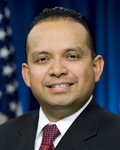
Photo of Luis Alejo
D California Assembly · District 30

Asm. Luis Alejo

Compare
Total votes
13,365
all sessions
Attendance
95%
552 missed
Near the chamber average
With party
99%
of cast votes
Near the chamber average
Bipartisan score
0%
crosses aisle rarely
Near the chamber average
Sponsored
940
bills & resolutions
Near the chamber average
Committees
0
assignments
940 bills and resolutions

Sponsored bills

Total
940
Primary
142
Co-sponsor
798
This page
940
matching current filters
Co-sponsor ACR 147
Signed into law · California Assembly · Co-sponsor
Relative to California Agriculture Day.

This measure would recognize and honor the men and women of California agriculture for their dedication and productivity by observing March 15, 2016, as National Agriculture Day, and designating March 16, 2016, as California Agriculture Day.

Signed into law Apr 29, 2016 1 co-sponsor
Co-sponsor SB 539
Vetoed · California Senate · Co-sponsor
Public property: names: Confederate States of America.

(1) Existing law prohibits the sale or display of the Battle Flag of the Confederacy, as specified, or its image, by the State of California, subject to exceptions serving educational or historical purposes. This bill would, on and after January 1, 2017, prohibit the use of an elected leader or senior military officer of the Confederate States of America to name state or local property. The bill would require a name associated with the Confederate States of America used to name state or local property prior to January 1, 2017, to be changed and any sign associated with the name to be removed. The bill would prohibit its provisions from being construed to require renaming of a city, county, or other political jurisdiction named after an elected leader or senior military officer of the Confederate States of America, or from requiring the renaming of property, as specified, that incorporates the name of the city, county, or political jurisdiction in which it is situated. By increasing the duties of local officials, this bill would impose a state-mandated local program. The bill would also make a statement of legislative findings and a conforming change. (2) The California Constitution requires the state to reimburse local agencies and school districts for certain costs mandated by the state. Statutory provisions establish procedures for making that reimbursement. This bill would provide that, if the Commission on State Mandates determines that the bill contains costs mandated by the state, reimbursement for those costs shall be made pursuant to these statutory provisions.

Vetoed Apr 25, 2016 1 co-sponsor
Co-sponsor AB 573
Vetoed · California Assembly · Co-sponsor
Higher education: campus closures: Corinthian Colleges.

(1) The California Private Postsecondary Education Act of 2009 provides for the regulation of private postsecondary educational institutions by the Bureau for Private Postsecondary Education in the Department of Consumer Affairs. The act also establishes the Student Tuition Recovery Fund and requires the bureau to adopt regulations governing the administration and maintenance of the fund, including requirements relating to assessments on students and student claims against the fund, and establishes that the moneys in this fund are continuously appropriated to the bureau for specified purposes. The act caps the amount that may be in the fund at any time at $25,000,000. This bill would raise the cap for the fund to $30,000,000. (2) This bill would appropriate the sum of $1,300,000 from the Student Tuition Recovery Fund to the Attorney General for the purposes of providing grants to eligible nonprofit community service organizations to assist eligible students affected by the closure of Corinthian Colleges, Inc., as defined, with loan discharge and other student loan-related requests and tuition recovery-related claims, and to pay an amount not to exceed $150,000 for the reasonable administrative costs of the Attorney General's office related to these grants, as specified, thereby making an appropriation. The bill would require the bureau to notify the Attorney General of all unlawful Corinthian Colleges, Inc., closures within 15 days of the effective date of these provisions. The bill would require the Attorney General to, among other things, within 90 days of the notification, solicit grant applications from eligible nonprofit community service organizations, select one or more of these organizations deemed to be qualified, and set additional terms and conditions of the grants as necessary. The bill would set a schedule for how grant funds are to be distributed. The bill would require the grantee to submit specified information to the Attorney General on a quarterly basis, and require the Attorney General to make these reports available to the Legislature and the bureau upon request. The bill would require the Attorney General to provide the Legislature and the bureau a final report summarizing all the information submitted to it by grantees, promptly following the time when all funds are expended by the grantees, or by August, 1, 2018, whichever is earlier. The bill would authorize the Attorney General to contract with another qualified entity to perform the Attorney General's duties under these provisions. (3) This bill would, for a period not to exceed 2 years from April 27, 2015, authorize state agencies that provide certification, registration, or licensure necessary to promote the safety and protection of the public to, on a case-by-case basis, consider for certification, registration, or licensure students who were enrolled in a program of Corinthian Colleges, Inc., that provided education or training aimed towards these students receiving certification, registration, or licensure from the state agency, and who did not receive that certification, registration, or licensure due to the closure of that institution. (4) The Cal Grant Program prohibits an applicant from receiving Cal Grant awards totaling in excess of the amount equivalent to the award level for a total of four years of full-time attendance in an undergraduate program, except as provided. This bill would partially exempt from this limitation on Cal Grant awards a student who was enrolled and received a Cal Grant award at a California campus of Heald College, and who was unable to complete an educational program offered by the campus due to its closure. (5) The California National Guard Education Assistance Award Program authorizes the renewal of California National Guard Education Assistance Awards, for a maximum of the greater of either four years of full-time equivalent enrollment or the duration for which the qualifying member would otherwise be eligible pursuant to the Cal Grant Program, if specified conditions are met. This bill would partially exempt from this limitation on California National Guard Education Assistance Awards a student who was enrolled and received a California National Guard Education Assistance Award at a California campus of Heald College, and who was unable to complete an educational program offered by the campus due to its closure. (6) This bill would declare that it is to take effect immediately as an urgency statute.


Vetoed Apr 21, 2016 1 co-sponsor
Co-sponsor ACR 133
Signed into law · California Assembly · Co-sponsor
Relative to Women and Girls in STEM Week.

This measure would designate April 3, 2016, to April 9, 2016, inclusive, as Women and Girls in STEM Week and would encourage all citizens and community organizations to support the observance of California Women and Girls in STEM Week by encouraging and celebrating women in the STEM fields.

Signed into law Apr 19, 2016 1 co-sponsor
Co-sponsor AB 2332
In committee · California Assembly · Co-sponsor
Transportation funding: complete streets.

Existing law provides that the Department of Transportation has full possession and control over the highways of the state and is responsible for preparing the state highway operation and protection program for the expenditure of transportation funds for major capital improvements that are necessary to preserve and protect the state highway system. Existing law requires the department to submit a draft 5-year interregional transportation improvement program that consists of, among other things, projects to improve state highways. Existing law also creates the California Transportation Commission, with specified powers and duties relative to the programming of transportation capital improvement projects and the allocation of state transportation funds for state transportation improvement projects. Existing law requires the department, in consultation with the commission, to prepare an asset management plan to guide selection of projects for the state highway operation and protection program consistent with any applicable state and federal requirements. Existing law requires the commission, in connection with the asset management plan, to adopt targets and performance measures reflecting state transportation goals and objectives. This bill would require the department to increase the annual number of complete street projects undertaken by the department by 20% over the 2016 baseline by the year 2020 and increase accessibility for low-income and disadvantaged communities by increasing multimodal transportation proximity to employment, jobs, housing, and recreation areas. The bill would establish department goals to reduce by 10% based on the 2016 baseline the number of transit, pedestrian, and bicyclist fatalities, and reduce by 15% statewide per capita the vehicle miles traveled by the year 2020, and to increase travel by nonautomobile modes of travel, as specified. This bill would require the draft 5-year interregional transportation program to include projects to implement complete streets, as defined, and the state highway operation and protection program to include capital improvements relative to multiuse, including complete streets. The bill would require the department to hold at least one public hearing in each of its districts on state highway operation and protection program projects and would require the hearing to be accessible by public transit, held at times that are convenient for disadvantaged community residents, and upon request, provide translation services. The bill would require the commission, no later than July 1, 2017, in connection with the asset management plan, to also adopt targets and performance measures that reflect state transportation goals and objectives that, among other things, improve mobility, access, and safety for nonmotorized users in disadvantaged communities by requiring not less than 35% of state highway operation and protection program projects be located in urban and rural disadvantaged communities. The bill would also require that funds in the State Highway Account in the State Transportation Fund be programmed for specified safety improvements that would reduce fatalities and the number and severity of injuries to pedestrians.

In committee Apr 18, 2016 1 co-sponsor
Showing 121 to 130 of 940 bills
Previous 1 … 12 13 14 … 94 Next