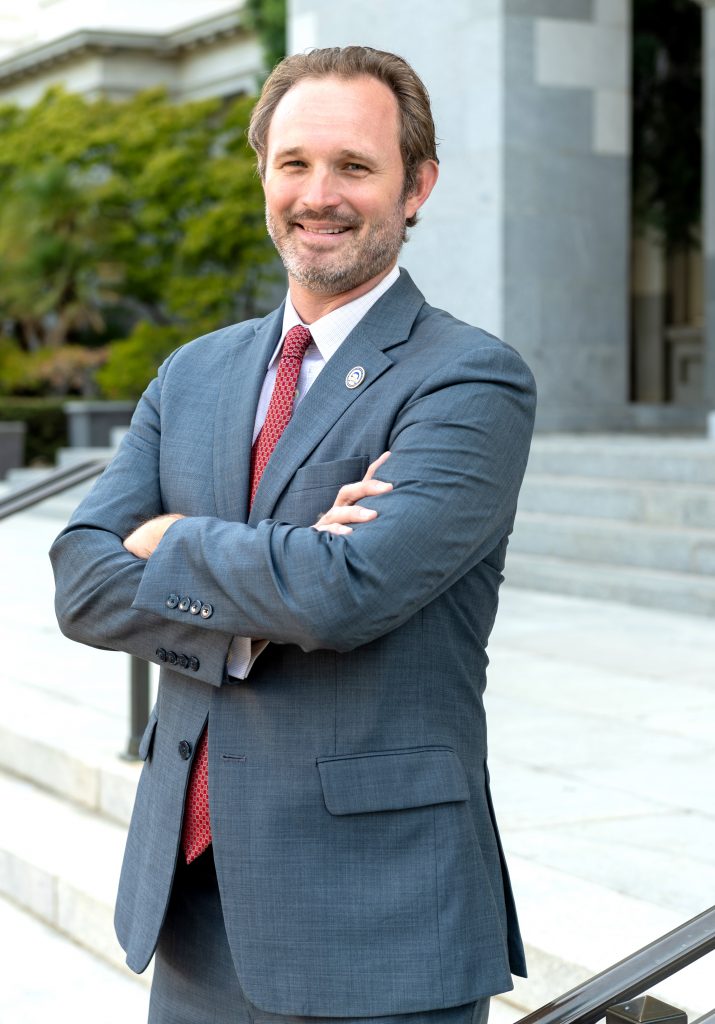
Photo of James Gallagher
R California Assembly · District 3

Asm. James Gallagher

Compare
Total votes
27,305
all sessions
Attendance
89%
2,334 missed
Lower than 94% of chamber peers
With party
97%
of cast votes
Lower than 91% of chamber peers
Bipartisan score
2%
crosses aisle rarely
Higher than 81% of chamber peers
Sponsored
2,099
bills & resolutions
Lower than 94% of chamber peers
Committees
5
assignments
2,099 bills and resolutions

Sponsored bills

Total
2,099
Primary
217
Co-sponsor
1,882
This page
2,099
matching current filters
Primary AB 2531
Vetoed · California Assembly · Lead sponsor
Access to judicial and nonjudicial proceedings: individuals who are deaf or hard of hearing: operators of computer-aided transcription systems.

Existing law requires that a participant in any civil or criminal proceeding, court-ordered or court-provided alternative dispute resolution, or administrative hearing of a public agency, who is hearing impaired be provided with a functioning assistive listening system or a computer-aided transcription system, upon his or her request. Existing law requires, if a computer-aided transcription system is requested, sufficient display terminals be provided to allow the hearing impaired individual to read the real-time transcript of the proceeding without difficulty. Existing law requires the Judicial Council to perform various tasks related to assistive listening systems and computer-aided transcription systems, including the development and maintenance of a system to record utilization by the courts of these systems. This bill would require an individual requiring the services of an operator of a computer-aided transcription system to give advance notice of this need, as specified, and would require the operator to provide the speech-to-text equipment to be used, unless otherwise provided by the court. The bill would require a sign to be posted in a prominent place indicating the availability, and how to request, the services of an operator. The bill would also require the Judicial Council to develop and approve official forms for notice of the availability of the services of an operator and to develop and maintain a system to record utilization by the courts of the services of certified operators of computer-aided transcription systems, the services of sign language interpreters, and the services of otherwise uncertified operators, interpreters, or captioners. The bill would also change references to "hearing impaired" to "deaf or hard of hearing." Existing law authorizes a court reporter to be present in the jury deliberating room during jury deliberation if the services of the court reporter for the purpose of operating a computer-aided transcription system are required for a juror who is hearing impaired. This bill would instead authorize an operator of a computer-aided transcription system to be present for that purpose. Existing law requires the Court Reporters Board of California to license and regulate the practice of shorthand reporting, defined to generally mean, among other things, the making of a verbatim record of any oral court proceeding. This bill, on or before January 1, 2020, would authorize the board to identify a certification process for operators of computer-aided transcription systems that is conducted by a state or national association. The bill, on or before January 1, 2022, upon appropriation by the Legislature, would require the board to adopt standards for certifying operators of computer-aided transcription systems and would authorize the board to satisfy this requirement by approving a state or national association to certify operators of computer-aided transcription systems. The bill, on or before January 1, 2026, would also require the board to report to the Legislature the number of operators of computer-aided transcription systems that, between January 1, 2022, and July 1, 2025, have successfully been certified pursuant to the standards adopted by the board.


Vetoed Sep 29, 2018 0 co-sponsors
Co-sponsor AB 2798
Signed into law · California Assembly · Co-sponsor
Hospitals: licensing.

Existing law establishes the State Department of Public Health and sets forth its powers and duties, including, but not limited to, duties relating to the licensing and regulation of health facilities, as defined. This bill would prescribe timelines for the department to approve a written application submitted by a general acute care hospital or an acute psychiatric hospital to, among other things, modify, add, or expand a service or program. The bill would require the department to complete its evaluation and approve or deny an application within 100 days of receipt of the application. The bill would require the department to approve a written application to expand a service that is currently being provided within 30 business days of receipt of the completed application, unless the hospital is out of compliance with existing laws governing the service to be expanded. Under the bill, an approved expanded service would remain licensed for not more than 18 months, unless the department approves the license for a longer period. The bill would require the department to develop a centralized applications advice program to assist hospitals in identifying and completing the correct paperwork and other requirements necessary to modify, add, or expand a service or program. The bill would require the department, on or before December 31, 2019, to develop an automated application system to process applications. Under the bill, the resources necessary to implement the application process would be made available, upon appropriation, from the Internal Departmental Quality Improvement Account.

Signed into law Sep 29, 2018 1 co-sponsor
Co-sponsor AB 724
Vetoed · California Assembly · Co-sponsor
Intercountry adoption finalized in a foreign country.

Existing law generally provides for the adoption of a child native to a foreign country by a prospective adoptive parent or parents who are California residents that is either finalized in another country or this state. A licensed adoption agency facilitating an intercountry adoption that will be finalized in a foreign country is required to provide specific services that include certification to the federal government whether this state's intercountry adoption requirements have been met. Existing law requires each resident of the state who adopts a child through an intercountry adoption that is finalized in a foreign country to readopt the child in this state if it is required by the United States Department of Homeland Security, and requires this readoption to include at least one postplacement in-home visit, a home study report, and final adoption order. Existing law also authorizes a resident of the state who adopts a child through an intercountry adoption that is finalized in a foreign country to readopt the child in this state. This bill would repeal these readoption provisions and would instead require an adoptive parent, or if an adoptive parent fails to do so, then the adoption agency that facilitated the adoption, to file a petition to readopt within specified deadlines to establish a record by which an adoptee can prove the facts of the foreign adoption. The bill would require the petition to include, among other things, a report from at least one postplacement home visit by an intercountry adoption agency or a contractor of that agency licensed to provide intercountry adoption services in the state. The bill would require the clerk of the court to submit an order granting the petition to the State Registrar, and would require the State Registrar to issue a delayed registration of birth, as specified. This bill would require a court that finds a child may be the subject of human trafficking or specified types of abuse to notify all appropriate authorities. This bill would, if a licensed adoption agency has a written agreement for which postadoption services have been paid, require the licensed adoption agency to provide those services, and would also make technical, nonsubstantive changes to the other services a licensed adoption agency facilitating an intercountry adoption is required to provide.

Vetoed Sep 29, 2018 1 co-sponsor
Co-sponsor AB 2339
Signed into law · California Assembly · Co-sponsor
Water utility service: sale of water utility property by a city.

Existing law authorizes the furnishing of utility services by publicly owned public utilities, including municipal corporations, which are subject to control by their governing bodies. Existing law authorizes any municipal corporation to acquire, construct, own, operate, or lease any public utility, as defined, and authorizes a municipal corporation to sell or dispose of any public utility it owns. Existing law establishes an alternative procedure whereby a municipal corporation can lease, sell, or transfer that portion of a water utility used for furnishing water service outside or inside the boundaries of the municipal corporation, including the determination that the public utility is not necessary for supplying water to its own inhabitants or that its inhabitants will be provided with equal or better service by the acquiring entity, the sale or transfer is approved by a majority of all voters voting on this issue in an election, and that the acquiring entity disclose specified information before the election. This bill would authorize the City of El Monte, the City of Montebello, and the City of Willows, until January 1, 2022, to sell its public utility for furnishing water service for the purpose of consolidating its public water system with another public water system pursuant to the specified procedures, only if the potentially subsumed water system is wholly within the boundaries of the city, if the city determines that it is uneconomical and not in the public interest to own and operate the public utility, and if certain requirements are met. The bill would prohibit the city from selling the public utility for one year if 50% of interested persons, as defined, protest the sale. This bill would make legislative findings and declarations as to the necessity of a special statute for the Cities of El Monte, Montebello, and Willows. This bill would incorporate additional changes to Section 10061 of the Public Utilities Code proposed by AB 2179 to be operative only if this bill and AB 2179 are enacted and this bill is enacted last.

Signed into law Sep 28, 2018 1 co-sponsor
Primary AB 3012
Signed into law · California Assembly · Lead sponsor
State Coastal Conservancy: grants: climate change projects.

Existing law establishes the State Coastal Conservancy, and prescribes the membership and functions and duties of the conservancy with regard to the protection, preservation, and enhancement of specified coastal lands in the state. Existing law authorizes the conservancy to address the impacts and potential impacts of climate change on resources within its jurisdiction, and to undertake certain projects within that designated area. Existing law authorizes the conservancy to award grants to public agencies and nonprofit organizations for certain projects that address the effects of climate change, and, to the extent allowed, to prioritize projects that maximize public benefits, including, but not limited to, reducing emissions of greenhouse gases, reducing hazards to harbors and ports, preserving and enhancing coastal wetlands and natural lands, conserving biodiversity, and providing recreational opportunities. This bill would require the conservancy, to the extent allowed, to prioritize projects that maximize public benefits and accomplish either the above-described benefits or reduce flood risk and enhance fish and wildlife habitat, as described.

Signed into law Sep 21, 2018 0 co-sponsors
Co-sponsor SB 577
Signed into law · California Senate · Co-sponsor
Public postsecondary education: California Community College Teacher Credentialing Partnership Pilot Program.

Existing law establishes the California Community Colleges, under the administration of the Board of Governors of the California Community Colleges, as one of the segments of public postsecondary education in this state. Existing law requires the board of governors to appoint a chief executive officer, to be known as the Chancellor of the California Community Colleges. Existing law establishes community college districts, administered by governing boards, throughout the state, and authorizes these districts to provide instruction to students at the community college campuses maintained by the districts. Existing law requires the Commission on Teacher Credentialing to, among other duties, establish standards for the issuance and renewal of credentials, certificates, and permits. Existing law establishes minimum requirements for the preliminary multiple or single subject teaching credential, including satisfactory completion of a program of professional preparation, as provided. This bill would establish the California Community College Teacher Credentialing Partnership Pilot Program under which the commission, in coordination with the chancellor, would award up to 3 grants, in the amount of $500,000 each, to collaboratives, that would be comprised of at least one accredited degree-granting institution of higher education with a physical presence in this state and at least one community college, for the purpose of offering teacher credential coursework remotely at participating community college or colleges. The bill would require these degree programs to be accredited by the commission's Committee on Accreditation on the basis of standards of program quality and effectiveness. The bill would authorize priority for the receipt of grants to be given to a collaborative that is located in areas of the state with low rates of K–12 credentialed public school teachers, demonstrates that its degree program or programs meet the documented labor market demand of its target region, and identifies the resources necessary to offer its degree program or programs. The bill would provide that grants shall be awarded only to the extent that funding for the statewide pilot program is provided in the annual Budget Act. The bill would require the Legislative Analyst's Office to submit a report on the implementation of the statewide pilot program to the Legislature and the Department of Finance on or before April 1, 2023.

Signed into law Sep 20, 2018 1 co-sponsor
Showing 1,351 to 1,360 of 2,099 bills