

The California Constitution generally limits ad valorem taxes on real property to 1% of the full cash value of that property. For purposes of this limitation, "full cash value" is defined as the assessor's valuation of real property as shown on the 1975–76 tax bill under "full cash value" or, thereafter, the appraised value of that real property when purchased, newly constructed, or a change in ownership has occurred. The California Constitution authorizes the Legislature to provide that persons over 55 years of age and persons who are severely disabled may transfer the base year value, as defined, of real property that is eligible for a homeowners' property tax exemption to a replacement dwelling, if certain conditions are met. This measure would additionally authorize the Legislature to provide for a similar transfer of base year value of real property to a replacement dwelling for persons who are the parents or legal guardians of a severely disabled child and reside with that child. The measure would limit this provision to replacement dwellings purchased or newly constructed on or after its effective date.
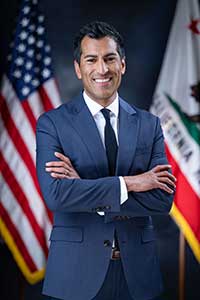
Asm. Robert Rivas
Sponsored bills
This measure would designate the month of January 2020 as Positive Parenting Awareness Month in California.
This measure, among other things, would declare that California is a Reproductive Freedom State for All and provide that the Legislature is committed to guaranteeing the constitutionally protected right to an abortion and supporting efforts to increase access to the best available reproductive and pregnancy-related care for women and pregnant individuals.
This measure would proclaim January 13, 2020, as Korean American Day.
This measure would honor the late Reverend Dr. Martin Luther King, Jr. and commemorate Dr. Martin Luther King, Jr. Day.
Existing law establishes the California Tax Credit Allocation Committee in state government to allocate the federal and state low-income housing tax credits. Existing law requires the committee to adopt a qualified allocation plan, as provided. This bill would make nonsubstantive changes to the provision requiring the committee to adopt a qualified allocation plan.
Existing law establishes in the Department of Conservation the Agricultural Protection Planning Grant Program, under which a local government entity, nonprofit organization, authority, or joint powers authority may apply to the department for a planning grant to be used for the protection and preservation of farmland, grazingland, and grassland, as specified. This bill would enact the Regional Economies and Equity in Agricultural Lands Act of 2019, or the REEAL Act of 2019, which would require the department, in consultation with the Department of Food and Agriculture, to establish the Regional Economies and Equity in Agricultural Lands Program and the Regional Economies and Equity in Agricultural Lands Fund. The bill would provide that moneys in the fund are available upon appropriation by the Legislature for the purposes of the program. The bill would require the department, under the program, to award grants to certain eligible entities to protect agricultural lands and to make agricultural lands accessible to socially disadvantaged farmers and ranchers, as prescribed.
(1) Existing law, the Brady-Jared Teen Driver Safety Act of 1997, establishes a provisional licensing program and generally requires that a driver's license issued to a person at least 16 years of age but under 18 years of age be issued pursuant to that provisional licensing program. Existing law requires a person to hold an instruction permit for not less than 6 months prior to applying for a provisional license. During the first 12 months after issuance of a provisional license, existing law prohibits the licensee from driving between the hours of 11 p.m. and 5 a.m. and transporting passengers who are under 20 years of age, as specified. Existing law provides limited exceptions to these restrictions under which a licensee is authorized to drive under specified circumstances. A violation of these provisions is punishable as an infraction. This bill would, commencing July 1, 2020, expand the scope of the provisional licensing program by expanding the applicable age range for the program to persons at least 16 years of age, but under 21 years of age. The restrictions on provisional licensees described above would apply during the first 6 months after issuance of a provisional license to a licensee who is 18, 19, or 20 years of age, subject to specified exemptions. The bill would, commencing July 1, 2020, require a person at least 18 years of age, but under 21 years of age, to hold an instruction permit for at least 60 days before applying for a provisional license. By expanding the scope of the provisional licensing program, the violation of which constitutes an infraction, the bill would impose a state-mandated local program. The bill would, commencing July 1, 2020, make other technical and conforming changes. The bill would also include specified findings and declarations. (2) Existing law generally authorizes the Department of Motor Vehicles, for good cause, to issue an instruction permit to any physically and mentally qualified person who applies to the department for an instruction permit and who meets any one of 5 specified requirements, including that the person is 17 years and 6 months of age or older. This bill would, commencing July 1, 2020, raise the age for the above requirement to 20 years and 6 months. Existing law provides that a person, while having in the person's immediate possession a valid permit issued pursuant to the above provisions, may operate a motor vehicle, other than a motorcycle, motorized scooter, or a motorized bicycle, when accompanied by, and under the immediate supervision of, a California-licensed driver with a valid license of the appropriate class, 18 years of age or over whose driving privilege is not on probation, as specified. A violation of this provision is punishable as an infraction. This bill would, commencing July 1, 2020, for purposes of supervising a person issued a valid permit as described above, raise the required age of the California-licensed driver to 21 years of age. By changing the definition of an existing infraction, the bill would impose a state-mandated local program. (3) Existing law prohibits a person from owning or operating a driving school or giving driving instruction for compensation without a license issued by the Department of Motor Vehicles. This bill would require an owner or operator of a driving school or an independent driving instructor, as a condition of obtaining a new license or renewed license from the department on and after July 1, 2020, to offer and accept installment payments, as specified, for the compensation to provide the instruction required by the Brady-Jared Teen Driver Safety Act of 1997. The bill would also authorize the Department of Motor Vehicles to charge a driving school, as specified, a fee not to exceed $1 for each driver education or driver training certificate of completion furnished by the department and issued to a person who has demonstrated satisfactory completion of a certified driver education and driver training course, in order to recover the department's reasonable costs in administering the provisional licensing program. The bill would prohibit a driving school from charging an applicant a fee for a certificate of completion that exceeds the fee the department charges the school. (4) The California Constitution requires the state to reimburse local agencies and school districts for certain costs mandated by the state. Statutory provisions establish procedures for making that reimbursement. This bill would provide that no reimbursement is required by this act for a specified reason.
Existing law, the Stop Tobacco Access to Kids Enforcement (STAKE) Act, prohibits a person from selling or otherwise furnishing tobacco products, as defined, to a person under 21 years of age. Existing law also prohibits the use of tobacco products in county offices of education, on charter school or school district property, or near a playground or youth sports event, as specified. This bill would require the Attorney General to establish and maintain on the Attorney General's internet website a list of tobacco product brand styles that lack a characterizing flavor, as defined. The bill would authorize the Attorney General to require a manufacturer or importer of tobacco products to submit a list of all brand stages of tobacco products they manufacturer or import to the Attorney General. The bill would authorize manufacturers and importers of tobacco products to submit to the Attorney General a list of all brand styles, as defined, of tobacco products that they manufacture or import for sale or distribution in or into California that lack a characterizing flavor. The bill would require a manufacturer or importer that submits a product pursuant to these provisions to, under penalty of perjury, describe each brand style and state that it lacks a characterizing flavor. By expanding the scope of the crime of perjury, this bill would create a state-mandated local program. The bill would require the Attorney General to determine whether each brand style has a characterizing flavor, as specified. The bill would require any manufacturer or importer that submits a product in this way to, among other things, consent to the jurisdiction of the California courts for the purpose of enforcing these provisions and to appoint an agent for service of process, as specified. The bill would authorize the Attorney General to recover reasonable attorney's fees, investigation costs, and other related costs, against any entity that makes a clearly frivolous submission to the Attorney General for inclusion on the list. The bill would require any money recovered by the Attorney General in an action pursuant to these provisions to be deposited in the Public Rights Law Enforcement Special Fund, as specified. The California Constitution requires the state to reimburse local agencies and school districts for certain costs mandated by the state. Statutory provisions establish procedures for making that reimbursement. This bill would provide that no reimbursement is required by this act for a specified reason.